Developing the Tai Chi Chuan Body
Several of Gin Soon Chu’s secret transmissions are difficult to describe. I do not think there is any material out there that explains them. They were new to me when I first encountered them at his school. I asked myself, Why is he doing this, why is he doing that? I struggled for clarification. Several years into my training, I realized that they were part of the curriculum to develop a Tai Chi Body. The technique described below was one such method. Truly a rare method, but it was just a daily occurrence at the school when Chu Sifu was teaching. Most everybody went through it at least once a week, especially those who were just beginning. It was foundational to his style.
show moreI am not sure, but I believe that Gin Soon Chu created his Tai Chi Chuan based not only on what he learned from Yang Sau-Cheung but from other masters as well. True, the core forms belonged to the Yang family style, but it was more than that; it was actually a synthesis of a lifetime that included other “keys” from other schools and went beyond the teachings of a single master or a family. The other methods — also intended to develop the Tai Chi Body — included training to attain the 28-35 fajing techniques, some of which a few students have achieved at Gin Soon’s school.
With your hands in a “press” position, Chu Sifu would lean on you with his shoulder or forearm. It is a simple gesture. Nothing seems to be happening. To somebody looking, there does not seem to be anything special about it. Just another exercise, one would think. There’s only a subtle shifting that’s not visible to the untrained eye. Sifu does not say anything. Every now and then, he would look at you. But most of the time, he is looking down at the floor. At first you can feel pressure on your arms, then your shoulders, down your spine and finally to the legs. The inexorable force. Both of you are kind of stuck in this position of nothingness and impasse that takes maybe 5–10 minutes. But to you it seems to last an eternity because it can get excruciatingly painful.
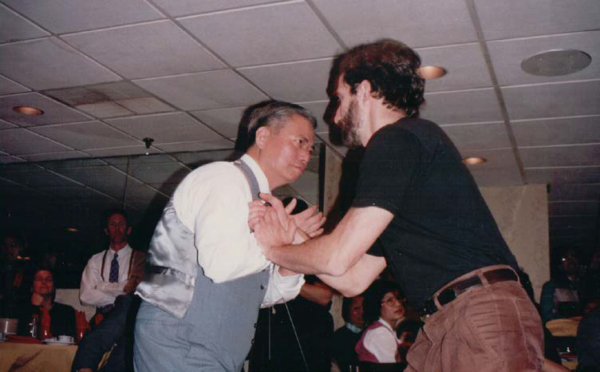
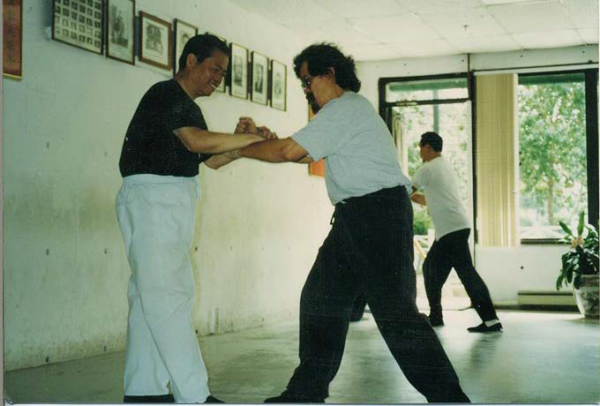
That is how it feels when you meet an immovable object. Your whole body seems to stretch and anchor, even vibrate. If you are fully conscious, if you listen to what is happening to your body, you’ll know that Chu sifu is doing “something” to you. No language, no word, is necessary. He does not have to say anything because you can feel it in your bones, in your tendons and muscles, in your qi hai, the “sea of qi”.
You can feel certain parts of your body responding, becoming aware, getting liberated, energized with qi. Your qi hai is receiving some pressure, a slow “ballooning” and expansion. Your tendons are being filled with energy. Your heels are sinking into the floor at first but later into the earth and then the gravity “recoils” up your leg into your spine, shoulder, and arms. It is a magical feeling. When Chu sifu is done, he tells you to stay in a Zhan Zhuang posture, stationary stance, both feet flat on the floor, with the hands in the “press” position, and you stay there for maybe 30 minutes or until your sweat begins to pool on the floor.
I have not seen this teaching device anywhere, except at the Gin Soon Tai Chi Club. It is in fact one of the ancient and secret methods of the Yang family. You can learn forms and you can spend years practicing the forms but if you are not exposed to the direct methods of transmission, you may not progress very much. The technique described here is one of the techniques for developing the Tai Chi Chuan body.
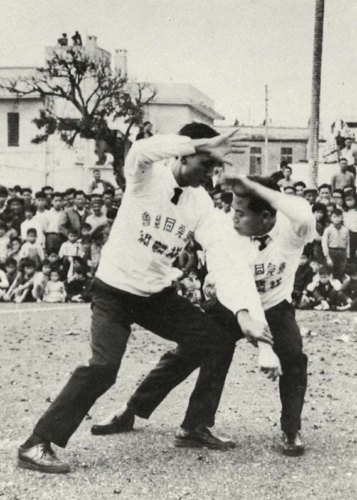
Some people do not understand what they are going through during this exercise because Chu sifu does not say anything. Many want him to say something, anything, but English isn’t his language. At one time a few of his American students in a school in the Northeast United States dismissed Chu as being incapable of transmitting the essence of the teachings because of his lack of proficiency in English. This small group of disgruntled students simply misunderstood the ancient method of transmission. It was a tense period that embarrassed the master, but he did not say anything public about it. Actually, he did not have to say anything. The fact is that when Chu sifu looks like he is leaning on the student, he is conveying a secret, a non-verbal lesson. What he is doing, the apotheosis he wants you to reach, is beyond language: words can only desecrate it. Silence and stillness are the bridge to the gong, the high achievement and goal of the Path. You don’t reach it through words but through a connection to your qi hai and eventually to your so-called dantian (the mystical Elixir field).
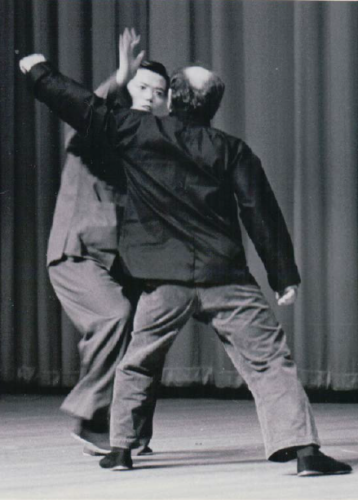
The profoundest teachings — ancient, huge, deep, and elusive like quicksilver — aren’t conveyed with words but with movement and subtle gestures. If you do not have an inner ear, a deep sensitivity, or a capacity for silence, you’ll miss a whole lifetime of transmission. Even a teacher who has a mastery of English cannot capture the inner teachings. What is missing is the ability of the student to receive the true transmissions. Even if the student understood Chinese, he will not be able to “embody” the distillation of Tai Ch Chuan classics unless he has the qualities required to reach mastery. The teachings, whether verbal or intuitive, are just the “finger pointing at the moon.”
Sometimes you may have to understand the paradigm of the elusive human body from an Eastern point of view with all the elements that go into who you are: physical, mental, emotional, energetic, spiritual. You must understand different concepts, too — dantian, the energetic cauldron that holds the mysterious jing (distilled qi); san bao (three treasures); the meridian system; Yin and Yang, and Tai Chi; the different energy centers that can receive and emit qi; the structure of the bones and the marrow and their relationship to the different organs; the shamanic nature of the movements.
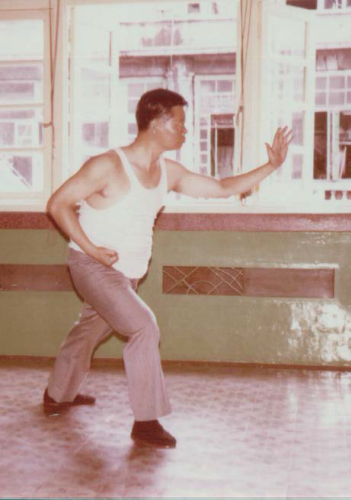
As Lauzi wrote, “The Dao that can be spoken is not the Dao.” And yet, most people demand explanation. They require words to clarify what is happening when what is happening is beyond words. If you are a teacher and you are conveying something magical and ethereal, it is ridiculous for a student to ask you to explain. The experience of the ineffable is private and personal. A connection, between teacher and disciple, attained on the level of energy, is simply not captured with words because it has its own inarticulate language. There is that elusive epiphany or satori: you have a rare insight into a magical and miraculous phenomenon.
There are those who will probably get frustrated and resentful because they demand instant knowledge and expertise. But “gong” requires conscious and countless repetitions. The Chinese character showing the radical for strength and a carpenter’s T-square means time and work as a measure of achievement. If you are gifted, you may get “It” faster than others. But if you are like most people, you may have to plod along; if you’re lucky, you’ll get a glimpse of It. Most people don’t: they’ll get the movement in Tai Chi Chuan by mimicking the teacher. They are like monkeys. The deeper lessons will just pass over their head and get lost. I have seen many practitioners who have spent years practicing forms, they will nurture their health and develop a level of proficiency, but they will remain at the foot of the mountain. Or if they climb the mountain of forms, they will not see the beautiful landscape. They will, in a manner of speaking, miss the forest for the trees.
The training that one undergoes at the Gin Soon Chu Tai Chi Club not only covers a whole repertoire of forms — fist and weapons, solo and paired, external and internal — but each form is connected to the next, one form strengthens and clarifies the previous one. For instance, the two-man sparring set reveals the fighting application of the solo fist form, the double staff form complements and improves on the single staff form. Obviously, the solo form is good, but it is self-limiting because while it can provide a level of expertise and experience, it does not, for one, connect to the application aspect of the art. Very often the practitioner who translates the solo fist form movements into a combative technique often frames them within the context of a Shaolin or an external system, therefore losing the inherent principles of Tai Chi Chuan.
The qi development is another matter altogether. When Chu sifu pushes against you with his shoulder while you are in the stationary posture of Press, he is not only aligning your physical body, but also “feeding” you qi and cultivating your qi. You become aware of how you should adjust your legs, your feet, to be able to hold your position because if you don’t your structure will collapse. It is like the training in certain Zhan Zhuang postures where you are pushed from different sides to get you to be aware of a center and to root.
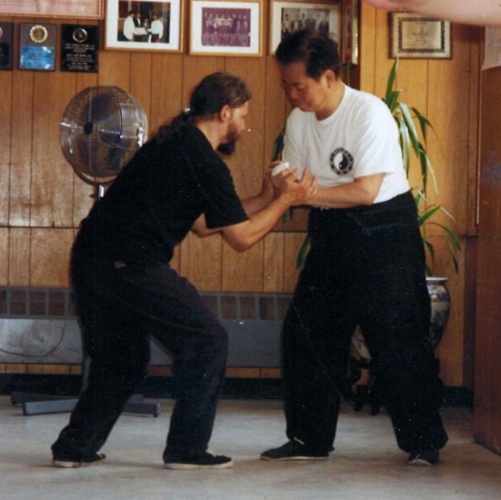
My own experience with this facet of the training may be different from others. But essentially, the purpose is the same. Chu sifu trains you to be aware of the different aspects of your body — physical, mental, and energetic. In short, the paradigm of the human body. When you were studying the movements, you were not much conscious of the different “inner” components of your body — the skeleton, the tendons, and muscles (sinews), your connection to a partner and to the earth, the alignment of the heel, leg, spine, scapulae, and the arms. With the push that he gives you that starts gently and then becomes an inexorable force, you begin to learn how to develop the Tai Chi Chuan Yin-Yang body — soft but solid, empty but full, “steel wrapped in cotton.” Later, perhaps much later, you begin to be aware of the dantian, that mystical cauldron behind the navel. It is one of the first stages in the development of the Tai Chi body.
The Tai Chi body is not just a physical, material body. It is the totality of who you are and more. It is your optimum potentiality, what you are capable of when you have combined the different elements — physical, material (muscle, tendon, and bones), emotional, energetic, meridian, mental, and intellectual. How do you comprehend the mind and spirit? How do you explain the extra-sensory being that you can emanate from the ordinary dimensions of your physical self?
I have seen Chu sifu demonstrate aspects of the 35 Fa-Jing (discharge of energy). It is incredible. He can grab your qi even when he does not touch you and you become immobilized or get bounced away as if an invisible palm has trapped you or smashed into your body. You ask yourself, where did that come from?
show lessThe Mind Mandala by David Verdesi
David Verdesi is a dear friend. He calls himself a “cultural anthropologist” but he is really a searcher, one of the rare few who have seen and/or studied with many masters in different parts of the world.
We first met in upstate New York back in the early 1990s when he was 15 or 16 years old, a curious student who was following the teachings of Mantak Chia of the Healing Tao (now Universal Healing Tao).
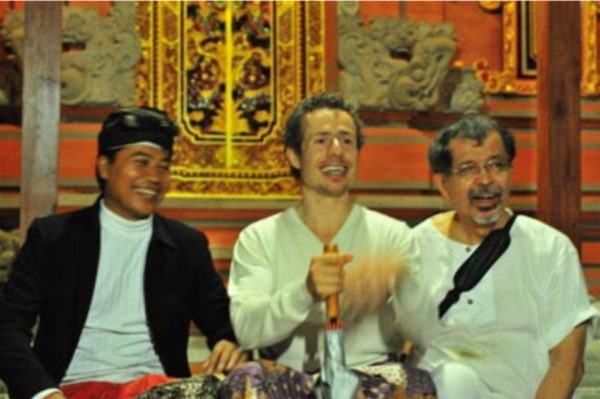
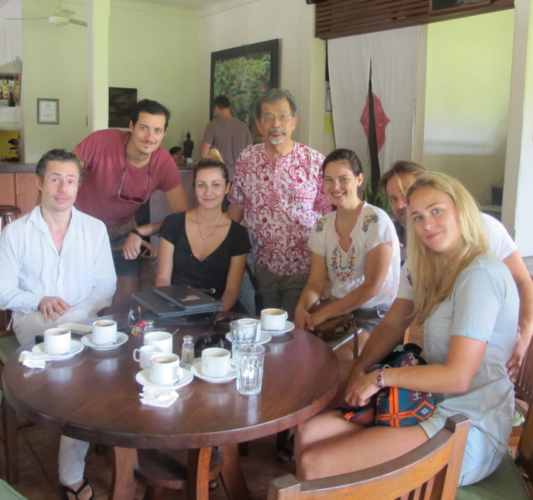
show moreI was at the time assisting Chia during the summer retreats as one of his senior instructors. David would watch me practice early at dawn: he would stand a distance away and just look until one day he asked me to teach him. It was the start of a long-tern relationship that is still alive and close to this day. We’ve met and trained together in different places: Rome, Java, Bali, Thailand, Huangshan, Istanbul, New York. I’ve written about him in my book “Of Fire and Water: Alchemy and Transformation” (Tambuli Media: 2023) available on Amazon and Barnes and Noble. It is a privilege to include his article and the video in my website.
The Mind Mandala
David Verdesi
The very perception of our being is defined by the mind space within which we experience ourselves.
Mind space is the vast unbounded space element which contains all other elements, the formless form, the womb and the matrix where all forms arise from, dance and abide in and dissolve into, it is the Mandala of the mind.
We will see through this introduction that this statement is far from being a disembodied speculation, for in fact it is something we as an individual constantly live in, it is innate and not conceptually created.
How the mind Mandala appears and what is it?
Whenever we walk into any space, outer, inner, innermost or secret, there is a twofold process taking place:
- Your mind is expanding to fill the space
- Your mind is literally taking in the space
There are two simultaneous events happening as one:
- Projection – the mind fills up the space
- Absorption – the space is taken in
This happens to ensure the perception of your being within that space.
The Mind Mandala
It is only when these two events simultaneously happen as they weave a continuum of one into the other, projection or absorption to an even yet dynamic equilibrium that the dependent and simultaneous perception of our being takes form.
The elegance of the process is that it does not need our conscious attention; this is something our mind does automatically, yet in making this process conscious we learn to recreate ourselves in to a Buddha or Mahasattva and dissolve our deluded selves.
You are in the Mandala
Imagine that you walked into the room you are presently in: what your mind did is that suddenly it expanded to fill the space and then by filling the space it gave you the sense of where you are in relation to space.
❖ The same happens at birth:
When the constructed sense of “I” takes over the body-form by expanding in the inner and outer space through sense-object interaction, the inner Mandala experience of self and others is created and appears as ordinary deluded perception of self and others.
❖ The same happens during the innermost secret tantric practices:
The body and space is filled by mind spaciousness revealing the empty and infinite nature of inner space, not in fact separated with outer space for both inner and outer are conceptual labels. It is not pertaining to all pervasive and all-embracing mind nature.
In a very literal sense we are creating Mandalas in every moment -a space of time-of our lives.
Inner and outer, outer and inner
We perceive our self-existence because of the Mandala we constantly create; we just don’t know we are inside them.
Quite literally we are led to believe by ordinary default perception that our mind, our self, exists framed within the body even to the point of experiencing the homunculus in our head delimited by the skull bones as the seer of life.
Yet this ordinary default perception represents in my view only 50% of complete reality of being, for in fact it is not really the mind that is inside the body in so much as the body is inside the mind.
This is a theory to be experienced and realized. The various practices Vajrayāna created and before Vajrayāna other forms of Buddhism, are fundamentally skillful means to realize this.
Tradition and Innovation in Vajrayāna Buddhism
From theory to practice
So let us try and experiment together, you are now sitting in a room; as I told you the very moment you walked in, your brain has mapped this room, so your brain has created tridimensional representation of the room to give a sense of being in it.
- Comfortably sit and just look around to have a sense of the space of this room
- Now close your eyes and still try to have a sense of the space
- For the experiment to work, repeat twice the above two sets for four to six times in a row
- Keep your eyes closed and keep an expanded perception of your mind to fill up the boundaries of space
- Now use your hands, your hands are the magicians’ magical wand, hands are what we use to expand and direct our intent and articulate our intent.
- Using your hands, I want you to push forward and touch the boundary of the wall that is in front of you, I am sure you can reach it, can’t you? You can feel that you have touched the wall in front of you
- Now take your hands from the wall, and I want you to stretch your arms on your side touching the walls. You can extend the hands to the boundary of space and then, open your eyes
- Try to do the same with eyes open and reach in front of you, of course physically you are not reaching or touching the wall in front of you
But when you close your eyes you experience that you did, why? Because when you close your eyes you are living in the representation the mind has made of the space you exist in. In that moment, you are Hevajra or Cakrasamvara, Yamantaka, Hayagriva, Guyhasmaja or Vajrakilaya or any other deity-mind form.
Arising as Tantric Deity
- You are the centre of the Mandala
- The Mandala is mind itself
- You are in the mind itself
- Meaning that every person around you, I, anyone or anything around you is included, the chairs and tables or other people that are inside the Mandala are also inside the mind
- They are not parted from it
- The implication of this is profound because it means that the experience of separation, of otherness, is flawed
The Mind Mandala
Dreams
If this was a dream, right now if you are dreaming to be in this conference and you are seeing all the people here, you see them as I see you, out there, and then when you wake up from the dream and I ask you, if people you saw in your dream were out there? Clearly no, as this is because they appear in your dream.
So they appear within your own mind, which means they are your own mind.
This become very clear when you learn to experience reality as the mind Mandala -the space within which everything exists.
What is perceived by mind as other than mind is in fact mind. But again this is not a theory it has to be lived; I reached this conclusion without Vajrayāna, for all the matter without Buddhism, because these are inherent experiences of the mind appearing upon investigation and enquiry, reflection and concentration, beyond labelings.
Vajrayāna give us the tools to do that, but the point remains; the tool is just a skillful mean, it is pointing the way, but did you experience it? So this is ultimately the message, those practices in their ideal diversity should lead to concrete experiences. The rituals, dogmas, beliefs and visualizations are skillful means to deliver an experience, a grand show if you wish to create the magic, the emotion, the belief, but often they are given an importance and a reality far beyond their meaning, while sacrificing the result and experience which they point to.
Anuttara yoga tantra is now
This experience does not have to be removed from the reality; you have a chance to practice anuttara yoga tantra every day. Every day you walk into any room and if you were conscious, you would know what happens; your mind in that moment has filled up that space.
If it is not contracted in its little delusion, confusion and thoughts – I, this, that, he, she, you, me constantly neurotically contracted in to a little point creating solid sense of separation and otherness.
Unfolding the Mandala of Mahamudra
If you give chance to mind to fill the space of the reality it will unfold into the Mandala, Vajradhatu the diamond realm, and in this Mandala all beings are, just like you are here and I am here, we are inside this mind Mandala.
If we realize that the mind that expand and fills up the space and brought in it all of you, and therefore apparent separation is just apparent, this is Mahamudra. In it all delusion of aversion, clinging and difference are resolved.
Tradition and Innovation in Vajrayāna Buddhism
Illusory body
The illusory body is the same body that allows you to fill the space of mind with mind when you close your eyes, it allows you to touch the walls, because you are touching the wall of your own mind, the mind that you extended to fill up the space, that is why you can touch. It is the same body you appear within dreams.
This conceptually created body is a body of action, the body that acts within the mind, is the illusory body.
This body – self-identity has the belief that is separated from mind, just like a wave believing to be separated from the sea, but this simple experiment proves you that your body is within the mind, and if you live your life just with its simple knowledge all the time.
This body, this mind experiencing them as separated and experience separation of others, and I gradually start to dissolve, the sense of separation start to dissolve and then clear light emerges.
Clear light
Clear light is bliss, is very physical, blissful experience that arises as the result of this realization. Again I came to these experiences without knowing anything, meaning that everyone can experience this.
The sense of bliss arises when:
- You realize this body is within the mind
- The very I who experience this body is also within mind
- When this I is realized to be within the mind, it loses its self-perceived reality
- Then this bliss arises and luminosity arises, which is what you experience every day when you go to sleep
When you are in a dream, you see the light? Sometime you see the sun, you see the objects just like you see this room, but most of the time when you are sleeping, and the world is dark, isn’t it?
At night, there is no light, and yet you see the light in your dreams; you see the sun, object and colours but where does that light come from?
How can you see the light when there is no light, how can you see the sun in dream is because of the inherent luminosity of the mind, Prabahasvara.
When the mind is realized to be the Mandala and the body and “I” is experienced to be within the mind and the illusion of separation is gone, that Prabhavasvara becomes self-evident, as the light that creates distinction and discernment of form and identity.
The Mind Mandala
When that emerges, the mind is known to be a mirror upon which thousand forms are reflected and all these forms are but display of luminosity that are never parted or separated from mind.
This is the unfabricated reality of our mind -Mahasanti- the great peace, which most of you know in the Tibetan translation Dzogchen.
I invite everyone to realize this, it is truly wonderful, natural, uncontrived, matter of fact, direct and available to you at the times.
Margaphala
The principle of mimesis is necessary in development at all levels, from children emulating parents to those tantric methods emulating some figure of authority such a great guru or a Buddha or a tantric deity.
Undoubtedly as humans we learn by emulation and mimesis, for which in tantrism there is a term Margaphala -taking the result as the path.
This is all good and natural if it leads to emancipation and liberation of critical thinking and analysis, deconstruction and eventually transcendence of those outer models once they fulfilled the educative and inspirational role.
Upadesha
All the transmitted methods, actions, rituals, objects, visualization orders and such, in my view, should be treated in the view of the theory of mimesis or Margaphala.
They were originally someone else’s experience, which we emulate. We emulate his or her mind, quality and traits to a certain extent because we have imbibed them with an hermeneutical meaning, something that can randomly be done with anything in daily life, from a phrase to a book to an action and object, substituting its meaning with another meaning. Therefore, transforming and transcending its function, this is the magical mind of children who can turn their parents and idols into super beings ascribed with all sort of powers, sticks and puppets into gods and goddesses, swords and stone into amulets and, a dress into a cape. This is what we are invited to do with our guru and their props.
We transform each of their looks, their words, their most banal actions and the bell and other implements they hold even their dresses into something other than it is, and imbibe it with a magical power, the power come from our investment in it, from the hermeneutical meaning with discover in it, and that help us to transfer our identity, we identify with it, and this help us transcend our limits, we reinvent and reimagine ourselves to be other than we are.
Like children do, we dress with capes and and hold sticks but we truly see and feel ourselves fearless knights with magical swords.
Tradition and Innovation in Vajrayāna Buddhism
It is all good, it works and it proves the method, but again it us not different from what we did as children, it’s a magical process, and yet there is nothing secret in it in fact, it is natural and it is not created or revealed by some deity or kept by some lineage: it is the way our mind works.
And true to the meaning that innately we have Buddha nature, that nature and its mode of revealing itself is repeated and enacted since birth.
What changes is simply the level of awareness of what is happening and what is it we do free from primitive limiting belief, this is the clarity of view, terse clear logical rational, as lord Buddha clearly declared his Dharma to be.
Abhisheka
As we observe first our teachers as mesmerizing stage magicians and then go through the magical gestures and phrases and images ourselves we reenact them with greater identification of the hermeneutical meaning juxtaposed and with greater forgetfulness of what we and they are in their bare simplicity we are transported in to a realm of renewed view and experience.
This is the Abisheka–empowerment- overtime we allow those transformed images, colours phrases and such leave a deliberate imprint on our mind continuum so gradually reshaping, recreating the form of our mind in emulation of this or that quality and trait.
As such the images and visualizations and, specific orders of events are guidelines rather than dogmas. Blue channel, red channel, red dot, green dot, left leg up or right leg up, left nostril breath right nostril breath could very well be any other color or pose chosen to represent this or that aspect of the mind.
When we give consensus to visualize paradise or pure land or Buddha form with that specific suggest form or colour we give consensus to the image of paradise first seen by someone else based on his or her memories, aspirations, needs, projections, unique character nature and karma.
By adjoining his or her stream of experience, we co-create and sustain it, to all extent making it more real.
But to all exten, it must be known with discernment that it is all just a magical display of illusion, a child magical castle, a dream that can easily change and be as real and as valid as any other.
Different people will find different expedients to be more effective. For some people, it is more effective to use physical means, or abstract means and for others those means are unnecessary.
This is because those are but skillful means, to facilitate the clarification of nature and function, substance and essence of your own mind and the sense of being arising in it.
The Mind Mandala
Let us remember that the Lord Buddha himself and many realized Zen master and the ancient orders of monk such as Ananda and Kassyapa the 16 arahts, did not do any extreme tantric practices.
There was no need of knowledge or consensus perceived need of tummo or candali or kundalini to be enlightened nor knowledge of channels, drops and essence, nor were there preliminary practices and 1,000,000 of mantras to be done to be liberated. There is not one single instance where Lord Buddha has ever recommended the pracitce of mantra in the historical sutras.
All traditions and belief systems concerning the perceived need of the so called preliminary practices as well as Tummo appeared very late in time in the wake of tantrism nearly 1,000 years after Lord Buddha parinirvana.
In the light of this dissertation we clearly see what those methods are, skillfull means of empowerment and transformation. We clearly see why those methods appeared, how they work, why they gained consensus, what is their educational and practical purpose, which is wide in scope and efficiency in term of both relative and ultimate results, but by no means they should become a dogma without which buddha hood cannot be known.
Lord Buddha’s revolution was just that, to free people from the rules of magical thinking, dogmas, rituals empowerment and mantras and offerings to gurus and deities without which people thought Moksa or liberation could not be known. This was the widespread belief and view during his lifetime in Vedic India.
He made us free through the terse non-religious and yet all inclusive logic of his view.
He proved that to be enlightened nothing else is needed but the direct and immediate noble eightfold path. So why are we falling back in the trap he dedicated his life to liberate mankind from?
Skillfull means and empowerment, deities and rituals, channels winds and drops, magical implements and tantric sex, even guru devotion, or lineage fixation, mantra secrets and such, all these marvellous tools should be carefully looked and known for they are, no less, but also no more.
There is no Buddha but in the mind of Buddha
My experience arose without any prior knowledge of Buddhism and Vajrayāna, proving that, although we can rely on the established tradition, those are constructed artificial means aiming at preserving an experience and later a tradition, they are not the experience itself nor are strictly necessary by everyone.
Tradition and Innovation in Vajrayāna Buddhism
We should use all upadesha to generate insight on their very nature, causation and function instead of giving them axiomatic and often dogmatic values; they were called upadesha for a reason.
Your mind, not my mind
Ultimately, we do not need to rely on anything but our immediate experience, creating or reenacting someone else experiences serves as tool to achieve a transformation through:
• Mimesis
• Guided projective identification and transfer • Putting us in someone else place and mind
• Exchanging self and others
• Release grip of self grasping
• Separation of “I” and all that it implies
But once understand the scope, you must let go of, for beyond its educational scope it leads to dogmatism, obscure the view and defy purpose. It is an obstacle on the path to liberation and a conceptual attachment.
We should rely and see what is moment to moment for that is the content and form of our mind. Ultimately it is our mind; we aim at realizing mind in its five attributes:
1. Nature 2. Form
3. Quality 4. Essence 5. Function
Dharma is a living experience of what it is, the reenactment and memory of someone else experiences, no matter how lofty it is but a memory, construct.
In it, no liberation nor ultimate refuge can be found as Lord Buddha said treat all such things as:
Not I, not mine, not myself No two Buddhas are the same We must become who we are, not someone else,
nor something else,
just who we are,
as we are.
The Mind Mandala
The suchness of Buddha’s nature is one it has samarasa -the same taste- in all Buddhas, yet it manifests differently.
No two Buddhas are same.
Conclusions
In my view, the practice of liberation aims at recognizing and then seeing what always is as it is.
To conceptually generating or confabulating what is not into a reality, a dance of appearances, is a powerful tool if it is done with knowledge and clarity of:
1. The four foundation of mindfulness
2. Madhyamaka
3. Especially both sunyata and bodhicitta
Enabling one to know what one is doing and recognizing what appears makes the difference between a tool of immediate liberation and a conceptual fetter.
Without this clarity and discernment one is entering the realm of magic, power and illusions; a tantra territory that often overlaps with natural borders.
Yet, the distinction is clear, magic conceptually creates what is not making it appear as what it is.
This is an aspect of the application of tantra as the continuum of the twofold truth, relative appearance and actual being.
However, it by itself does not lead to liberation; when the same knowledge aims at liberation it becomes the illuminating vision that makes it appear.
Verdesi, David (2017). The Mind Mandala. In Dasho Karma Ura, Dorji Penjore & Chhimi Dem (Eds), Mandala of 21st Century Perspectives: Proceedings of the International Conference on Tradition and Innovation in Vajrayana Buddhism (pp. 176-185). Thimphu: Centre for Bhutan Studies.
David Verdesi in Bhutan
Why Tai Chi Chuan and Chi-Kung? A Journey into the Paradigm of the Human Body in Chinese Medicine
By Rene J. Navarro, CA, TCMP
Thank you for inviting me to this convention of the Philippine Academy of Acupuncture. I remember that a few years ago I taught Qi Nei Zang internal organs transformation massage to the Academy organized by the resourceful and indefatigable Janet Paredes.
show moreAs I look at what’s happening in the Philippines, and listen to the varied stories, I can’t help but comment that there’s a phenomenon here of a market situation with different people and groups seeking recognition and acceptance for their approach, modules, techniques and protocols. It is a phenomenon that recalls the situation in the US when acupuncture was introduced and taught in schools: there was a kind of rush to be a part of the mainstream, a move to be taught in schools and institutions: massage, meditation, yoga, styles of acupuncture, dietetics, essential oils, crystals and stones, qigong, etc. There were at one time more than 50 schools in the mainland United States; in Hawaii alone, there were 3 Oriental medicine schools; in the New York area there were I think 5 schools, 4 of them located in Manhattan.
And then, to top it all, there were companies that supplemented this unprecedented growth: they manufactured and/or imported and sold equipment: paraphernalia like needles, electro-acupuncture machines, pain relief pads and pills, different herbal formulas, lotions, tonics, etc. Perhaps it was not all for the money but the healing profession with a mission to spread a different healing modality became big business. Even western allopathic doctors, nurses and therapists jumped onto this new Oriental Express. For a period of time, they were the group that dominated and controlled the profession as the acupuncture schools proliferated. But this year, about 50 years after the recognition and licensing of acupuncture by the states, some of the schools are closing partly because there are not enough students to keep the schools open. The US was so saturated with schools of acupuncture that the market could not muster enough students to keep them financially viable. One school in Hawaii, where I was teaching Qigong, closed as early as the millennium because there were only 4 paying students! My own acupuncture alma mater, the New England School of Acupuncture outside of Boston, got absorbed by a western medical school because it could not stand on its own financially. A prestigious Oriental medical school in the Western US closed just recently. Another school outside Washington, DC closed too almost simultaneously. Perhaps that tells us what the future is for acupuncture and other healing centers in the country. As I look around me, even when I drive from one town to another, I can see massage centers, many of them selling bodywork from Thailand. Back at the millennium, there were a few Filipino women studying traditional Thai massage in Chiangmai. Healing has indeed become just another commodity to be sold in the market!
To get to the subject of my paper: As far as I know, no single book or website has fully explained the many wonders of Tai chi chuan/Taijiquan. Many haven’t even come close. There are many possible reasons. Perhaps it is because the masters approach the art from one (or two) limited perspective, do not know (or did not learn) the art in its entirety or, because of the prevailing secrecy in the culture, have chosen to explain only one or two aspects of it. Perhaps also the public asks for lessons in Tai chi chuan only to learn the movements or as an exercise.The same is true of Chi-Kung/Qigong.
One problem is that “body and mind” are actually very limited and vague concepts. Moreover, the western body and mind are different from the eastern body and the eastern mind. “Xin” showing a heart in Chinese, is translated poorly as “body-mind”. There are many scholarly commentaries about this subject written by academicians. (Harold Oshima, “A Metaphorical Analysis of the Concept of Mind in the Zhuangzi,” Deborah Sommer, “Concepts of the Body in the Zhuangzi” in Experimental Essays on Zhuangzi edited by Victor Mair.)
One possible drawback is that Tai chi chuan and Chi-Kung have a different paradigm. If you are studying western medicine, you have the kind of body you are working on, there are the methods to address that body, you have the tools. Basically, the western approach to medicine is like the approach to a machine (the body). The eastern approach is more holistic: the eastern body is not just physical, it is energetic, spiritual and there are principles that govern its functions (qi, Yin Yang, Wu-Xing, meridian and organ system, the concepts of shen, prenatal and postnatal energetics, San Bao, polarities, neidan/internal alchemy, etc). These are two different paradigms, although western science is now beginning to adopt eastern premises and methods and vice versa. There are books explaining this difference (Ted Kaptchuk’s “The Web Without a Weaver” and Liu Yanchi’s “The Essential Book of Traditional Chinese Medicine”). Many people who practice Tai chi chuan and Chi-Kung do not even have half a comprehension of the profound and multi-faceted arts they are dealing with. The public especially see it sometimes only as a slow exercise for old people in the park or for people with certain disabilities.
To work with an art, like acupuncture, herbalism, qigong and internal alchemy, or painting and sculpture, you have to understand what you are working with: your materials and instruments. If you are playing the cello or the piano, you have to know the vocabulary of your instrument, its possibilities and techniques. If you are a poet, you would have words and rhythms and images, allusions and conventions of the art.
The same is true of Tai Chi Chuan and Chi-Kung. You have your body as an instrument. It is your means of expression. With your intent/yi and movement, you can tap into your body’s varied potentials –– to bring out what you are capable of.
So what is the nature of your instrument? What are its potentials and possibilities? What can you do with it? What “music” can you play? There was a time when the human being was divided into the Cartesian body and mind, each one with its own territory separate from the other. Nowadays there is a different division or combination: Mind-Body-Spirit. But it does not capture the totality of the eastern Taoist/Daoist paradigm.
Let me list a few things that are the components (physical, intellectual, emotional, energetic and spiritual) of the body from a Taoist Eastern point of view:
Muscles,
Tendons
Bones and of course, the bone marrow
Fluids and the blood
Hormonal, lymphatic
Organs and their different features (colors, senses, sounds, elements, seasons, functions, etc.)
Meridians, among them, the 12 Regular and 8 Extraordinary Vessels
Mind and Heart
Qi/Chi
yin and yang
5 elements: metal, water, wood, fire and earth; colors. Flavors, senses, animals, colors
Prenatal and Postnatal energies
3 Treasures – Jing, Qi and Shen – San Bao
3 Cauldrons/dantian and 3 Burners (lower, middle, uppers)
Dantian or the hara, the Moving Qi Between the Kidneys (MQBK)
3 Shen/Spirits and 7 Ling/Souls
Last but not least, the Ming Men/Gate of Life
All of what I have mentioned will come into play in Tai Chi Chuan and Chi-Kung later, if you have the passion for the art and if you have a good teacher. The question that comes to mind is, How do you activate or trigger some of these eastern body parts? For instance, the meridian jing/well points or the yin-yang in its many aspects? How do you work with the bones and the bone marrow? How do you build the dantian, the Elixir Field? How do you develop fa jing/discharge of jing in its 34 or 35 transmutations? All of these are an integral part of Tai chi chuan, at least in the authentic Yang Family tradition.
Do we even know what the Dantian refers to? What are the jing, qi and shen? How about Hun, Po and Shen and the 7 spirits? Where is the Ming-Men really located? How many acupuncturists and TCM practitioners have actually studied and practiced a meditation on the 12 regular meridians and 8 Extraordinary Vessels? What do we bring into our different practices?
Which of these components comes into play in your practice of the different healing modalities, whether it is acupuncture, massage, essential oils, stones and minerals, martial arts, feng-shui, astrology, Tai chi chuan, chi-kung, sexology, nutrition, dietetics and alchemy?
When your hands are on your side, palms facing the back, what is it that you are actually doing? Then, what are you doing when you are turning your palms to the front and raising them like so to the shoulder level; then you are turning them over and bringing them down back to their original position at the level of the thighs?
Tai Chi Chuan, like Chi-Kung, is movement of course but it is also much more. Here at the beginning you are aligning Hu Kou/LI 4 to the GB meridian, you are sensitizing and feeling the back with the palms. As you are turning your palm to the front and raising them, you are following the first hexagram of the I Ching – Heaven. You are activating the Jing/Well points and the Lao Gong/PC 8 and the Dantian/Field of Pills, you move and cultivate the qi, you make the bones and marrow “breathe,” you pack the Qi into the dantian, you activate the meridians. And then you turn the palms down at shoulder level and bring them down following the second hexagram Earth/Di. These simple gestures take time to explain, I’ve actually skipped a lot of information because I only have 20 minutes for this paper. And I have not even touched on the other fist and weapons forms – Push Hands,
2-man sparring set, the Great Puling/Ta Lu, the rare Tai Chi Chuan Chang Chuan or Long Fist, the staff-spear form, 3 Dao/Broadsword forms, and 2 the Jian/Straight sword forms.
You have to know the relationship of the different energy centers and points so that you can connect them in a pattern called Sacred Geometry, so that there is Gan Ying/Resonance. There are “points” in the body that connect to the external and internal world. The Bai Hui/GV 20 connects to Heaven, Yong Quan/KD 1 connects to the Earth, Stomach 25/Tian shu connects to the Big Dipper, the Lao Gong that gathers and emits Qi, the finger tips and toes that gather and emit Qi, etc.
You have to know what the human body is all about. That will show you the possibilities of the art.
Learning Tai chi chuan or Chi-Kung is analogous to building a house. You build the foundation first: that’s comparable to learning Zhan Zhuang, the stationary postures or standing meditations that are basically the basic structure of the body. Then, you build the walls and the roofs, the equivalent of the arms, the feet and the triangle bones. After all the material structures are put in place – the kitchen, toilet, bedrooms – you lay down the power sources, the grid of energy: wires and the lights. These are like the dantian and meridians of the body.
I started studying Yang Family 108 Tai chi chuan fist form at Hua Eng in Binondo in 1968 in the Philippines focusing on a form taught by Master Han Ching Tang of Taiwan and in 1970 studied a different version of the 108 with another Taiwanese master Liu Yun Hsiao. In 1978 I studied Wu Tai chi with Master Leung Shum in NYC. And then while studying acupuncture and herbs at the New England School of Acupuncture in Boston in the 1990s I trained for 10 years with the Yang Family master Gin Soon Chu: this was the complete curriculum of the Yang Family that included the 108 solo fist form, medium frame, tiger style; staff-spear; two forms of the dao or broadsword; two forms of the jian/straight sword; da lu or Great Pulling; Tui shou/Push Hands; San shou/2-man sparring; and Tai chi chuan chang chuan or Long Fist. I can truthfully say that this curriculum is the most complete in the world. Compared to the authentic Traditional Yang Family curriculum, the modern, Communist era Simplified Tai Chi Chuan forms are indeed a poor relative.
But perhaps I began to see the other aspects about 30 years ago when I was in acupuncture school and was writing the books on neidan, internal alchemy, the Enlightenment of Kan and Li/Water and Fire for Mantak Chia, grandmaster of the Universal Healing Tao. The paradigm is an essential step to understanding. This makes an important ingredient in our progress in Tai Chi Chuan and Chi-Kung. I also studied Tai Chi Chuan and Chi-Kung with him, along with sexology, and the Tendon and Bone Marrow Classic.
One thing too that we have to remember is that the legendary founder of Tai Chi Chuan was Zhang Sanfeng (Zhang of the 3 Peaks). He was a monk in the Shaolin Temple in Loyang for 10 years in the 10th or 12th Century of the Current Era, apparently studied Damo’s Yi Jin Jing/Tendon qigong and Bone Marrow Washing Classic, part of the Lei Shan Dao/Thunder Path lineage. The Immortal Zhang wandered China studying with masters and finally settled on a peak on Wudangshan, the Daoist sacred mountain retreat. There he choreographed Tai Chi Chuan after seeing (or dreaming about) the fight between a Snake and a Crane (incorporating the dialectic of yin and yang). Some of the transmissions of Zhang – like the 13 movement Tai chi chuan and the Yi Jin Jing –have survived and are being taught.
But I suspect that there are valuable pieces that have been kept secret by the masters, some of them the hermits I met in Huangshan and the Magus of Java and others.
Finally, we have to understand that what we are doing is not just an exercise, although it is good as an exercise. What we are doing is not just martial art, although martial art is good. What we are doing is not just movement, meditation, qigong, dance, alchemy, centering although Tai Chi and Chi-Kung are all that. We have to see the perspective of its mythology, its archetypical aspect, and our place in the history of the art. Tai Chi Chuan and Chi-Kung came from different legendary sources – shamanism: our connection to heaven and God or the gods and goddesses; eschatological: our relationship to ultimate issues; our body as a part of the universe, as a link in the continuum of energy/qi. As below, so above; as above, so below. There is no separation or disconnect between us and the environment. In the modern world, we seem to have lost this key. We treat nature and the earth as alien or, at best, something to be dominated and exploited. We treat our bodies only in the physical and material level.
Sadly, when the Communist government took over in 1949, they brought with them a materialist ideology to China and imposed their ideas on the country. Healing modalities were made to conform to this ideology – acupuncture, chi-kung, martial arts, etc. We saw practitioners of chi-kung being arrested and tortured and killed for promoting Qi-oriented and spirituality-directed practices. Martial arts were re-choreographed and revised by a committee. These revised principles and practices were also exported to other countries. I studied it at the New England School of Acupuncture in the 1990s. I also studied the wu-shu aspect in Chengdu, Sichuan, in 1983.
We have to take Tai Chi Chuan and Chi-Kung as a form of worship, a ritual of reconnection to our origins and to the divine. We need something like it to bring back the sacred in our lives. Through movement of the fingers we are reviving our sense of touch, our ability to feel the world around us, something we do not see or hear or smell or taste.
We have probably lost this extra-sensory perception while other animals have retained theirs: the bats can “see” in the dark with their ears; dogs can smell from a distance; salmons can “remember” and find their way back to the water of their birth; some birds can track their way in their ancient migration; even trees can detect the coming of a storm and they can communicate it to each other in their own vocabulary and language. The name Tai Chi Chuan has been translated into English as “Grand Ultimate Fist” which indicates its depth, magnitude and power. The pinyin transliteration is Tai which means great, Ji means the extreme (different from chi/qi or lifeforce) and Quan or fist. If you look at the characters, especially of the first two, you’ll see that the English translation is inadequate.
There is really nothing like the actual practice of Tai Chi Chuan to feel its effects. No explanation can capture the bliss and the power generated in the course of a long workout. Words, as the eastern expression puts it, are just the finger pointing at the moon. Chi-Kung is likewise a very much misunderstood art and practice. The character Qi – steam rising from the field of 8 directions — indicates the cultivation of the mystical Qi/Chi in the body while Kung or Gong – with the characters Li for strength and the carpenter’s square– tell us that we have to do it, not just for a weekend but over a long period of time. Whether it is Tai Chi Chuan or Chi-Kung, the road is long and hard. The different ingredients involve a different body, not just physical but also mental, energetic, shamanic, spiritual. The whole paradigm of the body from the eastern point of view.
show lessPilgrimages
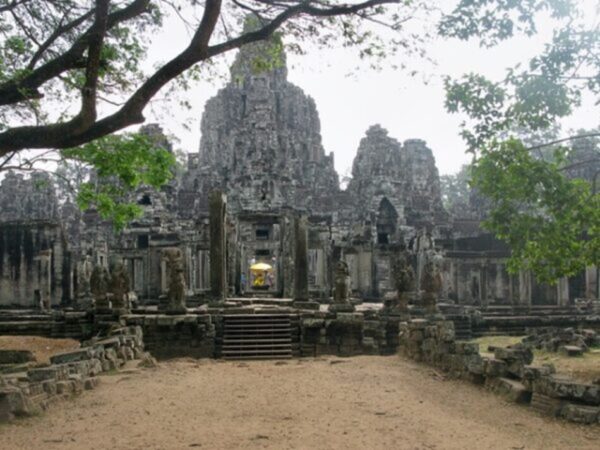
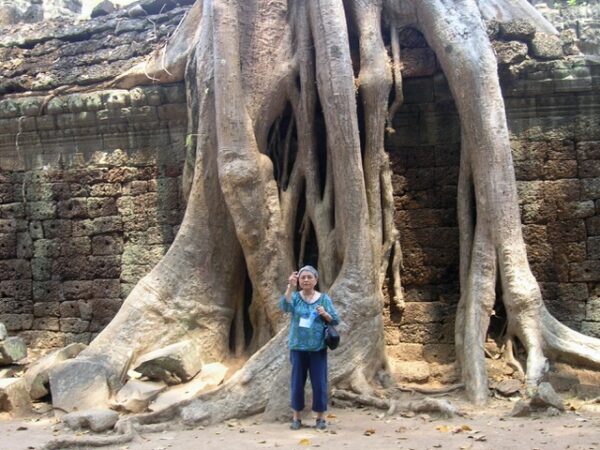
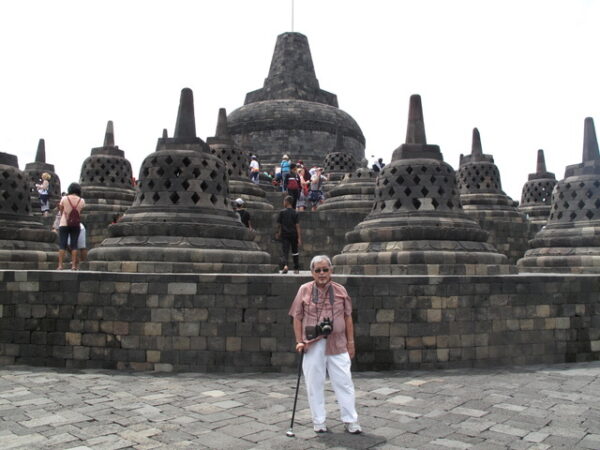
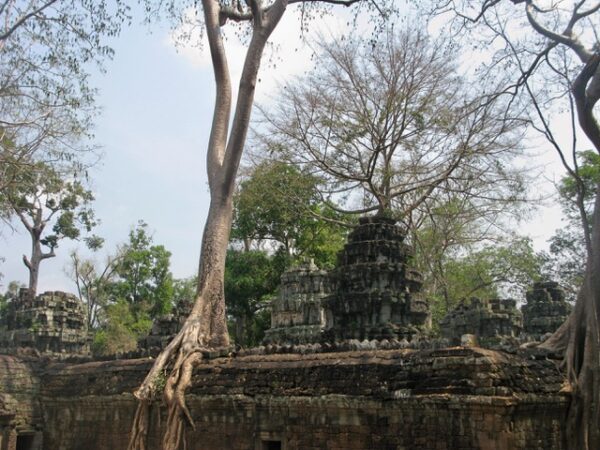
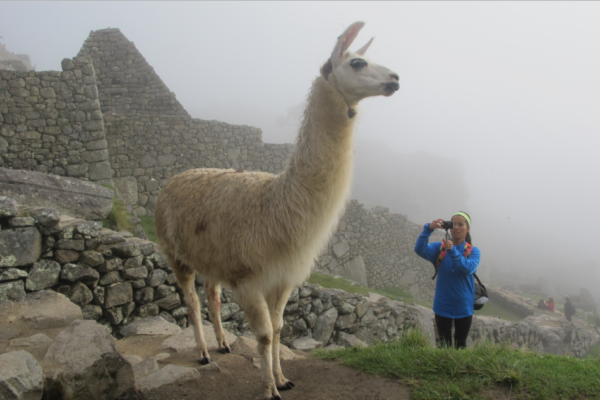
One of the things I miss is traveling to distant countries. Not only remote countries but sacred places. Every now and then I would look at my archive of photographs and revisit them: Borobudur in Indonesia, Angkor Wat in Cambodia, Glastonbury in England, Lake Titicaca and Machu Picchu in Peru, the stone circles of Scotland, Mount Banahaw in the Philippines, the stone house of Mother Mary in Ephesus, the Oracle of Delphi in Greece, the basilica of the disciple Lazarus in Cyprus and the pyramids of Giza in Egypt.
show moreI am not a good travel writer. I do not bother to point out ordinary places no matter how attractive or give directions to tourist spots. I am more interested in places of pilgrimage where I could feel a special energy, discover the divine presence, an insight into myself or life, or find an extraordinary experience that will transform me. There are many such places in the world.
But it requires a special kind of listening, patience and curiosity to “connect” to the special energy of a place. Perhaps, if you’ve done meditation, Tai chi chuan or an art like painting or poetry or you have a religious calling or love history, you’ll be able to feel the frequency or vibration or if you have the ability to keep quiet and allow the atmosphere to enter, you may be able to access the “heart” of the place. You have to leave most everything behind and be open to a new experience. In the phraseology of Zen, you have to empty your cup to get it filled. That is a precondition almost of how you build an energetic relationship with the place.
Often you have a background knowledge of the place you are going to because you have read about it in your research. But it could also be that you do not know where you are going because a guide has it all planned for you. This was what sometimes happens when only an outline of the tour is provided. It has happened to me more than once. On a trip to Myanmar, my companion and I were picked up from the hotel by car and were taken to a boat. We did not know where we were going. After an hour, we arrived at our destination. We walked to an old temple built into a cliff. It had a small, bare altar inside, hardly big enough to accommodate 10 people. There were 2 monks. And then the guide took us for a walk to a white temple. We had the same kind of experience when we were in Laos: a guide took us from the hotel, put us on a boat on the Mekong, and after 2 hours, we clambered up a a ladder to the Temple of 10,000 Buddhas.
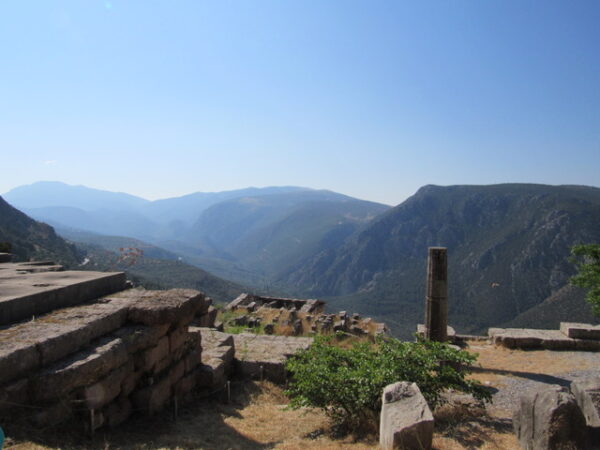
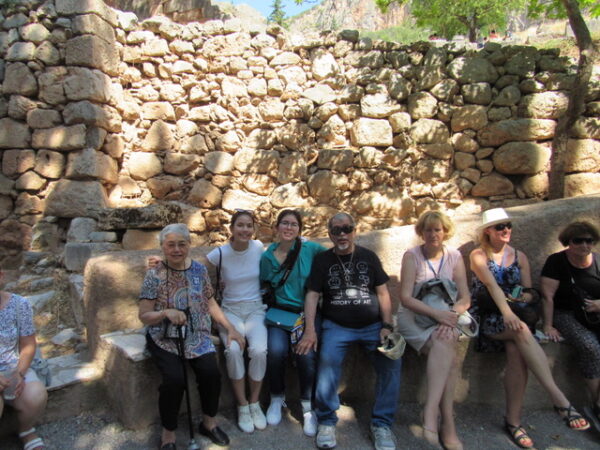
In other counties it was different. We had no guide to lead us. During a pilgrimage to Delphi I took my two granddaughters Ava and Isabel with me. They were a great help with navigating the mountain: My primary doctor allowed me to join the Mediterranean tour although several tests showed I had symptoms of a heart condition and a cardiac procedure was considered a possibility. I let Isabel and Ava to go ahead of me when I reached the plateau. I sat down and did my qigong overlooking a breath-taking landscape. It was Summer Solstice, June 21, and there were women in white tunics chanting probably in honor of Gaea, the Goddess who was the original Oracle before, as in many other places, the patriarchy installed a man – in this case Apollo — in her place.
Sometimes the destination is not the place but a master. This was true in my visits to Bali, Java and Huangshan. I was with David Verdesi; we went to see “King” (I do not like to disclose his name to preserve his privacy) and a 93-year old Hindu priest famous for his ability to change into a monkey right before your eyes. King gave us a rather strange initiation – passing a red-hot chisel on our tongues. It was a cleansing and kundalini ritual. Another master David took me to was the Magus of Java, the legendary John Chang who could project electricity from his body. And of course we went to Huangshan to meet with GM Kong and Feng shifu, both wonderful healers with powerful energy and generous spirits. Important to remember: Whenever you meet a master, it is important to be humble and sincere. The master invariably can “read” your energy at first sight and it’s possible you’ll be ignored or told to return in five years.
I’ve done my meditation rituals or, when possible, Tai chi chuan in different places: Avebury (an even larger and more extensive stone circle than Stonehenge),Temple of Karnak (where Jesus spent some years studying with the priests), several places in Scotland, and Besakih (Mother Temple) on the slope of the volcano Mount Agung in Bali.
It is difficult to explain the experience that is spiritual and mystical. There is a kind of transfiguration, a heightened sense of wonder, a departure from the ordinary and mundane. You leave the place transformed and you are aware of the possibilities of life and travel. This experience is totally different from mere tourist travel. In the latter you are just a casual visitor, you see things – however beautiful or impressive – but they do not affect you in a deep sense, you are not transformed emotionally and psychically, you do not establish a profound relationship with the place or the person you are seeing.
When I walked up the Tor in Glastonbury, I felt myself on some kind of initiation, walking along not just a path but a Path. Step by step, I was being suffused with energy of the place and its history, I was actually moving into the past or the mystical, beyond the geography or the location, beyond into the mystery.
That is the apotheosis of a pilgrimage. You are touched on a soul level and you are not the same again.
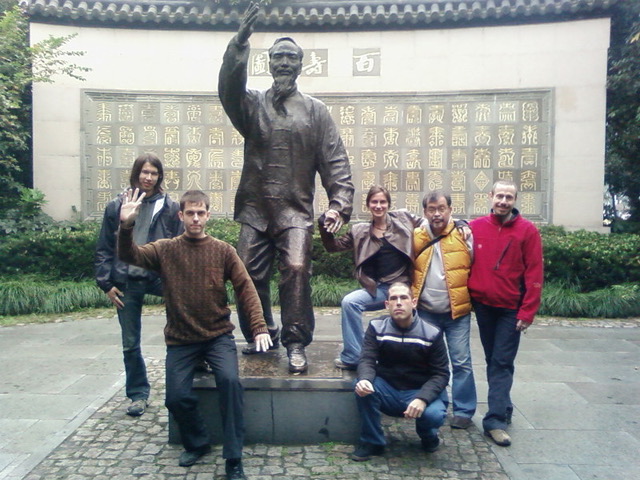
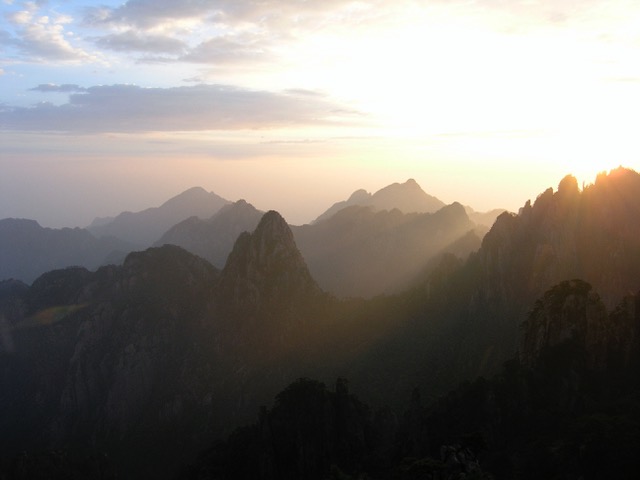
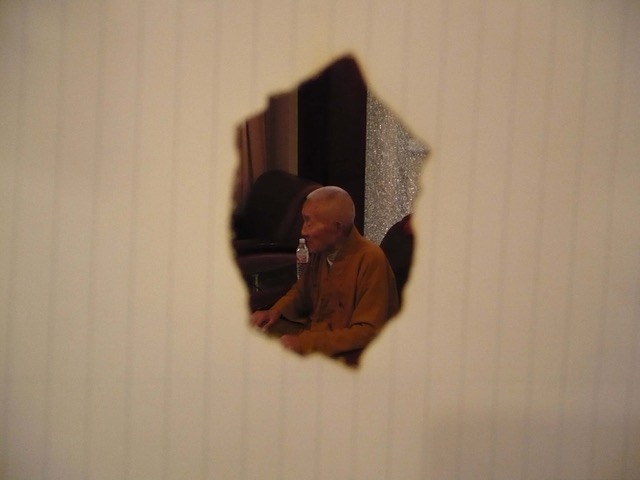
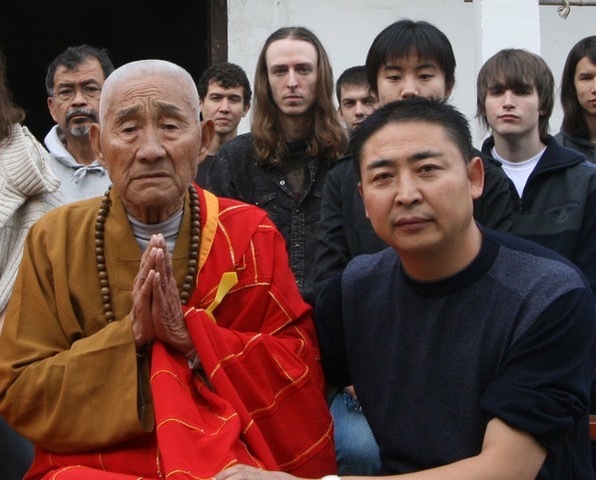
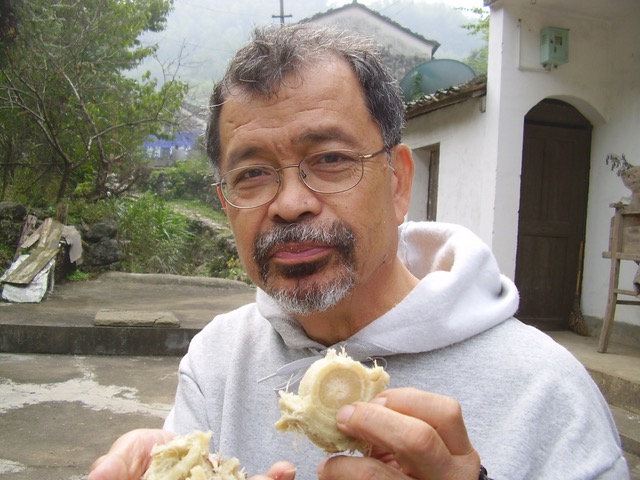
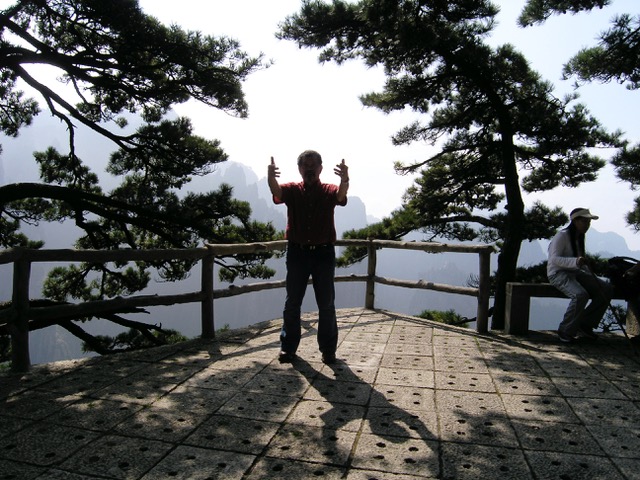
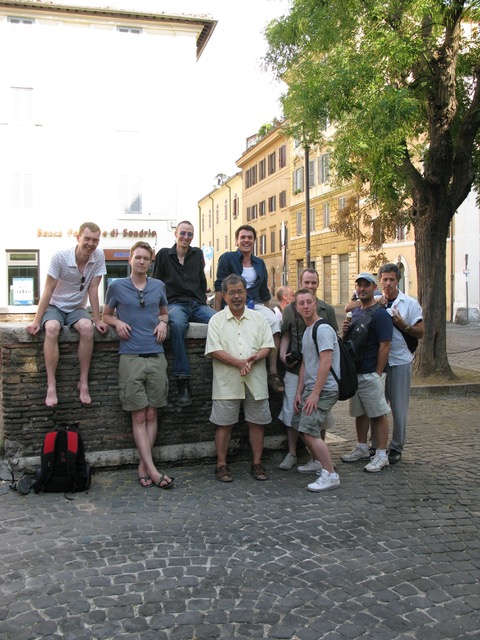
Huangshan is considered the most beautiful mountain range in all of China. It covers miles of awesome landscape. I visited Huangshan two times, once with my partner in 2005, the other time in 2007 with a group that was guided and taught the transmission of Lei Shan Dao by my friend David Verdesi. In these photos you’ll see the hermit and Breatharian Xuan Kong who descended his cave to be with his disciple David Verdesi and students. You’ll see Jiang Feng, Xuan Kong’s main disciple and David’s teacher. You’ll also see me eating a root that was the food of the hermits (who ate northing else). In one photo I am doing Tai chi chuan in one of the peaks and in another you’ll see the sunrise. The last photo shows a piece of paper with a hole that was made by the projection of Qi from the hands of Grandmaster Xuan Kong who was standing 10 feet away. We had plenty of opportunity to meditate and practice our routines after the classes. Gonca Denizmen, a young model from Istanbul, led us through the contortions of Xing Shen Zhuang.
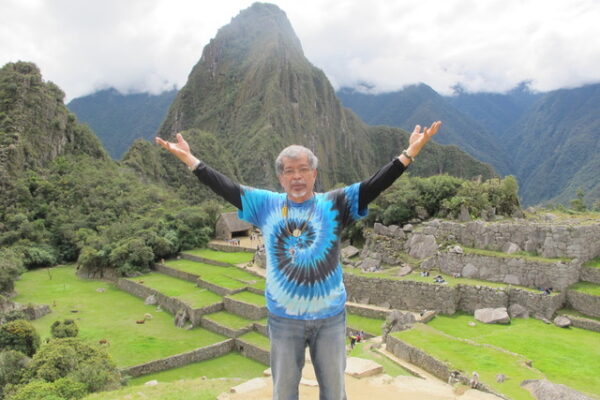
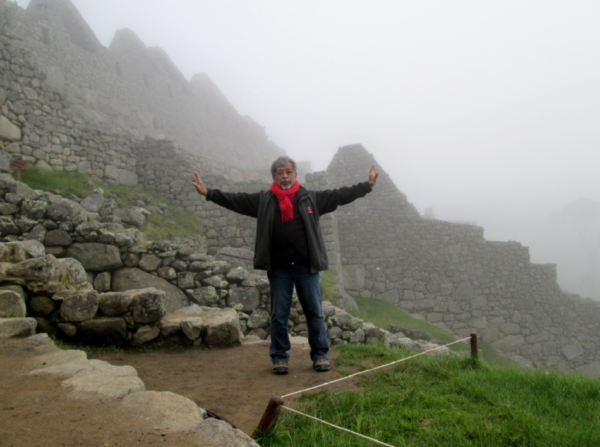
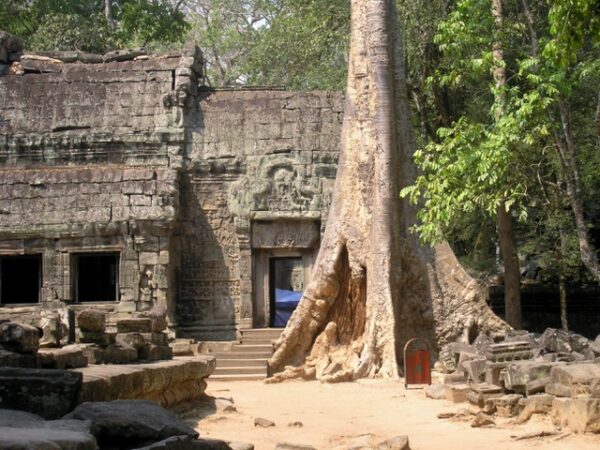
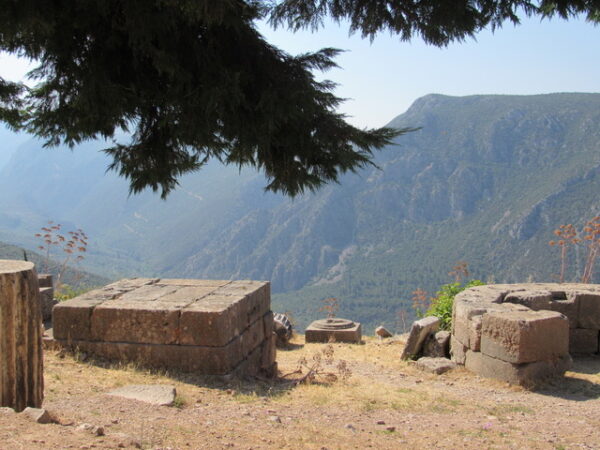
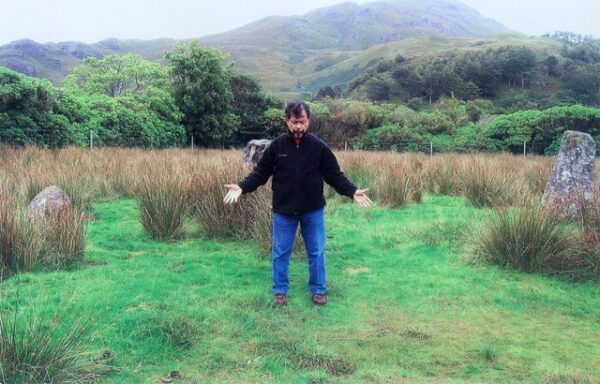
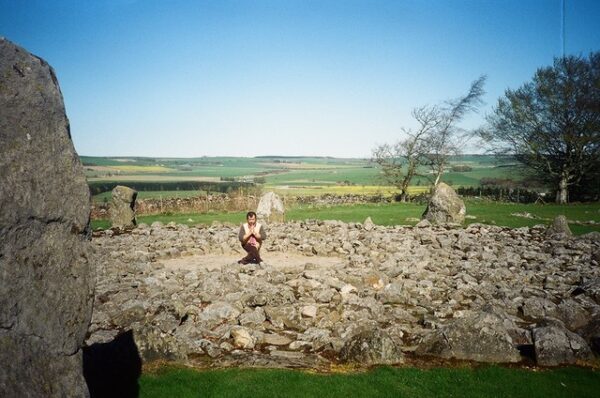
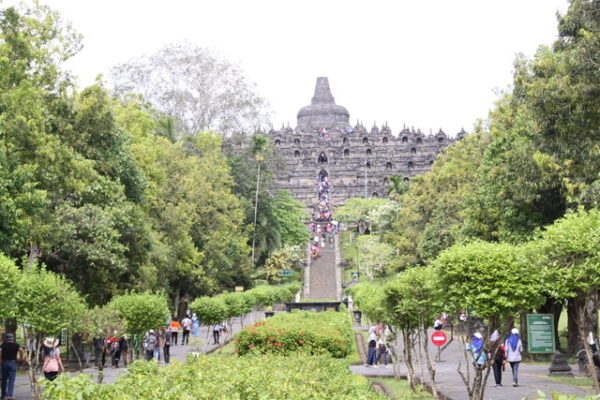
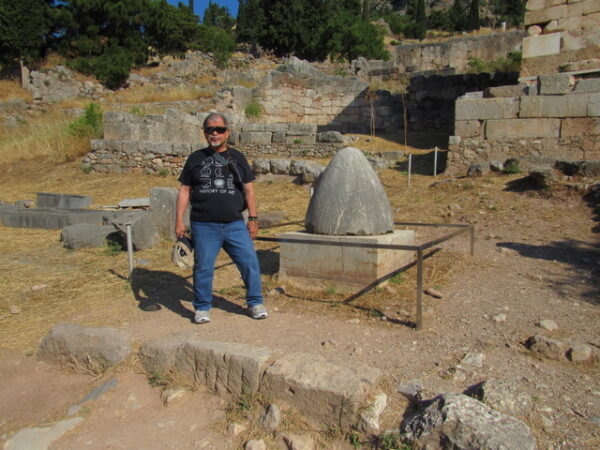
Nelson A. Navarro: In Memoriam
December 11, 1947 – September 22, 2019
(Read at the “Celebration of Nelson A. Navarro’s Life” held at the Kalayaan Hall of the Philippine Consulate in New York City on October 4, 2019)
show moreAlthough Nelson and I have the same surname, we are not related by blood. However, our ancestors – great, great grandfathers – came from Batangas. They were Chinese. Family name: Chan. Apparently, the Spanish Governor-General (perhaps Claveria? Nelson would know the name) issued an order to change the names of the Filipinos for purposes of the census. Nelson’s ancestor went South to Bukidnon, mine went North to Tarlac. Nelson is the godfather of my son Albert who was born in 1969. We were/are also fraternity brothers. I met Nelson in the mid-60s in UP when he was perhaps 16 or 17, a young sophomore finding his way in the university. Later Nelson and I were both involved, in different roles, in the First Quarter Storm, he as an activist and spokesperson for the Movement for a Democratic Philippines, me as a lawyer. I remember that he used to visit me in my apartment in Kamuning. We joined protests, along with Chito Sta Romana (now ambassador to China), Ericson Baculinao (for sometime bureau head of a media syndicate in Beijing) and a few other people who lost their lives in the struggle. I know Nelson so very well I could write a book about him.
AS WE CELEBRATE OUR FRIEND’S LIFE we have to promise to let him go, despite the strong desire to hold on to him, to keep him and the treasure trove of memories alive with us. We should remember that life is ephemeral, that in the Tibetan Buddhist classics on death and dying like the Bardo Thodol nothing lasts, we transition through the in-between, different stages through time, that ultimately death is liberation from the physical, that if we are lucky or if it is our destiny, we get reincarnated again to fulfill our karma on earth: somehow that’s something I would like Nelson to experience. We should also promise to look at Nelson with clear eyes and a balanced perspective because, like a lot of big personages who are larger than life, he was a multi-faceted man and we can be tempted to see him only from one angle or only from the bright side.
I should qualify my thoughts about him. We shared certain interests: literature, travel, politics, art. But we were also different. I am basically a man steeped in the eastern literature of the Tao Te Ching and the Bhagavad Gita, trained in the traditions of healing, martial arts, meditation, and quiet rustication , who pursued serenity and peace in in solitary contemplation while Nelson was a man bred in the culture of the west with its music, philosophies, and literature, the quintessential intellectual, passionately committed to learning more about History and its players, the issues of the day and writing about them, involved in the analysis of why certain events happened and what could have been done to alter their direction. To him, change was initiated in the world of action; to me change happened in tranquility, from within. Perhaps the truth lies between these opposite poles: we are transformed in our engagement with the external world as well as through our contemplation of the inner self.
I honestly believe he is one of the best Alphans the fraternity has ever produced — original, creative, productive, generous, protean, a shape-shifter, dedicated, thoughtful, authentic, brilliant, and in a good way, opinionated. I admired the man and his scholarship and embraced his genius and his idiosyncracies and achievements. He died at the height of his powers and at a time when his talent was in full bloom. If I had my way, I would have given him another decade or two on this earth for him to finish his work, and to find the peace and harmony that eluded him most of his life.
Last February I was surprised to see him waiting for me at the Asian Institute of Management café in Makati. He just showed up without calling ahead. He dropped by just to say hello; he stayed to talk for almost 3 hours. As usual, I just listened to him. That’s all one can do when Nelson starts talking usually non-stop. When he held court, he regaled us with these stories, details we did not know about famous people and our friends and history, obscure facts we were not aware of. His stories, collated through research and interviews over many decades, gave interesting twists to the ordinary lives of people and added color and definition to heroes and public figures and cast them in more human or more heroic portraits and scale or proportion.
He looked down on our country’s leadership, often exasperated and frustrated and angry that politics took this or that turn. It was obvious he loved our country and shared her sufferings and achievements with her. He was one of the few exiles who came back in 1986 leaving America and all its promise of a good life. He may have returned to the Philippines but was a New Yorker at heart: he loved Greenwich Village, Lincoln Center, the restaurants and cafes and the libraries and book stores, he passionately followed the operas, ballet and the symphonies and he returned to New York City, his true home, again and again.
He was extremely loyal and generous to friends, going out of his way to visit them and encourage them for their work. When he arrived in the US in 1972, we were the first family he visited. We lived in New Jersey at the time. Coincidentally that day I was driving to Chicago to pick up my 2 year old son Albert, his godson, who had also just arrived from the Philippines. So Nelson joined us on this long 2-day trek from Asbury Park to the Windy City up north. *One time back in the 1980s he got tickets for me and my 2 kids and we all went to a Richard Wagner opera, the Ring of the Nibelung, at the Met in NYC. We often attended the same Filipino events. We performed In the same shows, some of them just agitprop at LaMama ETC under the direction of Cecille Guidote. For some shows we wore bahags or loincloth and pretended we were Igorots. I choreographed fighting scenes and believe it or not, danced some numbers, including the role of Malakas to a 16-year old’s Maganda. Nelson was in the play “Ang Tatang Mong Kalbo,” Isagani Cruz’s spin on Eugene Ionesco’s The Bald Soprano. I remember the Hungarian coffee shop near St John’s Cathedral and the café in Greenwich village where we spent afternoons talking about our beloved Philippines that was in the grip of a brutal and predatory dictatorship, two expats homesick for their country, and dreaming of going home. We were both active in the anti-Marcos movement, we joined demos in NYC and Washington. we attended the same progressive DGs or discussion groups where we studied the literature of protest and revolution, and we wrote for expat publications, he for Loida Nicolas Lewis’ Ningas-Cogon, I for Philippine News. **
In the 1990s we hardly saw each other. For 10 years I lived in Boston to study acupuncture, Chinese herbalism and Classical Yang Family Tai chi chuan and got deeper into esoteric Taoism. He was in the Philippines writing books and doing commentaries on television with contemporary Jerry Barrican. LIke me, he traveled a lot.** For a long time I did not see him even when I returned to the Philippines to teach seminars on meditation, Qigong and massage. One day, at the Via Mare café in UP Diliman, I had dinner with Josue “Sonny” Villa, former ambassador to China, a childhood friend. It turned out Nelson was in the same restaurant with Ericson Baculinao, the old China hand and fraternity brother who had flown in from Beijing. So destiny brought Nelson and I together again. There we were, 50 years after we first met, Nelson and I were both aging seniors, silver haired and bearded, pale and wrinkled, miserably overweight, stooped and sadly limping – he from a stroke, I from injuries sustained in martial arts training and possibly old age.
No doubt he left his mark, he will be remembered … for his achievements no doubt, for a couple of his books possibly and his love for our country and people most certainly. I do not like to use the word hero to describe the man but he was definitely close to being one. We can truly say, he was one of a kind. That’s what the poet Du-Fu said of his friend Li-Po. It’s the best compliment we can ever pay a man.
I would like to close by reciting the mantra from the Heart Sutra, the Buddha’s sermon to his disciple Shariputra:
Gate, gate, paragate, parasangate, bodhi svaha! Translation: Gone beyond, beyond, to the Other Shore, everyone, Hallelujah!
Rene J. Navarro
*Martial law was declared three months later on September 21, forcing us both to remain in the US until 1986 after the fall of Marcos when we both returned home to the Philippines. He stayed in the Philippines, I returned to the US (in 1987) and trained to be a Taoist teacher and eventually study acupuncture and Chinese medicine in 1990. I kept my Philippine passport and citizenship and INS green card.
** Some of these essays – “The Last Days of Marcos,” “God Looks Down from Heaven,““Marcos Coliseum,” and “Jose Rizal: Zen Life, Zen Death” — appear in the Writings section of my website. There’s also my free English translation of Amado Hernandez’s “Kung Tuyo Na Ang Luha Mo, Aking Bayan” (from “Isang Dipang Langit”) in the poetry section. “Marcos Coliseum” was reprinted in Primitivo Mijares’ book Conjugal Dictatorship.
***He traveled to Machu Picchu, Egypt and China. So did I. I heard from Ericson Baculinao that he and Nelson went to Mongolia.
show lessJose Rizal: Alchemist
… the ultimate subject and object of the alchemical experiment (was) the alchemist himself. Michael Baigent and Richard Leigh, “The Elixir and the Stone”
… the true end of alchemy is not the manufacture of gold but the purification of the soul and the contemplation of god. Peter Marshall, “The Philosopher’s Stone”
Jose Rizal was a Mason but there’s nothing in the record to show what level he was. As far as I know, there’s nothing to show what he did as a Mason either. We can ask other Masons what they do but in all probability, they won’t say anything because the rituals are a secret. Rizal had many friends, in the Philippines and Europe who were Masons. Did he discuss Masonry with them? It is possible, but I have not seen any indication that he did. Perhaps somebody who has access to more of the Rizaliana materials could help me in my research.
show moreOne of the traditions and practices associated with Masonry is alchemy, the art of transformation that may have had its origins in Egypt, China or India. The word itself came from the root Alkemia, or black lands, the ancient name of Egypt. Alchemy was referred to later as Hermetic knowledge because the Greeks called Thoth, the Egyptian god of wisdom and writing Hermes. Alchemy was partly based on the Emerald Tablet, the sacred text that was attributed to Thoth. There are different versions, one of them in China. Some of its maxims are:
As above, so below. As below, so above.
What’s within is without; what’s without is within.
For every positive, there is a negative; for every negative, there is a positive.
These sayings underscore the system of correspondences and parallels between the body and the earth, on one hand, and the external world, on the other. If there’s divine in heaven, there’s also divine within. If there’s a feminine, there’s a masculine and vice versa. The art embraced a paradigm that included certain belief and concepts – nature and man as a manifestation of god, the possibility of perfection, of man being capable of reaching godhood. It is a system that established an ancient paradigm of reality and transformation.
We do not how it developed but in the course of its history, alchemy evolved a method for the transmutation of lead into gold, or the transformation of the raw human being into the perfect sage or magus. The process of alchemy was held as a secret, its “formula” was contained in esoteric symbols and images like sulphur and silver, Sun /Sol and Moon/Luna, Musculine and Feminine, Tiger and Dragon and the different elements like Earth, Fire, Water, Wood and Metal in China.
Alchemy itself started as a process of producing gold and immortality through the mixture of 4 different metaphorical elements: Earth, Air, Fire and Water or their equivalents. This was called external alchemy. In the course of time it became, as in China, a method of prolonging life and achieving perfection (internal alchemy), twin goals of the tradition. By finding the equivalent elements within the body, internal alchemy (also called Philosopher’s Stone) made it possible for practitioners to achieve perfection through the transmutation of energies and emotions. There are different paths or ways. In simple terms, the alchemy of Fire (Li) and Water (Kan) was able to produce “steam”, a higher element in the process.
Since the early 1990s, when I started studying Taoist internal alchemy, I began looking for evidence if Jose Rizal knew and practiced alchemy. His library contained books by Masons like Voltaire (Jean Marie Arouet). He associated with Masons like his friend Blumentritt. No doubt he was exposed to –- and was immersed in — the culture of the Enlightenment. But I did not expect him to mention alchemy, much less to talk about it of course because the theory and practice is considered a secret. Studying it without a knowledgeable master is dangerous and we are warned can result in mental derangement or death. It is evident that many of the symbols and images in Rizal’s poetry and the arguments in his writings, especially his correspondence with Father Pablo Pastells, were derived from the Enlightenment, the Hermetic transmissions, and Masonry and their vocabulary. For instance,
And when in dark night shrouded the graveyard lies
And only, only the dead keep vigil the night through:
Keep holy the peace, keep holy the mystery.
Strains, perhaps, you will hear – of zither, or of psalter:
It is I: O Land I love: it is I who sing to you.
Nothing then matters to place me in oblivion—
Across your air, your space, your valleys shall pass my wraith.
A pure chord, strong and resonant, shall I be in your ears:
Fragrance, light, and color – whisper, lyric, and sigh:
Constantly repeating the essence of my faith.
— Jose Rizal’s valedictory poem translated by Nick Joaquin
The verses suggest the destruction of the physical and its transformation into something subtle, energetic or spiritual. This is the essence of alchemy – dissolve et coagula. The transmutation of lead into gold, the gross human material into divine possibility.
“… in the light of the knowledge of the past and present, I weigh things, try to determine their causes and the finality of their activity, and strive to follow the direction they take. I see in everyone an inborn desire to know; I see the world outside full of colors, qualities and incentives that nourish this desire; I see misery as the chastisement of ignorance, well-being as the prize of knowledge. And I come to the conclusion from my humble reasoning that the Creator desires man to perfect himself by growing in knowledge.”
“Regarding the immortality of the soul and life eternal, how can I believe in the death of my consciousness, when everything around me tells me that nothing is lost but things merely change? If the atom cannot be annihilated, is it possible for my consciousness which rules the atom to be annihilated?”
— The Rizal-Pastells Correspondence by Raul J. Bonoan, SJ
Another poem is even more suggestive of Jose Rizal’s interest in and practice of alchemy:
Water and Fire
We’re water, you say; you’re fire.
As you like it, let it be!
We live in calmness,
And ne’er will fire see us fight;
Rather joined by wise science
In the burning seat of boilers,
Without anger; without rage.
Let’s form the steam, the fifth element.
Advancement, life, light, and movement.
— quoted from Pedro Gagelonia, Rizal’s Life, Works and Writings
It is clear that “the burning seat of boilers” refers to the laboratory that was used by alchemists to produce the Philosopher’s Stone. The poem points to the reconciliation of opposites – hot and cold, dry and moist – that is followed in all alchemical traditions, whether Egyptian, European, Indian or Chinese.
A prolific writer, Jose Rizal kept a meticulous and detailed record of his observations, thoughts and experiences. But sadly, in keeping with the tradition of Masonic secrecy, he did not bequeath us his method of alchemy, the path to human perfection.
The Last Days of Marcos
by Rene J. Navarro
Contemplating the ruins of his regime, Ferdinand E. Marcos stood frozen on the balcony of the palace. The waters of the Pasig River had never seemed so murky and polluted. His eyes scanned the faces around him. There were generals and presidential guards, cabinet officials and relatives, Imelda adherents and loyalists. And from the corner of his eye, Marcos caught a glimpse of the American ambassador with a military aide.
He wondered, Who had betrayed me?
show moreWhile the streets resounded with gunfire and the windows rattled from the explosions, Marcos searched the faces of those huddled about him for any sign of
deceit. Who could have been responsible for this coup? He was almost sure it wasn’t the military, for he had seen to it only his trusted lieutenants were in control. Was it his wife? But she was in New York since the week before – presumably occupied with her endless and extravagant shopping sprees.
Marcos quickly considered every name on his list. Not one of them could have had the temerity, much less the power, to initiate and pull this seizure through. They were all powerless. He had planned it that way. Could they have closed ranks secretly and decided on a mutiny? Impossible because he had taken care that each person in charge of a department or a bureau was hostile to and insulated from the others. Even the military was purposely fragmented to keep its generals from having any ideas. And his enemies – the radicals and progressives – were either in the mountain or in jail.
Meanwhile, masses of people armed with bolos, runs, sticks and stones, and molotov cocktails were marching, in union towards Malacanang. They came from different corners of Manila. Filling the streets with their numbers, they waved their weapons and their torches. Their chanting and footfalls drowned the sound of bullets in the distance. They marked inexorably closer until their united voices echoed through the deserted corridors of the palace.
As Marcos waited for the rescue helicopter to land, he vainly searched for that one renegade who had unleashed the storm.
A master tactician, Marcos had not anticipated the effects of recent developments – the bombings and selective assassinations and the demos in the streets. Ordinary citizens were marching, ready to face the powerful guns of the army. Students were again in the barricades with their pillbox bombs, molotov cocktails and, sometimes, guns and explosives. Many had died before international media coverage – and it focused world attention and drew pressure on the bankrupt and tyrannical regime.
The military had simply refused to confront the seemingly fearless and quixotic mobs after the first few weeks of bloodshed. Marcos thought that fear was enough to keep the populace silent; but, as more and more people were imprisoned, tortured and killed, and as life became more and more uncertain, the people became bolder, and they turned out of their hovels and tenements and joined hands with their comrades at the gates of Malacanang. No matter how many soldiers reinforced Mendiola, column upon column of slumdwellers, students, professionals, and all manner of men and women and children, came to fill the void of fallen comrades, and they could not be pushed back by armalites and grenades and smoke bombs.
Marcos did not also anticipate that the occasional bombings, which barely affected the workaday operation of the bureaucracy, would escalate into a systematic, orchesrated urban guerrilla warfare. At first, there were the small explosions in hotels and bazaars, which he dismissed as almost laughable. Later, after he was given fair warning, the explosives became more powerful and were planted in electrical stations, resulting in blackouts and partial paralyzation of the city. Government vehicles would stop in mid-traffic because either their engines were tampered with or the gasoline was diluted. There were more and more sabotage techniques employed by the shadowy urban resistance. Still later, when Marcos refused to abdicate, the underground escalated the pressure. He realized it was close to impossible to finger the suspects in the city and to round up the resistance members because, while it was comparatively easy to locate the mountain guerillas, it was very difficult to identify the urban underground. Guerrillas in the fields were fish in the ocean – drain the water and you catch the fish. But urban guerrillas were the ocean! Marcos understood and studied the modern rules of urban resistance from Cyprus to South America to Asia, and he knew well that a sophisticated city underground is almost impossible to contain.
As Marcos stepped forward into the waiting helicopter, he hesitated and took one last look at the assortment of people in the balcony and at the palace now dark and ghostly. He raised his right hand to wave a farewell but caught himself, turned and entered the helicopter door.
A few days before, he was comfortably in power, he thought. Meeting with his cabinet and his military leaders he assessed the political situation and decided there was no significant danger. He was assured the heat would just simmer down after the usual arrests and media announcements. Everybody he talked to said the situation was under control. But, as a precaution, he hastily and secretly sent his children abroad – just in case.
As the helicopter hovered over Manila, Marcos looked down and was seized with an undefinable anger. Who had betrayed me? he asked himself. He would, of course, issue the public statement to the media – that he was abandoned by the United States; that a communist clique had infiltrated the government; that he had served his country well….But right now, winging his way to the airport for that jet plane out of the country to his exile, he felt a sense of betrayal and, perhaps, self-pity. He was, finally, alone.
N.B.: While clearing my files, I found the article (a copy of the typewritten original is attached hereto) entitled “The Last Days of Marcos.” I think it was written in the late 1970’s and submitted to the Philippine News for publication. I don’t know if it was published.
In those days, we used to organize rallies and demos in front of the Philippine Consulate in New York or the United Nations, we used to write political analyses and satires, we used to gather to talk about the dictatorship.
Behind the major premise of the article was the belief at the time, held by many people, that President Ferdinand Marcos will not surrender his powers, that only some sort of armed struggle will work, that if he died, his heirs – Imelda and Bongbong – were there to succeed him. The elections of 1986, of course, led to his eventual defeat and exile. It wasn’t violence that did it but the united and peaceful will and determination of the people – the February Revolution.
Sometimes, we played the role of a prophet, we made predictions on how a person will die, we invented scenarios how a regime will end, who will win an election. History has a way of surprising us. Marcos himself did not believe that an election would result in his defeat or that the people and the army would revolt against him. I am sure that many people had predictions about Marcos. Mine is just one of them.
(First published in the Philippine News in 1982, this is one of the political pieces I wrote during the dictatorship of Ferdinand Marcos. I will reprint a couple more in the next few months.)
show lessPORTRAIT OF AN EXILE
Reynato Yuson, Greenwich habitué, expatriate writer and versifier, now on his nth unemployment check, had emerged, blinking, from the cluttered haven of the downtown eastside apartment he shared with the other Filipino bachelors, into the autumn sun. Clutching the satchel on his shoulder, he picked his way past the bushels of cabbages, yams and cucumbers on the sidewalk. The street outside the decaying Fillmore East Theatre had already burst with commerce and sounds on this early Monday morning.
show morePicking an apple along the way, he sauntered past the derelicts and Bowery bums, descended into the subway stop at Houston East, jumped over the turnstile as the doors of the train were about to close, and rushed in. He opened his bag and pulled out a manuscript of an essay on the Last Days of Marcos, a futuristic study of the dictator’s demise. Pen in hand, he made corrections on page one until it looked like the sketch of a wild bush.
He went down at the Grand Central Station, walked lazily through the harried commuters and up the steps past the Commodore Hotel sign, to the street drenched with rain. He scurried across into the New York Public Library, and quiet.
It was here we met to verify a matter that he had been working on rather enthusiastically, namely, the Wagnerian symbolism of Dr. Jose Rizal, the national hero of the Philippines. He suspected there was something uncannily similar in Rizal’s Noli and Fili and Wagner’s Ring of the Nibelung. There were, he thought, too many similarities to be considered coincidental.
Reynato was at a friend’s apartment one night listening to the Ring Cycle with a libretto and an annotation by his side when it occurred to him that Wagner’s symbols and characters were oddly familiar. The story of the ring sounded
like the story of Maria Clara’s necklace or Simoun’s jewels. The fire symbol was like Elias’ immolation scene. Siegfried was like the noble Elias. Before he could finish Gotterdamerung, Reynato was holding, not the libretto of the Ring, but Rizal’s Noli and Fili, and was in an animated discussion with his host.
“I hope nobody has written about this,” he said to himself as he went through the index cards at the library. He admitted it was impossible to verify if any work has been done on the same theme, considering all the term papers and theses and dissertations decaying in some History or English Department.
He leafed through the diaries of Jose Rizal. Sure enough, Rizal was in Germany when Wagner was the rage of opera. But he could not find any indication in Rizal’s entries that he had listened to or knew about Wagner. Finally, Reynato reluctantly conceded that the similarities could be mere coincidence, that perhaps the parallel symbols occurred because they were universal. But he could not believe that Rizal thought of the immolation scene on his own. Reynato believed that Elias’ fiery death was new in Philippine literature. “It can only be explained by Wagnerian influence,” he said.
It was after one o’clock when, still unable to find confirmation of his thesis, he decided he needed more time and materials.
He walked to Times Square. He wanted to pick up a copy of Gustav Mahler’s Symphony # 2 (The Resurrection) conducted by Eugene Ormandy. “The one with Evelyn Mandac doing the soprano part,” he told the salesgirl at Sam Goody’s, as if this additional information would provide her with a further clue as to the record’s whereabouts. “And please get me Rampal’s ‘Sakura’,” he added.
Back at his apartment on the lower east side of Manhattan, we settled to a vegetarian brunch of yogurt and spinach omelette as the Rampal record played. While he boiled water for the herbal tea, I sat back to listen to Mahler’s 2nd. Reynato was quite curious about Evelyn Mandac’s performance whom he had heard during his college days at the University of the Philippines. Several times in the early 60s he had seen her at the Agnostic’s Inn, a carinderia owned and run by Dr. Ricardo Pascual , dean of the department of philosophy, after whom the place was named. But he had never talked to her even if sometimes they moved in the same circle because she looked solemn and forbidding. He liked her voice because it was edged with pain and vulnerability, a feminine quality that was elfin and oriental. He often heard her at the College of Law auditorium, where she was often invited to sing at the intermission of convocations. He concluded that her duet with Birgit Finilla was a powerful moment of artistry – they had two contrasting, but balanced, styles that gave the Mahler’s last movement a soaring, heartbreaking thrust into the triumphant choral finale.
Like somebody who wanted to probe the taste of his subject by dwelling on minutiae, I took a mental note of Reynato’s considerable record collection and minuscule library. He has the complete symphonies of Shostakovich and Beethoven; about seven or eight versions of Rachmaninoff’s Piano Concerto #3; a copy of the orchestral works of Revueltas; several Berlioz; Tchaikovsky’s Piano Concertos and Souvenir de Florence; a bunch of Japanese music for the koto and shakuhachi; two records of Maria Farandouri singing the ballads of Mikis Theodorakis; one by Suni Paz; several Cleo Laine and Red Army Chorus; Bach’s orchestral suite and Brandenburg Concertos; a few other classical records, prominently works of Brahms, Mahler and Prokofiev. His books included the collected poetry of Dylan Thomas, Eugenio Montale, Juan Ramon Jimenez and TS Eliot; the novels of Jose Rizal and James Joyce; the stories of Bienvenido Santos and Ninotska Rosca; the writings of Marx, Mao, Lenin and Stalin; a few Sartre and Camus. He also had an extensive literature on war (Clausewitz, Mao and Sun-Tzu), zen and Tai chi chuan.
Begging to be excused, after he served tea, Reynato lighted three joss sticks, bowed three times in front of an improvised altar with the statue of Guanyin, and put the smoking incense on a brass vase. It was then I noticed the enormous picture of Shiva dancing.
Reynato switched on a tape recorder and the small apartment was filled with Indian music: sitar and table with chanting in the background. He sat in front of the altar, twisted into a full lotus posture and assumed an attitude of meditation.
As the afternoon deepened, I realized one fact about this man. He did not betray it, but he was quite homesick for his country. He reminded me, as he drifted into inner space, of certain characters from the fiction of Bienvenido Santos and Nick Joaquin. He may be listening to Beethoven or Japanese koto music or, like now, to the staccato rhythm of a Hindu ritual, but he is realy imagining that he’s back home – or escaping from the unreality of America. He may be at the beach watching the ocean or the sea gulls, but he’s actually dreaming of his homeland. His attachment to the sea, I suspect, is a well-disguised nostalgia for islands far away.
But he can’t go home yet – or he refuses to go home – although the prospect of again walking the streets of Manila tantalizes him. Like Joaquin’s exile, he’s waiting for his country to be free. He keeps on searching for reports on the successes of the underground movement and the defeats of the dictatorship. Often his moods are determined by the developments in the Philippines. Is there news of Marcos’ ill-health? Reynato celebrates. Is there a new wave of tortures and arrests? He becomes upset.
Born at the foot of Mount Arayat, he was able to observe the underground at close hand. He remembers the times, in his childhood, when peeping through the window, he caught glimpses of armed men moving silently along the barrio trail. Growing up at the edge of town, he had become familiar with the cadres – they would drop in to talk; and he noticed the rifles that glinted in the dusk. But times there were when bloody bodies would be paraded through the streets in a native sled and dumped in front of the town hall. Reynato would run the dusty mile to see them. Attempting to identify the faces, he found the carcasses unrecognizable from the bullets that had smashed the bones and flesh.
Reynato learned from the teach-ins conducted by the cadres in his hometown that there was a guerrilla war. Which brings me to another aspect of his exile: he feels guilty for being in America. “We should be in the mountains of Sierra Madre wielding armalites,” he says. Somehow, in the wave of the 1960s he fell in with relatives who had filed applications to migrate to America. When his papers were finally approved by the US Immigration and Naturalization Services, he had become involved with the vociferous and militant student movement in Manila. Given a couple of weeks to leave as an immigrant, he decided against doubts to book a flight. Late in 1970 he found himself in New Jersey with cousins who had offered to take him in, in the meantime that he was looking for a job.
But he regretted his decision to leave the Philippines as soon as he stepped on the plane.
When he was advised by a fraternity brother in the military to stay in America because there were orders for his arrest in 1972, he felt a little relieved. At this point, he vowed to write of the situation back home and the liberation struggle of his people.
Thus began another phase in his life. For he had never considered himself a writer. He had settled early on to become an accountant. Going to college in the late 1960s he came under the influence of certain members of the Kabataang Makabayan. He joined teach-ins. He watched the Kamanyang Players, a political drama collective. He went to a few demos. He read the works of Renato Constantino and Jose Ma. Sison. Somewhere, in the process, he was politicized.
“It was on one May Day march that I really underwent a change,” he admits. “We gathered at the boundary of Manila and Quezon City, at that circle where so many demonstrations began. Waving flags and banners we marched through the streets of Manila, along the university belt, past Quiapo, to Congress, where we stopped to listen to speeches. Eugene, Raquel, Gary, Julius, among others, were there. While we were all gathered, I joined a friend who was working with a senator to pick up some papers from his office. As I walked along the corridors on the third floor of the congressional building, I saw soldiers aiming their high-powered rifles at the demonstrators in the street. I could not believe my eyes. Later, while on a sit-in with strikers at the US Tobacco Corporation near Bonifacio Drive, we were trapped by the military in that small alley. From both sides, they came, their guns cocked. We were completely surrounded, and helpless. It was then I realized the truth of the adage that political power grows out of the barrel of a gun.”
Now, in America, not having taken up a gun, he has taken up a pen (a ballpoint pen really). “It was a difficult education,” he says. “There I was, an expert on numbers and, suddenly, I decided to string words. I read a lot: James Joyce, Nick Joaquin, Sartre, Camus, Dylan Thomas, Malraux, Hemingway. It was an agony to write but I had a valuable ally: my imagination. As a child, I sat at the feet of my grandfather who told me stories from native folklore and corridos.”
While his work is not known for its literary merit, it reflects that imagination. Such satires as Marcos, Inc., Marcos Coliseum, The Assassination Attempt Revisited, God Looks Down from Heaven, to name a few, are an exercise in fantasy. Reading them one detects that unmistakable flight of fancy, that hint of humor, forcing one to conclude that somewhere in that biting indignation and trenchant style is a child retelling the stories he had heard from his grandfather.
“My writing is intuitive. I don’t aim to achieve literary or journalistic excellence. I express my anguish and my joy,” he says.
At this point he feels he has exhausted the medium of the political satire. He’s itching to write a novel about an exile (semi-autobiographical, I am sure) who had an itinerant Batangueno for a great-grandfather and a Pampangueno for a grandfather (a former member of the wartime guerrilla movement called Hukbalahap). He’s als planning to to write a play – “ a didactic one along the Brechtian mold, which will deal with the moral questions facing a revolution, and will center on the death of Andres Bonifacio.”
But he complains of not having enough time. “Too many engagements, too many preoccupations,” he says. “I will go crazy if I don’t see plays and museums and concerts.” With his girlfriend, of course, whom he refuses to identify. “We’ve grown together intellectually and emotionally. We’ve weathered a lot of crises in America. But we’ve survived, together. We’ve shared a love for certain writers and composers, especially at the beginning of my apprenticeship as a scribbler. She introduced me to books and classical music. At the start, I could not tell the difference between Beethoven and Mahler. I went for the schmaltzy romances of Mantovani. But unfortunately, it’s coming to an end, this relationship, because she wants to get married, to a Jewish doctor. She wanted to continue our friendship. We’ll still go to concerts and museums together and you can visit me, she said, but I don’t think I’ll see her again because I’m not too sure she can stand the gossip that usually hounds even a platonic relationship of a bachelor and a married woman or, for that matter, of a married man and a single woman. I don’t think she should take the risk because there are too many aggravations. And the Filipino community is not famous for its tolerance. If anybody sees us attending a play together, she’ll be the talk of the town. It would be nice to share a friendship with a woman of her humor and intelligence, but.” Here his voice drifted wistfully and his eyes wandered about restlessly.
It has not been an easy break-up for him. For his commitments are strong and emotional. To cheer him up, on his 30th birthday, a few mutual friends (identified here only by their nick names) gave him a surprise party. Angie prepared a dish of crispy fried duck and spicy string beans. Nelson cooked one of his giant omelettes. Tanya flew in from California to add the honor of her presence to the occasion. Ching whipped up her delectable sinigang na sugpo. Elvi prepared her chicken relleno. Loida, heavy with her second child, brought a bottle of Chablis. Poch graced the festivities with his professorial mien. Rev dropped by, greeted the honoree, sat in one corner and ogled at the girls. Mike came with his ubiquitous guitar. Sonny brought his justly famous chicken estofado de Cagayan. It was a happy event for everybody except for the celebrant. He brooded endlessly even if everybody commiserated with him.
Terribly moody, Reynato has a vulnerability about him. His spontaneity makes him an easy target for jokes and intrigues. “My reclusiveness is my defense,” he confesses. An admirer of Exupery’s The Little Prince,” (of which incidentally he has versions in English, French and Spanish, and records by Peter Ustinov and Richard Burton), he adheres to the credo: “It is only with the heart that one can see. What is essential is invisible to the eye.” (Actually, he said this in Spanish, a rendition which he thought sounded better than the English or the original French.) He is also fond of saying, “You are responsible for what you have tamed.” (He said this line in French, which he considered better than both the English and Spanish translations.)
As I write these lines, Reynato is having another “agenbite of inwit” – a description from James Joyce he tells me –which means I presume a seizure of guilt. He wants to go home. Despite the icy winter weather, he goes to the beach more and more frequently. He would take the train to Long Beach or Far Rockaway in the morning, stroll stroll along the shore, do his tai chi chuan several times, and catch the train back to Manhattan. I can imagine him as he walks on the beach, his eyes constantly drifting to the horizon and the hazy sun. No, his mind is set not on the scene but beyond 10,000 miles away where his country is in the grip of a crisis while he is out here scribbling satires or weaving nostalgias.
Often I wonder if he should go home or if he has already gone home. He is so much a part of émigré propaganda literature I can’t conceive of him not writing for Filipino periodicals whatever his excuse or wherever he may be. At the same time, his guilt trips are profound and disturbing, I am afraid he would become pathologically melancholic.
If and when he goes back home, what would he do? Live in the old hometown of Arayat? Or work in Manila as an accountant? Considering his background, would he go to the hills? I have not asked him these questions but they weigh heavily on my mind.
There are times when I have an image of him in the middle of a demonstration in Manila. While he sympathizes with its tactics of a protracted war, he has chosen not to join either the NPA because, being a free spirit and an unfettered mind, he has found it impossible to abdicate his freedom for something he considers intellectually elusive, or the Democratic Socialist underground because he considers it a basically elitist improvisation. He is essentially a writer of the human condition; therefore, he would cast his lot with the downtrodden without committing himself in an ideological box. I can picture him: he stands side by side with the slum dwellers of Tondo as pillboxes and Molotov cocktails explode about him. A smoke bomb whistles in front of him as the Marcos mercenaries force the crowd from the gates of Malacanan. Finally a shot rings …
The thought he might get killed has occurred to me, it is true. As one who has been involved in the student movement of the 1970s, I know the risks inherent in street radicalism. I also know the fascist soldiers of the New Society would not have the scruples or respect his noble dreams or his frail body. It is a morbid thought, to be sure, but having known him so closely, I feel anxious for his life. He is not, after all, just another number in the struggle as far as I am concerned. Perhaps., again, my anxiety may be due to my own memories of mangled bodies exhibited by the military on the steps of the plazuela in Tarlac, of demonstrators mowed down in the streets of Manila and of comrades tortured mercilessly in the Philippine prison camps. Even today, in my sleep, I am haunted by the eyes of a friend whose genitals bore the marks of an electric wire and whose back was permanently scarred with the imprint of an army knife.
Nevertheless, while I hope for his safety, I can understand his obsession to return. Whatever happens to him there would be a lot better than for him to be run over by IRT subway express or shot by a desperado in Central Park. I can also understand his existential search for meaning – that defiant affirmation of self against the fatal negation of an absurd universe.
If he chooses to find fulfillment in action, he cannot be faulted. For, as an exile twice over, his loneliness is more profound, his sense of absurdity deeper, and his dread more painful than Sisyphus’. It is possible he may find that lost humanity in the barricades or in the camaraderie of the committed or even in the earthy sweat of the urban proletariat. It is also possible that he may discover that intense union of mind, body and spirit when the psyche is least fragmented in the classic confrontation with the Enemies of the People. I hope he would find success where I, sad to admit, have failed.
I have not seen Reynato Yuson since our last interview. But reading the Philippine News, I can see that he is alive and well, living in Manhattan and up to his old tricks.
Somehow, as I close this brief sketch, I entertain the hope he would not read it. He is a very reclusive chap and will probably be embarrassed to read an article about himself. He allowed this travesty and invasion of his self-imposed and well-guarded hermitism only with an assurance that his mug shot will not be used and that no impertinent physical description would be made. He has tried to maintain his anonymity all these years under the guise of pen-names. On impulse, in a rare display of daring, he consented to an interview and, despite doubts, opened himself to scrutiny and exposure.
He is not the type to hang around the phone or attend socials. In Gotham he would rather have dinner with a friend, listen to a new recording or cuddle in bed with a book. A tai chi chuan student he would practice alone every day and get high after the third set; but he is not a martial artist in a strict sense because he would go through the regimen not for combat but to be in tune with the universe, to achieve satori and improve his sexual prowess. He is also wont to descend on bookstores for that rare tome or print. On summer nights, when the heat is oppressive, he would walk either to the esplanade overlooking the FDR drive and the Queensboro Bridge or the Brooklyn Heights promenade facing the Manhattan skyline and, unafraid of the muggers the city is famous for, watch the lights in the distance.
Whatever, he is the quintessential urban loner. If he had a chance, he would probably repair to some desert cave or a mountain monastery to contemplate his novel if not his navel (or both). He avoids company if he could help it because he finds most New York conversations hypocritical and wasteful. Corollary to this bias is his preference for physical contact which he finds more direct and satisfying than words.
If only he had the transportation, he would take a dear friend for a drive to Long Island, via the Southern State Parkway, exit for the Robert Moses Parkway, and go south, past the verdure of Belmont Lake, into the open plain, where the road leads to the awesome bridges spanning the waters of Oyster Bay, from whose promontory they could glimpse a view of the islands on the right and the leisure yachts beneath, and on to the shores of the Atlantic, where alone they would walk hand on hand, pushing a clam with bare toes here and there among the wet sands, watch the sunset over Manhattan and, listening to the endless roar of the sea and the shrill cry of the seagulls overhead, dream of his colonial country where at the moment a war of liberation is being waged against a fascist state while he awaits the end of his exile in the metropolis torn between a mixture of emotions — the need to withdraw from the crowd, a desire to write and the compulsion to return to his ancestral home.
By Rene J. Navarro
Malverne, LI, NY 1982
LIBAI’S CROSSINGS
Weston, Massachusetts
It was going to be a rather long
journey but not long enough.
I had not gone home
to the Philippines in 6 years.
I wanted to stay
for a while.
I have been uprooted
so many times, there’s really no home
to speak of, not in Asbury Park, New Jersey,
not in Malverne, Long Island, not Pburg,
New Jersey, not in Lake Harmony,or Easton,
Pennsylvania, where I lived
for a longer time.
For the expat, home is
where he is. Afraid and tired
of moving, some don’t even unpack
anything, except what they need
for their job or daily living.
A journalist in Singapore
had a number of foot lockers
which she never did empty,
except for a few clothes
that she wore to work and sleep;
she had no books, except what
she loaned from the library
or friends. They follow the trail
of employment, wherever
it will take them.
I was for 2 years in Neptune, New Jersey
when I first migrated. Then Albany
corner Winthrop, Brooklyn, just across
from the drug addiction center: four
years. And Long Island: 6 years. And back
to New Jersey again. Like migrant
workers who stay
for the season, and then move on.
I wanted to see Bamban,
where I was born,
the only place to which I truly feel
a sense of connection although my family
and I left when I was 11 or 12 years old.
It was buried in lahar
from the volcanic eruption
of Mount Pinatubo. I wanted to see
my relatives, especially
the old uncles and auntie whom I may not
see again.
I missed my Shaolin/Buddhist martial arts
master, Johnny Chiuten; he had not written
to me for years, not even a Christmas
card. Last time I saw him,
he had a triple by-pass surgery.
It was in New York in early ’89,
and he could not really move
around much or eat.
I used to train under him
in the ’60s. We studied Tai Chi Chuan
together in Manila’s Chinatown.
I saw him a few times in Bantayan,
a tiny island off
the northwest tip of Cebu province
in central Philippines.
where he had retired
to run his family’s
bakery.
I also wanted to visit Lao Kim,
Johnny’s old teacher, and mine too,
who was in Kowloon. Eighty-nine
years old last time I saw him, frail
and going blind, shuffling his way
across the small one-room space
of his 27th floor flat.
At 54, I was suddenly more aware
of getting old. It was a realization
of mortality, not just of myself,
but of everything
that I know and remember,
that brought me back for one more visit.
Something you do not expect:
a sense of time running out
when you see others
and yourself
getting sick.
I booked my flight more than a month
in advance. My travel agent
in Weston was supposed to make
some changes in my itinerary
(a few more days in Korea, for instance)
but two days before my departure,
I was told she wasn’t working
at the agency anymore. The new
travel agent told me
in so many words that I couldn’t change
my itinerary at all, that I got some
kind of economy package, I had to stick
to it or else I had to pay a lot more.
I thought she did not really
know, she was trying to scare me
so that I won’t
force her to do any more work.
I should have suspected when
she could not tell me if I needed
a visa to China that Asia
wasn’t her turf. It was one
of the first bad omens
of my trip.
The thing is not to be upset
when something like that
happens. Consider it as part
of the adventure. You just have
to bear up to them. Next time
get a travel agency that knows
the route that you are going
to take. It’s great to give
advice like this
in retrospect, but at the time
I was furious and ready to hang
her by her toes.
My mother asked me to bring
some canned goods/corned beef for my brother
in MetroManila. I vigorously refused
saying that I wasn’t going to lug
a box of Libby’s Corned Beef across
two continents
and an ocean for anybody,
not even for her. What is it
about the Filipino’s fondness
for carne norte anyway? A G.I.
legacy from the postwar, it’s
expensive, unhealthy and colonial.
When my dentist heard
that I was passing by Seoul,
she advised me to see her best friend
— I was not asked but I thought
a pound or two of decaffeinated organic
coffee was an adequate gift.
Kim, my Tai Chi friend, asked me
to see his wife and wanted me
to give her some cosmetics
— and if you have a problem
with accommodations just tell her,
she has a room to spare, he said.
It’s the curse
of traveling — you have to spend
part of your time being
a messenger
and a parcel delivery
man. Did Libai/Lipo,
my friend from the Tang Dynasty,
ever worry about transporting
a box of dried dates for a relative,
from place to place?
I thought I couldn’t catch
my early dawn flight
from Boston. Two toll booths
on the Mass Pike wouldn’t
let me through.
My housemate, who took me
to the airport,
couldn’t believe it either.
Why is it things like that
happen when you are in a
particular hurry?
You want to travel
on vacation? Get ready
for something to go wrong,
if not on the road
or the plane, then at customs
or immigration.
Seoul airport was a bad sign, too.
My made-in-Japan camcorder
was confiscated by Korean customs.
Perhaps it was due to a misunderstanding.
The customs man spoke only Korean,
I spoke only English. Fortunately,
my friend Kim’s Korean wife
Eugene met me at the airport.
She interceded in my behalf
until Customs, after filling
up all those forms and blaming me
for the episode, gave me
back my camera. It’s modern
travel: you zip through
time zones and when you land
you are in a different culture.
The old-time hoboes,
I am sure, did not have to deal
with language barriers as much
since they moved within
their own
nation.
The night wasn’t over
yet. I had to see Sarah,
my dentist’s friend,
at the Dragon Hill Inn
in a US military base.
She was supposed to reserve
a room for me. When I arrived,
she was already waiting
for two hours, she had given up
on me, and was ready
to leave. It was quite
a warm welcome she gave.
She screamed my name and gave me
a bearhug. If she were stronger
she would have lifted me in the air.
I was quite happy to see her really
but I couldn’t help
but feel self-conscious
about it. Imagine
the scene: at least 50 Americans
waiting for a taxi were
watching while a young
blonde woman wearing camouflage
uniform, complete with a cap
and polished boots, gave an ear
-splitting welcome to a bearded
Oriental.
There was no room at the Inn
but one was available
a mile away in another military
hotel.
Far from being a tropic
country, Seoul was very cold,
colder than Boston.
Southerly winds
bringing the frost
from the Siberian
desert up north
that chilled the bone.
Sarah and I went slumming in Itaewon,
Seoul’s bargain shopping district
near the US military base.
I’ve been to Itaewon before (in 1988)
to buy a few things — a replica
of an ancient bell (for its sharp,
sonorous, mournful sound and elaborate
dragon design); some cushion covers
with variations on the Tai Chi symbol;
and a few crystals (Pa-Kua and pyramid
shaped). I recommend Itaewon
to those who are interested
in guaranteed cheap imitations
of Gucci leather bags, Eddie Bauer coats
and Armani suits. For serious shoppers,
Itaewon also offers some Burma jade
and rubies and emeralds set
in 14 – 18 karat gold with beautiful crane
designs (however, get a warranty —
it’s not worth the paper
it’s written on but it’s proof
that you bothered about authenticity);
hand-made wooden house decor elaborately
designed; and different porcelain
and ceramic work.
Whatever you’re
interested in, always offer
to buy at 25-50% off
the marked price. It’s
the cardinal rule
everywhere in Third World
countries. Just put on
a straight face.
And have fun.
Haggling is an ancient
and honorable tradition
in the underground market
around the world. If you don’t play
the game, you will be considered
a sucker. Worse, you’ll lose money
and face in the transaction.
Sarah apparently knew — and was
good at — the game. She bought
some odds and ends — black cotton
gloves and a black backpack, a tunic,
and some fancy earrings for a formal
ball at which she was supposed to
dance in a long gown with a marine.
I bought a jade necklace, and earrings
for a friend who gave me the money
for it. I thought it was cheap
but I still felt I was somehow cheated
in the transaction because as I was
leaving they offered another item
for $25 less.
I thought I’d go crazy
looking at all the bargains.
lt’s one of my weaknesses:
my tendency to collect
things I don’t need. It’s
a vice a wanderer cannot
allow himself to have.
Collecting is a no-no
if you are a traveler
on the Way — there is just
no room for additional
luggage or attachments.
We took the subways (clean,
comfortable and efficient
like Paris’s) to get
to a Buddhist temple but we couldn’t
find it. Nobody could offer us any
help because we did not speak Korean.
One good thing to remember when
you’re traveling to Asia: do not
be upset if there are no English
speakers available; English,
despite America’s power and ego, isn’t
spoken by everybody in the world.
It pays, I think, if you bring
a Berlitz to tide you over.
Surely it is important to know
where the toilet is or the local
information bureau for tourists.
You may look like a laughing stock
but people generally will help
if they can.
We took a taxi and ended up
in the wrong place. It was
frustrating more than humorous
to argue with a taxi driver
who spoke no word of English
and whose language was limited
to incomprehensible Korean, grunts
and hand gestures. Of course,
to him, we must have been idiots
whose language was limited to hand
gestures, grunts and incomprehensible
English. We did not share
a common vocabulary, a bridge
that connects people to each other.
Sarah and I ended up in Seoul’s
highest building outside
the city limits. An open elevator
ascended slowly over the city,
and took you to the penthouse-
restaurant where you could watch
the skyline and the sunset unfold
in shimmering light as darkness
filled the sky.
We spent the time drinking a pitcher
of dark beer, eating scallion pancakes
and a Korean version of Mexican
seafood seviche, an appetizer
of explosive spiciness. It wasn’t
a bad place. Apparently, from
the pairs who kept cozying up to each
other in the semi-darkness, it was
where lovers met. The couple
at the next table were arguing
bitterly, we knew, although
we couldn’t understand
a word. It was the language
of courtship around the world.
The woman was crying,
the man was making gestures
of apology and regret. It wasn’t
apparently going anywhere.
They were still arguing
when we left. And they did not
watch the sunset.
Sunday, before departure, I spent
with Eugene, Kim’s wife, and Hyo-Jung,
Kim’s sister. They were quite
interesting people, two educated
and professional Korean women,
who spoke English very well.
Hyo-Jung, it turned out, has a degree
in theology, doctor of divinity studies
from Yale. She was doing translation
for her Protestant church.
But she hated the food: everything
tastes the same, the same spice
from kimchee to bulgoki, she said.
Our brief encounter was one
of the most interesting moments
in my whole trip and it made me
feel a great curiousity about her
own story.
Often in journeys
you have so little time
to know each other.
You feel a sudden connection
but you have to go
to catch the next plane.
And then you don’t know
if you are going
to meet again.
It was a short flight to Manila
arriving there late at night.
There were crowds flying in,
many overseas workers from Saudi,
quite a number from the United States.
Relatives were looking for relatives.
My brother and I found each other
in the helter-skelter two hours
later. It was the kind
of things that can only happen
in the country
of your birth, where things
conspire
to make your arrival
doubly frustrating.
At past midnight, there
were plenty of cars stuck in traffic
along the only road to the airport.
Hamburger stands were still open.
So were restaurants and Beer Hauses
specializing in broiled liampo
and lechon chicken and
barbecued pork. The country
is always the same as before,
but more so, with the bad aspects
getting worse. But it’s a good
feeling for the Filipino
to be back after many years.
If nothing else, he feels
the familiar ancient vibration
in his bones that he is home.
After my arrival in the Philippines,
I spent a few days recuperating
from jet lag and exhaustion. I did
nothing much except my journal
(fortunately a computer was available)
and Tai Chi Chuan. Everybody else
was quite busy since Christmas
in the “only Christian country
in Asia” was as much religious
-cultural affair as a commercial
enterprise. Everything else stops
at Christmas season
(from September to January).
Well, I did take family to the Duty
-Free Shop, a western-type store
selling all sorts of American
goods. It was a virtual free-
for-all. Long lines of Filipinos
with their carts piled high
with stuff: stereos, computers,
Hormel’s canned hams.
A dreamscape: Chocolates,
liquors, grapes and apples,
electronic toys, sporting
goods. For relatives I got a few
boxes of Libby’s carne norte
(cheaper and better than the local
brands, I heard), a dozen pieces
of sirloin steak, some Scotch whisky
and Toblerone chocolate, things
I studiously avoid in the States.
I am still paying for the tab
a year later with my Mastercard.
I stayed at my brother’s house
in MetroManila South. His oldest
son (“panganay”) vacated his bedroom
for me to use. There were seven
in the family, plus 3 domestics
(one who did the marketing and cooking),
another who did the laundry and
another who did the housework.
My brother had a real estate
outfit and ran with his wife
a talent pool of artists
who sang arias from operas like
La Boheme or hits from Broadway
in first-class hotels while
the audience ate late dinners
with their beer. He also doubled
as a political consultant
handling public relations
for a senator who had a problem
with his image.
Three of his kids (all males)
were of college-age. An only girl
is 12 and in junior high school.
She does western ballet. The youngest,
a boy, is 10.
My brother Flor wanted to learn
Tai Chi Chuan Yang style from me.
We had a few sessions but his legs
gave out from under him
after a few movements
of the Long Form. It’s difficult
to do martial arts when your lungs
are lined with nicotine and your
weight is 50 pounds over the limit.
His oldest son, Rolf (Flor inverted)
Junior, studied a Shaolin
Fist and finished it in two
sessions of practice.
I also taught him Philippine
stickfighting that very few
Filipinos like to do.
There was an irony here
about a Filipino from America
teaching arnis to a Filipino
in the Philippines.
Rolf not only gave up
his bedroom, he also picked me
up from the bus stop a distance
away when I came home
late at night.
Entries from my Manila journal:
“***December 11, 1994: Sweltering heat
and oppressive pollution is what you get
going through the traffic in MetroManila.
It’s the worst traffic and pollution
I have seen among the cities I have
traveled — Madrid, Seoul, Paris, Rome,
London, Shanghai, Tokyo, New York, Chicago,
Singapore. I haven’t been to Bangkok
but Manila seems to be up (down) there
among the worst. After an hour or so
through the smoky roads, my nose gets
stuffy and my throat scratchy.
“***After dinner in a Chinese restaurant
last night my fraternity brod, Eddie
and I were taken by a couple of guys
to a small bar near the airport.
It was one of those bamboo-wooden
affairs that you see in magazines,
a Saigon type, where you can
visualize the joint going
up in smoke from the explosion
of a pillbox bomb or a molotov
cocktail. It wasn’t exactly
a fanciful thought since there
have been grenade explosions
in the MetroManila area
the last few weeks.
The bar played karaoke
music with a diminutive singer
performing rather half-heartedly.
The waitresses all wore
minimal outfits, as if they
were getting ready for the beach.
My hosts, a couple of bureaucrats
connected to Customs and Immigration
(admittedly dens of corruption) were
talking about their conquests, both young
teen-aged girls, from the provinces,
and the moral complications
of multiple relationships in a
Roman Catholic country like
the Philippines. A rather pretty
woman sat with us briefly
and I was introduced to her.
She was 15 years old and left
home because of an abusive
father. The guys had a Carlos
Primero brandy with them,
which they drank on the rocks.
I nursed a bit of it
straight and then begged
to go with the excuse
that I had to be up early
in the morning for a Tai Chi
workout.
December 12. There’s an
itinerant peddler barking
“taho” outside in the street.
He’s the traditional vendor
with 2 large pails carried
on each end of a bamboo
pole yoked on his shoulder
as he walks around
town selling a creamy
soft tofu. He evokes a childhood
memory of the barefoot Chinese
who, arrived in the morning
with his familiar chant.
He was the Philippine equivalent
of the western ice cream man.
You summoned him to your front
door with your bowl or cup ready
and he ladled thin layers of the silky
bean curd topped with a sweet
sugar syrup for maybe
a peso and change. It wasn’t much,
come to think of it, but to the kids
it was a big event. Now, nobody
calls him to the gate. Everybody
is warned about sanitation
and the dangers of hepatitis
and dysentery.
There was never a dull moment
in Manila.
A famous cop, whose story
was made into a blockbuster movie,
was killed in his car while stuck
in traffic. A TV cameraman was around
at that time and was able to get
it on his camcorder but the assassins
saw him. They returned the camera and
kept the film. They were
terrorists but
they were not thieves.
A leftist underground group later
claimed credit
for the incident.
Two boats collided off the entrance
to Manila Bay in broad daylight. Many
drowned. Both boats were reportedly
under Filipino captains. There was a big
investigation, as only Manila bureaucrats
and politicians could stage.
Kris Aquino, favorite daughter
of the former president, announced
that she was pregnant by an older,
married man. Everybody in the mass
media had something to say about it.
Corazon Aquino, her mother, refused
to talk to her.
A Philippine Airlines plane flying
from Cebu to Hongkong was sabotaged.
Something exploded and killed a passenger
and injured a dozen others. The pilots,
with great courage and presence of mind,
landed the plane. It turned out the plane
was bombed by terrorists as a rehearsal
for a plan to kill the Pope who was going
to the Philippines.
There was a trial involving the film
society awards that were given to the
wrong people. The main witness, a famous
actress, was on stand a couple of times.
The mass media asked not whether she
was telling the truth about the scam,
but whether was pregnant and by whom.
My teacher Johnny Chiuten called me
to say he was coming to town, he’ll
call when he arrives.
I visited Bamban, the old
hometown, where I was
born and spent the first
decade of my life. For a long
while, it was reported
that it was buried
under lahar from the volcanic
explosion. Syndicated
photos showed the lahar
reaching up to the church
belfry. I was relieved
and happy to discover
that it had somehow literally
emerged from the ashes.
My brother escorted me
to the river, now completely
covered, where children
like me used to swim
and where three of us kids
got our dawn circumcision
from grandfather with a razor
blade — still an obligatory rite
of passage in the hinterlands.
You immersed yourself
in the cold water to numb
the pain, the blood flowing
with the river. And then it was
a regimen of chewed guava
leaves applied on the wound
to heal.
We went to the old farm
which somehow
seemed smaller
than my recollection
of it; so were the mountains.
And the dam, where we used
to swim as children, was gone.
I stood on the edge
of the brook winding
between the bamboo
grove and the ricefield
and thought of those childhood
days with cousins Ray and Dan:
we gathered some ripe tomatoes
and eggplants while Ingkong Poli,
our grandfather, sat under the mango
tree with his cane as the smoke
curled up to the branches
and the leaves.
I met the clan for a reunion
of sorts. Three of my father’s
siblings were quite old now,
one of them was in her 80’s,
and I felt that they may
not be around for very long.
My Auntie Flora, older than
my father, was hobbled by arthritis,
she couldn’t really walk and was
in constant pain. There were
nephews and grandchildren,
born after I left the Philippines.
My uncle Dandong’s house
was located at the railroad
crossing near the train
station. The house is gone now, a
casualty of Mount Pinatubo.
As a child of 8 or 9,
I used to wait for the trains to pass.
Sometimes they stopped to drop
a passenger or two, sometimes they carried
a cargo of sugar cane. I don’t know
who did it, but somebody would apply
grease on the rails to slow down
the train, and several of the bigger
boys would steal some of the sugar
cane. I used to put soda pop lids
on the track to flatten them
to make them into a toy,
a kind of yoyo on a horizontal string.
The railway was no longer
used, it was covered with lahar
and the station was still there,
looking shriveled up and forlorn.
The railway track was the best way
to reach the river. We followed it
when we were kids, balancing ourselves
on the rails, avoiding the dead snakes
that occasionally lay on the tracks.
There was a bridge over the river.
One time, I walked
on the bridge. A scary experience.
The bridge was gone. Somehow
in my memory I kept seeing it,
with a train chugging along,
and I was a child waving
to the passengers.
I took a few photographs of the intersection
where the road crossed the rails:
dust and lahar, and weeds growing
where the train used to pass.
Many of the townspeople
had evacuated to a settlement
near grandfather’s farm. Tin-roofed
shacks made of brick.
I also visited Tarlac, the provincial
capital, where my family moved
in 1951. The old white house
where we lived near the capitol
was gone, only the concrete
walls about 4 feet high
were left standing among the rubbles.
Not even the concrete stairs
leading to the second floor
was there. I looked at the ruins
from across the street. A brief
image of long ago flashed
as if I took a tour
of the whole house. I quickly turned
around and walked away.
I saw my childhood friend Cesar, whom
I had not seen for 25 years. We were
both members of the United Methodist
Church in the 50’s doing
the usual routine: confirmation,
choir, Sunday school, Bible
class, Christmas caroling,
church picnics and Galilean Hour service
(fellowship and worship by the river
at sunset). The last time I saw him
he wanted to be a lawyer; I had the
gall to advise him to take up ministry
instead, since preaching and church
work was something he enjoyed doing.
In a culture where a great majority
of college students are trying
to become lawyers, one can
fall into the inertia of movement.
He did not like it at all and took
offense at my suggestion. When I met
Cesar again in December
he mentioned that little episode.
He had a small rural parish
just outside of town.
I also visited with Sonny, our organist
in the old church, now the chief
medical pathologist in the provincial
hospital. He did not change
much, just a little
bald in front. He was wearing
shades for his degenerative
eye problems but he was fine.
He did not recognize me at first
because of my beard.
He mentioned that sermon
I delivered a quarter
of a century ago
(of which, incidentally,
he had kept the only copy)
during Good Friday’s
7 Last Words (it was
on “Consummatum est”).
Sonny had an influence
in my early interest
in music. He used to play
Ernesto Lecuona’s Malaguena
during our church concerts (Handel
and Bach were in our repertoire, too)
and gave thoughtful renditions
of Sergei Rachmaninoff’s Prelude # 2
for piano and Claude Debussy’s Clair
de Lune during church service.
In a small town where the dominant
music was the Platters and Elvis,
it was a different.
After Christmas, my brother Flor
and a neighbor decided to take me
north to see the land, past La Union,
Vigan, Laoag and Pagudpud on the western
coastal route, down to Tuguegarao
and Cauayan in Cagayan and then up
to Banawe and Bontoc and Mount Data
and down to Baguio City on the Halsema
Highway and back to Manila.
If you look at the map, the route
was practically the whole of the
northern territory.
We were fortunate
not to have been ambushed by the
underground guerillas or brigands
in the mountain passes. If you
are driving a Toyota 4×4,
don’t be surprised if you
are robbed of it since in a poor
country, some people
will kill for a leather jacket
or a watch of any kind.
We encountered a couple
of minor vehicular mishaps
due to my brother’s negligence
but we were otherwise unscathed.
The North appeared somewhat harsh,
dry and crisp. Some of the places
were really quite beautiful. Shorelines
and blue mountains and torquoise sea
like Hawaii’s. Breathtaking cloud
-covered mountaintops and deep ravines
with the famous terraces in the distance.
They were reminders of how the Philippines
must have looked before the logger,
the power saw, the bulldozer
and greed entered the picture.
The trip was exciting but terribly
tiring and scary. Up in the mountains,
especially, the roads were bordered
by sheer cliffs on one side and were
hardly wide enough for two vehicles
to pass. At several points the foundation
had collapsed from under the concrete
road and you can see a slab of cement
just waiting to crash down
the mountainside. There were also
avalanches, one of which was being
cleared by a heavy bulldozer
just as we got there. At 8000 feet
above sea level, it was a phenomenon
to see, a veritable scene from
a Hemingway novel set in Africa.
Behind was this awesome view. Ahead was
this winding road. All the time
you held your breath and
grabbed your seat
and prayed.
The experience was quite profound
but I was disappointed,
sad and angry that the mountains
were bald apparently from too much
logging and the rivers had dried up.
It was likewise upsetting to see
so many signs along the roads
advertising fertilizers
and fungicides and insecticides.
I wondered what’s going to happen
10 or 20 years down the ecological
road with all that toxic chemical
polluting the land.
More of the terraces are being planted
to cash crop, that is, produce
that yields quick money. Some
of the remote areas are used
for marijuana nurseries.
I heard the unverifiable rumor
that the Philippines is second
to Mexico in the exportation
of this profitable
commodity. At the time I was in Bontoc
I heard that a kilo was selling
for P80; in the lowlands
it was P1000.
I did not touch
the stuff myself, but not
being lucky in the lottery,
I had intermittent
fantasies about smuggling
a ton through US customs,
selling it through the underground
network in Boston’s Combat Zone,
getting rich overnight and to atone
for my sin, establishing a healing,
martial arts and meditation center
in the mountains up north.
Just like this Mafia man
who gave this friend
a load of money to fulfill her
dream of culture
out in the Catskills
saying I am filthy
rich.
The tribal villages had almost
disappeared. The ancient dances
were performed in mountain inns
and hotels before tourists
and travelers.
The warriors and hunters
had nothing to do with their
spears, except pose for photographs
in front of model copies
of ancient huts at 5 pesos
a shot or guide the tourists
up and down the terraces.
A band playing at the Mountain Breeze
Bar sang Donna and
Okie from Muskogee along with
Simon and Garfunkel and
Bayan Ko and Sinisinta Kita.
We stopped to see a bishop
of the Philippine Independent Church,
a sect that split from the Roman Catholic
Church sometime ago and was founded
by Reverend Aglipay. The rituals
and doctrines are basically
the same except that the priests
can marry and they don’t believe
in the infallibility of the Pope.
The bishop has a widespread
reputation as a psychic: he has
(I heard) told the fortunes of people,
past and future. I found him
to be extraordinarily charismatic,
with penetrating eyes and youthful
appearance.
His small church made of hollow
blocks, wood and bamboo was being
renovated with financial aid from
Alfred, one of our companions
on the trip, who also donated
a beautiful statue of the Lady
of Penafrancia, one of the popular
objects of veneration and reputedly
miraculous. Last I heard, church
construction was finished.
Another church we visited
on this trip was the Shrine
of the Lady of Manaoag. She
is another incarnation of the Virgin
Mary like the Lady of Penafrancia
of Naga City. She is also
considered miraculous and has
legions of devotees. We visited
another old church north of Manila
(I think in La Union), where one
of the female figures in a huge
mural looked strangely like
a glamourized Imelda Marcos
in her youth. We also visited
the Cathedral in Vigan, a city
up on the northwestern coast.
It is quite interesting
how profoundly religious
the Filipinos are. Devotees
worship and offer their gifts
and seek the guidance
and intercession
of the saints. Miracles, mystics,
psychics, healers, spirit guides,
enchanted places, malignos
(curses or witching) are part
of the common beliefs. I can not
really dismiss their practices
as folk superstitions because
they are part of the divine worship
around the world. To these people,
these rituals and images are real.
Somehow over the years the icon
acquires so much energy from
the worshipers you can feel
its positive emanations
coming down from the altar.
After having seen different religions,
I feel that the Germans and the English
and later the Americans made Protestant
rituals a little bit too formal, stiff
and intellectual, like a kind
of literary-musical program. You stand
to sing, you sit to listen and pray.
You sing to march in, you sing to march
out. The highlight, of course, is the
sermon where the minister gets
to use oratorical flourishes
to lambast the sinful and commend
the good.
I like it when something profound
happens to the worshipers,
a transformation,
a quickening of the blood as if
they have been touched by the Spirit.
Something primal, primitive, a welling
from deep within our ancestral past,
when fire, drums and snakes and shamans
played a role in the ecstatic rituals.
The trip was both a cultural, aesthetic
as well as a culinary experience.
We stopped to eat in a number of places
along the way. The food was typical
Filipino fare: heart of banana
(pusong saging) marinated in vinegar
and pepper; fried catfish (African hito)
with vinegar and bagoong (fermented
shrimp paste) for dipping sauce;
chicken or pork adobo; sinigang soup
with fish or pork ribs with tamarind
base flavor; pinakbet (stew of eggplant
and bitter melon and okra with anchovy
sauce); caldereta (goat stew with tomato
sauce and spices); pinapaitan (stew
of goat organs and entrails flavored
with bile); fried beef tapa (dried meat).
Much of Philippine cuisine tends
towards the salty side,
and is fried,
and strangely enough
for an agricultural
country, there
isn’t much greens.
You drink a lot,
you use a dipping
sauce of vinegar or patis
with labuyo pepper
in it.
We did not see much bulalo (bone
marrow and tendon soup) on this trip
but there was an embarrassment
of it south of Manila.
In Vigan we had a broiled local fish
(relleno) stuffed with tomato, onions,
garlic and ginger. It was quite a treat.
In several restaurants they served
deep-fried pork hocks (pig’s feet
or crispy pata) which I did not eat
because it was too greasy but my companions
relished it with the dipping sauce
of vinegar, garlic and siling labuyo
(a scorcher of a pepper). At Cafe
in the Ruins in Baguio City, the summer
capital, we had among other things,
a native rice wine that was a bit
on the dry side. Flor had a strange
craving for dog meat (Asocena)
up north but we steered him out of it.
We brought a bottle of rum
but we gave it away to some
soldiers who were patrolling
a high mountain pass.
For us, during the trip, it was
all San Miguel beer, which
to me, used to Sam Adams,
tasted flat like
Bud Lite.
It was quite strange seeing
the McDonald’s Golden Arch looming
ahead on the highway even in towns
far from Manila. And there were Dunkin’
Donuts, Shakey’s Pizza, Burger Kings
and JolliBee everywhere.
I also made a pilgrimage to Mount
Banahaw, the holy mountain, a regular
destination almost every time I visit
Manila. There were about 25 to 30
religious groups, many headed
by priestesses. There are women
who take care of the different groves
and trails. The mountain is mystical
and enchanted. I’ve had several
mysterious experiences up there.
But from a distance you see
the bald spots on top,
where loggers have done
their job.
The landscape south of the capital
is more lush and green than up north.
They are not as mountainous, but
the provinces of Batangas, Laguna
and Cavite are beautiful. There is
a great variety of trees too, even
yards are planted. You’ll see lanzones,
mabolo, langka, coconuts, mangos,
oranges, chico, guayabano, cherimoya,
chesa, guavas bearing fruits.
It’s one of the delightful blessings
of the country that these extraordinarily
delicious fruits — to me, a lot better
than apples, plums, peaches and grapes
— are available in many roadside stands
at relatively low prices. Cherimoya,
a Mexican specialty, costs about $4.50
a pound here when you can get it.
Guayabano is $180+ a pound in Chinatown.
Mango from Haiti is about $1.25 each,
it’s fibrous and is not as sweet
as the native Philippine variety.
I got chesa just one time from
a grocery store south of Boston.
Lanzones you can never get here,
not even in Filipino grocery stores.
The people seem healthy and gentle
in the Tagalog region. They are
communicative. It may be due
to the environment. The food here
is rich and sophisticated. Up north,
where life is spartan, there is minimal
ricados (ingredients), the food isn’t
inventive, it’s basic.
South of Manila the cuisine gets
much more cosmopolitan and creative.
You see the different cultural
influences. I liked the crispy fried
small fish from Taal (called Tawilis),
the Sweet and Sour Fish Head,
the fresh lumpiang ubod (made from heart
of palm), the tulingan with spicy coconut
milk sauce and of course the ubiquitous
bulalo soup.
Christmas in MetroManila was a lot
of food. In the house (the Katigbak’s
in Alta Visa) here we spent Christmas Eve,
there were: a casserole of tripe;
fried rice; lengua estofada; chicken
with mushrooms; meat roll; fried prawns.
New Year’s Eve I spent with my cousin’s
family. I brought them CD’s (Sarah Chang’s
Debut and her performance of the Paganini
Violin). They had a whole lechon
(roast pig) and other dishes.
I often visited with my old college
brod Eddie, now professor in law.
When he was reading for his masteral
degree in law in Neuven, Belgium
two years ago, I went to visit him
on my way to Paris. We went to Bruge,
the Venice of Belgium. (The eel
in green sauce, the specialty
delicacy of the area, did not
live up to expectations.)
An old friend, Carmencita Aguilar,
from the late 50’s and early 60’s
took me out to dinner.
We knew each other from our College
Editors Guild of the Philippines days,
when we were both writing for school
periodicals. She’s a grandmother now.
Before I left, there was a big fuss
about the Pope’s visit. Signs were
coming up in the streets of Manila.
Commemoratives were being sold: medallions,
rosaries, key chains, books. People
were flying in from all over
the world. I bought some medallions
and a miniature cross.
I did not pay extra fare for changes
in my itinerary. I extended my stay
in the Philippines a few days.
After the Philippines, Hongkong
was lonely and drab. It may have been
due to my state of mind but this time
Hongkong looked like a typical western
city — tall buildings, stressed people
scurrying around like worker ants,
dehumanized by commerce. It was
quite exciting the previous time
I was around in 1988.
Now it’s just raucous, greedy,
frenetic, materialistic, decadent,
overcrowded, and more so. It has
lost its mystique to me. When you
talk to the shopkeepers, you feel
that they are going to skin you
like a rabbit. In short, it’s not
a good place to be if you don’t
like to play the game. I did not
see Master Lao Kim because Johnny
did not give me his address. I wondered
what had happened to him. In ’88
he was going blind in his one-room
apartment up in the projects with
his disabled wife (a broken hip).
I did not stay around long
enough to mope. Per advice of a tour
guide, I applied for and was granted
a visa to go to China (I felt like
an idiot paying HK$315 for it)
to see my friend Chen Hui in Shekou,
Shenzhen, where she was working
as an “assistant manageress”
in a 5-Star hotel.
She and I met each other in ChengDu,
Sichuan in 1983 when I was there
with 20 other martial artists training
in Wu-Shu and she was working
as a salesclerk in the Friendship Store
on Great South Road where the biggest
statue of Chairman Mao stands.
We managed to keep an intermittent
correspondence over the years —
through her studies for a bachelor’s
degree and a master’s in mass
communications, her courtship
and marriage, pregnancy and motherhood,
her move to Shenzhen, the busy commercial
port zone north of Hongkong, with her
husband, an engineer.
It’s one of those friendships
that last through shifting relationships
and fortunes. It started in Chengdu
when she gave me paintings of flowers,
pandas and bamboos done by her father.
I tried to pay for them but she refused
saying that they were her gifts
to a friend.
On the eve of my departure for Shanghai,
she called me up on the hotel phone.
She said she wanted to say goodbye.
She arrived at the hotel gate in her
bicycle with another woman.
I invited them to attend the despedida
(farewell) party we were holding
on the roof garden of the hotel
but Security denied them entrance
because they were Chinese. I argued
and cajoled, screamed and pleaded,
but Security in China was terribly
close-minded and refused my expostulations.
Chen Hui and I decided to walk
to the park and talk. I apologized
for my inability to get her
to the party and she apologized
for her people’s narrow-mindedness.
The commute from Hongkong to Shekou
by jetferry took an hour. Chen Hui
met me at the port wearing a grey
suit and black turtleneck shirt.
She recognized me immediately,
despite the beard. We spent
the day together biking around,
shopping, eating in a Sichuan
restaurant with one of her friends.
She walked me to the harbor
for my trip back to Hongkong
and did not leave
until I was gone.
I should have stayed longer,
come to think of it. We did
not even have enough time to talk.
Eleven years is a long time, isn’t it?
I wonder now when we will ever
see each other again.
Guess what? You do not need
a visa to see China for a couple
of days. New regulation, Chen Hui
told me. The border guards would
look at your passport and documents
and let you go.
My flight out of Hongkong
was delayed a whole day
because of the bomb threat
against US airlines. Something
about a terrorist plot
against the Pope in Manila.
But the airline had a facile
explanation: the security
measures were required by the FAA.
I thought they were joking.
Every piece of luggage
was closely inspected
before the passenger was allowed
to get on board.
So I missed my connecting flight
to Honolulu. So did two women
from Hainan Province in China.
United Airlines offered us a free
night in Hongkong but I refused
and the two Chinese played along,
opting to spend an extra day
in Japan. I asked for spending money
to get me around but United chose
to scale my ticket to Business
(through Hawaii, it turned out),
give me food vouchers and a free
hotel in Narita.
It wasn’t enough to ameliorate
all that inconvenience but there was
no other recourse for a stranded
passenger.
(A front-page article in the
New York Times yesterday said
a gruesome plot by some Arab
terrorists in Manila
to assassinate the Pope
was discovered when a fire broke
out in the apartment where they
were operating from. Last Sunday,
another NY Times News reported
in detail that United Airlines
in Hongkong was the target of this plot,
including a simultaneous explosion
of two 747 arriving and leaving
Hongkong. The man responsible
for the bombing of the World Trade Center
is purportedly the same brains
behind the HK plot.)
Business Class was fine. There was
ample leg and elbow room. There
was unlimited champagne and excellent
Cabernet Sauvignon and smoked
salmon and filet mignon for dinner.
An attendant suggested a cordial,
an after-dinner drink, a Cointreau,
one of those liqueur that usually
smelled and tasted like elixir
paregoric. It would have been
quite classy and fashionable,
but I declined. Li-Po would have been
quite pleased with that unlimited
supply of French wine, but I wasn’t
into it at all.
Tokyo wasn’t bad; but it was
quite expensive. A one-way ticket
from Narita to Tokyo was $30.
Besides it was Winter, and I had no
clothes except what I was wearing,
a batik shirt and chinos.
You should have seen me looking
like a Polynesian straggler
wandering around the Imperial Palace
Gardens with 2 Chinese women.
The overnight flight to Honolulu
was delayed a couple of hours
but hey, it was nice to get
to a warm climate. Lolit, my host,
wasn’t there to meet me
at the airport. I planned to stay
a week, I stayed three.
I got a chance to see Honolulu
Chinatown a few times, eat Chinese
(mostly Buddhist vegetarian,
which was 3 stars) and Filipino
(standard carinderia cuisine),
shop for herbs and grocery,
and enjoy the Year of the Boar
celebrations. Chinese New Year
is religiously observed in Honolulu,
with festivities
going on frenetically for two weeks.
There were dragon dances, martial arts
exhibitions, delirious drums
and cymbals accompaniments, dances,
beauty contests, food festivals.
I filmed a lot of it, especially
the martial art forms. There were
a few good ones.
Much of my time was spent
doing Tai Chi Chuan in the park
across from the apartment,
writing postcards, and watching
the O.J. Simpson trial
(all of America, I was sure,
was riveted to the proceedings).
I especially liked a number
of places on Oahu: the fluted
mountain ranges on the Windward
side of Oahu just 25 minutes
from Waikiki, the drive down
along Route 83 East on the coast
towards Hanauma Bay (you’ll see
colorful islands and surfs),
the bowling alley that serves
superior oxtail soup (for $4.50
not a bad price) and corned beef
with cabbage (unmistakably
a Philippine invention)
on Kalihi Street (many Filipinos
meet there to talk and play and shop).
It’s not in the category
of favorites but I enjoyed walking
through the International Market
on the main drag in Waikiki
just to browse in the stalls
and watch tourists haggle
with the vendors. I also enjoyed
walking in the Ala Moana Beach
Park in the morning for a variety
of reasons: the banyan (balete)
whose roots sprawl like octopi,
the giant baobabs (from Africa)
and the fire trees
that were blooming.
Lana’i is one of the smaller
islands with a population of 2500.
It’s privately owned, mostly by Dole,
and used to have a lot of pineapples.
(How Dole acquired the land —
and how the US acquired Hawaii
— is quite an interesting story.)
There are two luxury hotels,
one on the south shore
and the other near the center
of town.
There’s one restaurant (the Blue Ginger),
two grocery stores and a Bed
and Breakfast. Everybody seemed to be driving
a 4×4. I spent hours just walking
around the hotels and beaches. It’s
the kind of place that you go to
if you want to get away from people
and urban life. You should get
a companion you really like
since you are stuck to each other
for the visit, unless you like
golf or horseback riding,
which are the only activities
happening outside the bedrooms.
The Big Island Hawai’i was a day’s
drive across volcanoland,
desert with cactuses, large ranches,
tropical gardens and black beaches.
It was sugarland but it, too, was
being cut up for condos and
subdivisions. Much of my time
was spent looking at calderas
and smoke coming up from fissures.
Everywhere you went
there were Japanese tourists
with their cameras
snapping photos.
I met an old couple
on the Windward side of Oahu, Hawaii.
Both of them had grey hair, first
generation Japanese. Both walked
with a slow, quiet gait in that way
of people who were used to an unhurried
pace. Their faces looked slightly
weathered, the skin like rice paper,
from working outside in the sun, I guess.
They kept a nursery, mostly of orchids
and bonsai. I can’t remember the location
but it wasn’t far from the Valley
of the Temples overlooking the Chinaman’s
Hat.
A Filipino physician who owns land
by the mountain ranges brought me
to this place. She wanted a couple
of orchid plants for somebody who
was celebrating a birthday. She urged me
to bring one or two to Boston
but I refused because I did not feel
they were meant to grow here
where the weather can freeze in winter.
The Japanese woman led us past
the varied bonsai to the greenhouse
at the rear of the premises. On the way,
a glimpse of the interior of their house
awakened images of a more sedate life:
a low Japanese table often used for dinner
and tea ceremonies sat in the center
of the living room.
A subtle scent met us at the door
of the greenhouse: the elusive perfume
of the orchids that one sometimes
encounters on a hike through dense
tropical rainforests.
I wasn’t into orchids but here
was an array of some of the most
beautiful I have seen in one place.
The only other private orchid collection
that I admired belonged to a young man,
a brilliant student and progressive
and a vocal critic of the Marcos government.
He spent some time in jail for his politics.
He must have cultivated thousands of them.
A brave patriot stooping over these
delicate flowers. Later he died
of a heart attack, as a result
of his imprisonment.
In the Philippines, the orchid was
the bouquet I gave my date at the
fraternity ball. It was quite expensive
but it was the only choice for us who
wanted to make an impression.
I walked around the greenhouse to see and smell.
As we prepared to leave, the Japanese woman
urged me to come back. “Come visit again,”
she said. “Let’s talk story.” It sounded
like an invitation to an ancient pastime.
People gathered in one place telling stories.
Children seated at the feet of the patriarch
listening to folk tales and legends.
“I’ll come back,” I answered.
It wasn’t meant to be. The Filipino
who knew the place was too busy to take me
back. Next time, if there is a next time,
I’ll put that visit on my priority list.
I departed Hawaii with much
regret and conflicting emotions.
When I got back to Boston, it was
quite cold. There was a card
from Johnny saying he could not
see me in Manila because he had to go
to Hongkong on an emergency.
The next day there was an earnest
snowstorm. I felt like taking
the next plane back to Hawaii.
2/17/95. I have not done too well
on re-entry into the real world.
The adjustment was most difficult.
I had an herb test to review for
(I had already missed one).
My spirit was low, my body refused
to get up in the morning, I was miserable.
Now that I have the time, I’ve been
thinking about my visit
to the Philippines. I did not
accomplish most of what I set out
to do but I am happy nonetheless.
I wanted to see some healers,
publish my book of poems — I did
none of those but it’s probably
just as well since the healers
seemed mercenary this time around,
my poems needed more work anyway.
In retrospect, I should have spent
more time in Bamban and Tarlac,
I should have seen more of my friends
in the MetroManila and studied a couple
of arnis systems. Perhaps next time
I’ll do it.
Mount Banahaw was both a pleasure
and a disappointment. It’s always
uplifting to be there with all
those religious folk who worship.
But every time the place seems to become
less spiritual, there is more garbage left
behind by pilgrims, despite
the effort of the women
to keep the place clean. I should bring
a spade and some garbage bags next time.
It was a tremendous high
to see old friends and relatives,
to be back in the old hometown;
I was sad to leave.
The Philippines is still rich
in natural resources but much
of it seems to have been lost
or pilfered. MetroManila is a
little too crowded and polluted.
The Filipinos are quite brave
and determined to create
a stable future. But it seems
that there is a disregard
for ecological consequences
(the rivers are drying up,
the forests are decimated,
the seas are polluted,
the corals are dying).
There is a lot of goodness
and nobility but also
pervasive corruption.
MetroManila to me was more
polluted than ever before:
there were more cars on the road
than I have seen anywhere
and they were just crawling
to their destination.
I did not pay too much
attention to government
activities, but the media
were full of exposes about
public officials running
around with young women,
a Second Lady acquiring
unprecedented powers, cabinet
officials and military officers
getting rich on shady deals.
The Ramboys who were the moving
spirit of the coups against
President Corazon Aquino in
early 1987 were now rehabiliated
and were planning political
careers under President Ramos
(himself a cog of the Marcos
dictatorship).
I haven’t completely sorted
out my feelings. It may take
me a while to understand
my reactions. In my trips,
I’ve seen much goodness,
but also greed and violence.
In my lifetime I’ve seen
dehumanization, the decay
of values and respect for nature,
people just plain pushing
each other over the cliff
when the place got crowded.
Visiting the Philippines
usually opens
up many memories, expectations,
fears. The balikbayan may have
been away for a long time but
he cannot be detached from
the experience; he is pulled
in by different threads of
connectedness to the country,
land and people. When he reads
about corruption, he hurts and
gets angry. When he sees
the bayanihan spirit, he feels
elated. Something in his cells,
in his bones, in his heart,
moves him to respond. He is
very much a part of the drama
of his homeland, much more
than he realizes.
A moment of illumination
for me: Standing outside
the hotel in Mount Data
under a starry sky
late at night, after a long
rigorous drive on dangerous
mountain passes, gongs still
ringing in my ears and images
of dancers and warriors
coming in from everywhere,
I felt like a native shaman
and experienced a hopefulness
for our country, but also
a sadness and a sense of
loss.
I would like to stay longer
next time I visit. Perhaps
I’ll take that trip on the land route
to Mindanao with my college
buddy Eddie after all.
Copyright (C) 1996 by Rene J. Navarro
Opening the Body to Nature
By Rene J. Navarro, Dipl. Ac. (NCCAOM)
I have often done qigong and Tai chi chuan in power vortices – in the pyramids at Gisa and the temples in Upper Egypt (Karnak, Dendera, Abydos), in the Tor on Glastonbury and the Stonehenge in England, in the peaks of Huangshan in China, in the stone circles of Scotland, Iao Valley in Maui, Hawaii, and Mount Banahaw in the Philippines. I have even done qigong in enclosed spaces like the Egyptian section at the British Museum and the Metropolitan Museum in NY City.
show moreIt is essential – even critical – to harmonize our lives, culture and lifestyle with the world around us. We are at risk of losing the earth to deadly pollution, severe exploitation and extreme climate changes. The situation is dangerous for the world, humanity and the diverse animal and plant species, an issue we’ll have to address sooner than later. But there is, in the meantime, a very simple way of connecting and harmonizing with nature and translating the language of ecology in our daily lives. Since the body itself is naturally constructed with energy points like the earth in feng-shui, it is really quite easy to align to the world around us. It is just a matter of:
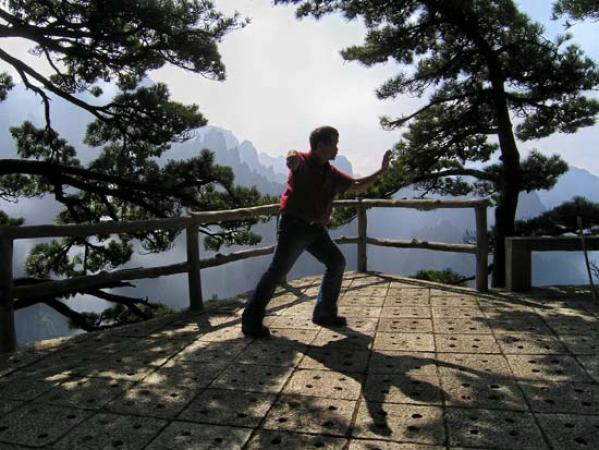
Keeping quiet and still and listening
Avoiding distractions from the senses or the mind
Allowing the body to settle down
If you need to breathe, make it soft and gentle like a tiny ripple on a lake.
If you are standing, plant your feet shoulder-width apart and straighten your back
and relax. You can do the same thing if you are sitting on the edge of a chair. Remember to slightly bring your chin down toward, but not touching, the manubrium. You may not be aware of it in the beginning, but this act stretches the cervical vertebrae and opens Governor Vessel 16/Fengfu and Governor Vessel 20/Baihui and Yintang/Esoteric Hall (3rd eye). Bring your hands down, palms either facing the outer thighs (to align the Laogong/Pericardium 8 to the Gallbladder/Wood meridian running down from the head to the feet) or the palms facing to the back (to feel what’s behind you). Put your tongue up to the hard upper palate or just behind the teeth to create what is indicated in the Neijing Tu as the Sacred Ground.
Many people ask, “Are there any techniques?” Yes, there are techniques. You can
do Tai chi chuan or 8 Precious Brocades or a series of Qigong or Daoyin movements. But you can reduce them to the most basic level like what is listed above. Just quiet down, close your eyes, and it helps if you feel grateful for who you are. There is always something special or even magical that happens when one feels a sense of gratitude for the blessings of life.
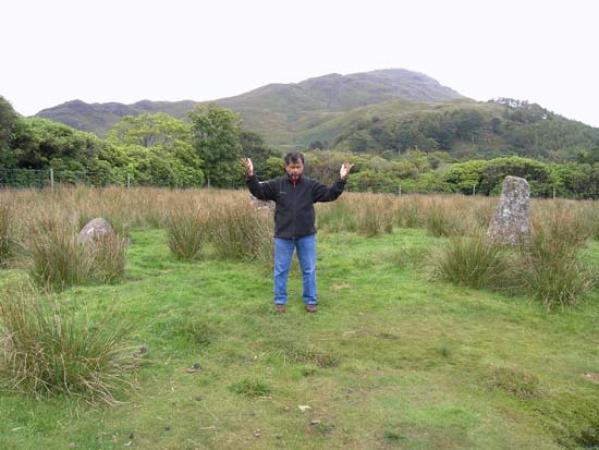
When one is positioned for standing or sitting meditation as described, one does not have to do anything else. Just keep to the bullet points above. It is that simple. You do not need to travel to the King’s Chamber in the Great Pyramid, or in Haleakala Volcano on Maui. You can just do it in your backyard or in your own living room. You do not need any extra equipment or any elaborate clothes. If it is necessary to focus, you can light incense or a candle or play a soft meditative music or breathe softly. But these can be distracting for some people. So find what you are most comfortable with.
You will possibly realize, as you practice more, there is a subtle activation of the Bai Hui/GV 20 at the top of the head, the Qi Hai/CV 6 and Shenque/CV 8 in the area of the belly, and the Yongquan/Kidney 1 at the bottom of the feet. These are 3 of the most prominent points in the body that are the easiest to activate. There is also the Laogong/PC 8, the power point of the palms. Often, the vibration of qi starts at the fingertips or Jing/Well points, collects at PC 8/Laogong and travels up the arms.
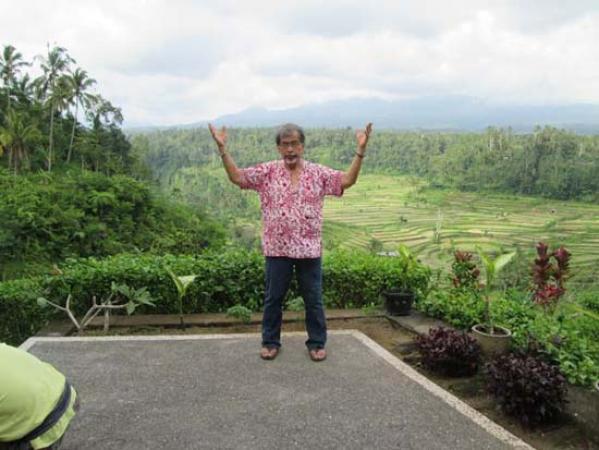
Blessings to you!
Stay in position for 30 minutes to an hour. It is usually difficult in the beginning to be still for more than 5 to 10 minutes. But with regular practice, you will start to feel comfortable doing it for longer and longer periods of time. You will also start to feel different experiences. The energy of the feet sinking into the ground, for instance. Or the Jing/Well points of the fingers feeling vibration or some meridians opening. The optimal experience is when the body itself seems to become transparent or porous as if its boundaries have dissolved. The whole body would seem to be “breathing” after a while. There is a sense of opening to the outside world. The body and the earth in incredible alignment and harmony: It is the path of stillness that is suggested in Chapter 16 of the Dao De Jing. At the end of your work – call it meditation, call it qigong, whatever name you may use – be sure to make a gesture of closing. Put your palms over and breathe into your navel. Imagine the energy collecting in your lower belly (often associated with the dantian/field of pills, qihai/sea of qi, navel center) and resting there in a sturdy container. A closure is necessary in a ritual so that you can connect again to the mundane, and return to the everyday world and time.
This essay was originally published as the feature article in Yang-Sheng Magazine, Vol. 3 #4, August – September 2013 issue.
show lessWhy Tai Chi Chuan?
By Rene J. Navarro, Dipl. Ac. (NCCAOM)
As far as I know, no single book or website has fully explained the many wonders of Tai chi chuan/Taijiquan. Many haven’t even come close. There are many possible reasons. Perhaps it is because the masters approach the art from one (or two) limited perspective, do not know (or did not learn) the art in its entirety or, because of the prevailing secrecy in the culture, have chosen to explain only one or two aspects of it. Perhaps also the public asks for lessons in Tai chi chuan only to learn the movements or as an exercise.
show moreOne problem is that “body and mind” are actually very limited and vague concepts. Moreover, the western body and mind are different from the eastern body and the eastern mind. “Xin” showing a heart in Chinese, is translated poorly as “body-mind”. There are many scholarly commentaries about this subject written by academicians. (Harold Oshima, “A Metaphorical Analysis of the Concept of Mind in the Zhuangzi,” Deborah Sommer, “Concepts of the Body in the Zhuangzi” in Experimental Essays on Zhuangzi edited by Victor Mair.)
One possible drawback is that Tai chi chuan has a different paradigm. If you are studying western medicine, you have the kind of body you are working on, there are the methods to address that body, you have the tools. Basically, the western approach to medicine is like the approach to a machine (the body). The eastern approach is more holistic: the eastern body is not just physical, it is energetic, spiritual and there are principles that govern its functions (qi, YinYang, Wu-Xing, meridian and organ system, the concepts of shen, prenatal and postnatal energetics, San Bao, polarities, neidan/internal alchemy, etc). These are two different paradigms, although western science is now beginning to adopt eastern premises and methods and vice versa. There are books explaining this difference (Ted Kaptchuk’s “The Web Without a Weaver” and Liu Yanchi’s “The Essential Book of Traditional Chinese Medicine”). Many people who practice Tai chi chuan do not even have half a comprehension of the profound and multi-faceted art they are dealing with. The public especially see it sometimes only as a slow exercise for old people in the park or for people with certain disabilities.
To work with an art, like acupuncture, herbalism, qigong and internal alchemy, or painting and sculpture, you have to understand what you are working with: your materials and instruments. If you areplaying the cello or the piano, you have to know the vocabularyof your instrument, its possibilities and techniques. If you were a poet, you would have words and rhythms and images, allusionsand conventions of the art.
The same is true of Tai chi chuan. In Tai chi chuan, you have as an instrument your body. It is your means of expression.
So what is the nature of your instrument? What are its potentials and possibilities? What can you do with it? What “music” can you play?
Let me list a few things that are the components of the body:
muscles,
tendons
bones and of course, the bone marrow
fluids and the blood
organs
mind and the heart
There are principles and concepts that govern it, among them:
qi/chi
yin and yang
5 elements
prenatal and postnatal energies
meridians and pathways.
3 Treasures – Jing, Qi and Shen
3 Cauldrons and 3 Burners
dantian or the hara, the Moving Qi Between the Kidneys (MQBK)
Tai chi chuan isn’t just movement, it isn’t just the physical body, it is your relationship to Tian/heaven, Di/Kun/Earth, the Dantian/Field of Pills, how you move the qi, how you make the bones and marrow “breathe.” You have to know the relationship of the different energy centers and points so that you can connect them in a pattern called Sacred Geometry, so that there is Gan Ying/Resonance. There are “points” in the body that connect to the external and internal world. The Bai Hui/GV 20 connects to Heaven, Hui Yin/CV 1 connects to the Earth, Stomach 25/Tian shu connects to the Big Dipper, etc.
You have to know what the Tai chi body is all about. That will show you the possibilities of the art. I started studying Yang Family Tai chi chuan in 1968 in the Philippines focusing on a form taught by Master Han Ching Tang of Taiwan but perhaps I began to see the other aspects about 20 years ago when I was in acupuncture school and was writing the books on the Enlightenment of Kan and Li/Water and Fire for Mantak Chia, grandmaster of the Universal Healing Tao. The paradigm is an essential step to understanding. This makes an important ingredient in our progress in Tai chi chuan.
One thing too that we have to remember is that the legendary founder of Tai chi chuan was Zang Sanfeng (Zang of the 3 Peaks). He was a monk in the Shaolin Temple in Loyang for 10 years, apparently studied Damo’s Yi Jin Jing/Tendon qigong and Bone marrow washing, part of the Lei Shan Dao/Thunder Path lineage. Zang wandered China studying with masters and finally settled on a peak on Wudangshan, the Daoist sacred mountain retreat. There he choreographed Tai chi chuan after seeing (or dreaming about) the fight between a Snake and a Crane (incorporating the dialectic of yin and yang). Some of the transmissions of Damo have survived and are being taught. But I suspect that there are valuable pieces that have been kept secret by the masters, some of them the hermits I met in Huangshan and the Magus of Java and others.
Tai chi chuan is therefore not just the slow dance the old Chinese do in the parks in the morning. It has many aspects. There are also other forms — Knife/Dao, Spear/Mao, Staff/bang/gan, Sword/Jian, Chang chuan, etc. — that many masters do not even know. I studied them with GM Gin Soon Chu, second disciple of GM Yang SauCheung, in Boston for at least 10 years. I am still studying them.
All of what I have mentioned will come into play later, if you have the passion for the art. The question that comes to mind is, How do you activate or trigger some of these body parts? For instance, the meridian jing-well points or the yin-yang in its many aspects? How do you work with the bones and the bone marrow? How do you build the dantian, the elixir field? How do you develop fa jing/discharge of jing in its 34 or 35 transmutation?
Finally, we have to understand that what we are doing is not just an exercise, although it is good as an exercise. What we are doing is not just martial arts, although martial arts is good. What we are doing is not just movement, meditation, qigong, dance, alchemy, although Taichi is all that. We have to see the perspective of its mythology, its archetypical aspect, and our place in the history of the art. Tai chi chuan came from different legendary sources – shamanism: our connection to heaven and God or the gods and goddesses; eschatological: our relationship to ultimate issues; our body asa part of the universe, as a link in the continuum of energy/qi. Asbelow, so above; as above, so below. There is no separation or disconnect between us and the environment. In the modern world,we seem to have lost this key. We treat nature and the earth as alien or, at best, something to be dominated and exploited. We treat our bodies only in the physical and material level.
We have to take Tai chi as a form of worship, a ritual of reconnection to our origins and to the divine. We need something like it to bring back the sacred in our lives. The name has been translated into English as “Grand Ultimate Fist” which indicates its depth, magnitude and power. The pinyin transliteration is Tai which means great, Ji which means the extreme (different from chi/qi or lifeforce) and Quan or fist. If you look at the characters, especially of the first two, you’ll see that the English translation is inadequate.
There is really nothing like the actual practice of Tai chi chuan to feel its effects. No explanation can capture the bliss and the power generated in the course of a long workout. Words, as the eastern expression puts it, are just the finger pointing at the moon.
Some books give a suggestion of the wonders of Tai chi, its effects on body and mind. Vincent Chu, my teacher and the son of my master GM Gin Soon Chu, has written a couple of books (I edited both and wrote the introduction to the first) and issued a few DVDs on Traditional Yang Family Tai chi chuan. My website www.renenavarro.org has essays about Traditional Yang Family Tai chi chuan curriculum, Tai chi chuan Chang Chuan and the Sword. You can also go to these websites: www.gstaichi.org and www.nytaichi.com
Book Review: Ultimate Journey: Retracing the Path of an Ancient Buddhist Monk Who Crossed Asia in Search of Enlightenment by Richard Bernstein
New York: Knopf, 2001
Hardcover, 352 pages
$26.00 US; $40.00 Canada
By Rene J. Navarro
When we reach a certain age, there sometimes comes a desire to do something special and challenging. Perhaps, study a language, settle down and have children, build a center, go on a long retreat in the mountains. In the case of Richard Bernstein, New York Times book critic, it was to build Shaker furniture and to take a trip duplicating the journey of the famous Chinese monk Xuan Zang/Hsuan Tsang (603-664 CE) who was the patriarch in the famous epic “Journey to the West.”
show more
It is a pagoda tree that curls like a green dragon. Located in front of the Giant Wild Goose
Pagoda in Xian. Green is Spring and Dragon.
He says, “My yearning to get away derived from the banal conviction that I had crossed the bourn of fifty, and that some of the things I had promised myself I would do would remain undone if I didn’t do them quickly. Along with that conviction came the dread thought that this was it, my life, this and nothing more, until the end, which suddenly seemed less hypothetical than it did when I was less than fifty.”
Hsuan Tsang’s journey, traced across the maps of China, India, Pakistan, Afghanistan, took a daunting route. In search of the Truth — or Bliss or Happiness or Immortality, whatever we may call it — that would free humanity from cycle of life and death, the monk set out to find it in India. Against the Emperor’s orders that sealed the borders of China, he took a 17-year journey across dangerous passes and mountains. He did not know the route but went in a general direction and, to hide from the authorities, he assumed disguises and took labyrinthine passages, often at night.
Monk Hsuan speaks of his goals in the third person and then in the first: “Hsuan Tsang owing to his former deserts was privileged at an early date to adopt the religious life, and till he had completed about twenty years, received instruction from his masters…. His hand never ceased to examine the different Sacred Books, but notwithstanding all his pains he was never free from doubts, until, wearied with his perplexities, he longed to go wend his way to the monastery of the Jetavana (the garden in India where monarchs presented gifts to the Buddha) and to bend his steps to the Vulture Peak (the hill where the first Buddhist congress was held) that he might there pay his adoration and be satisfied as to his difficulties….No anxiety will afflict me lest I should be too late to pay my reverence at the spots where stand the heavenly ladder and the tree of wisdom…. And after questioning the different masters and receiving from their mouths the explanation of the true doctrine, I shall return to my own country and there translate the books I have obtained. Thus shall be spread abroad a knowledge of unknown doctrines; I shall unravel the tangle of error and destroy the misleading influences of false teaching. I shall repair the deficiencies of the bequeathed doctrine of Buddha, and fix the aim of the mysterious teachings of the schools.”
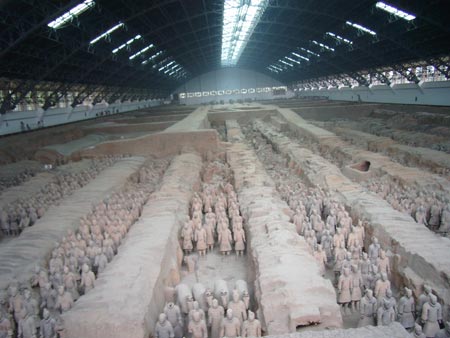
The terra cotta warriors of Qin Shihuang Di, the First Emperor of China, in Xian (formerly
Chang’an, the ancient capital of China). Maurice Cotterell, an author famous for his books
on the pyramids of Egypt and Mexico, wrote an interesting book about them explaining the
meaning of the different armors, weapons, postures and hand positions.
For those who have read the book “Journey to the West” and seen the movie “Monkey,” Hsuan’s Road of Great Events became the “Ultimate Journey.”
For Richard Bernstein, NY Times book critic, and former bureau chief of Time magazine in Beijing, learning the story first as a student at Harvard and then as correspondent in China, the idea for this difficult travel must have crystallized over the years, finally becoming an obsession when he reached 50.
I can sympathize with him, since in my early 40s, I had fantasies about studying Chinese culture fulltime — Tai chi chuan, acupuncture, herbology and the language. Indeed it was in 1989 I made that leap by moving from Pennsylvania to Boston to study at the New England School of Acupuncture and Yang Family tai chi chuan at the Gin Soon Tai Chi Club.
Bernstein says, ” What appealed to me about woodworking was what I imagined to be the tranquility
of it, the concentration on the physical object — very different from the sedentary mental work that now occupied my professional days. But I knew that what I really wanted was another experience of foreign climes and distant shores, perhaps my last such experience. To reproduce Hsuan Tsang’s journey, and to write my own version of his Chronicles, represented an opportunity for me to turn the clock back on myself, to recapture some of the freshness of my earlier years when, anxious and ambitious, I was just starting out. There was nostalgia in this, but there was also a test, a kind of dare that I could fulfill a promise I made to myself, that I would never, even when I got older, get so settled that unusual adventure would become impossible. Not believing in reincarnation, believing that this is the only time I will exist on the planet, I wanted to go.”
Bernstein had the time and the money to fulfill his fantasy journey. But he was anathema to the Chinese government for writing about US-China relations. Predictably, his application for a visa was denied. Like many travelers to China, he knew other creative ways of circumventing red tape — by applying through a Hongkong travel agency.
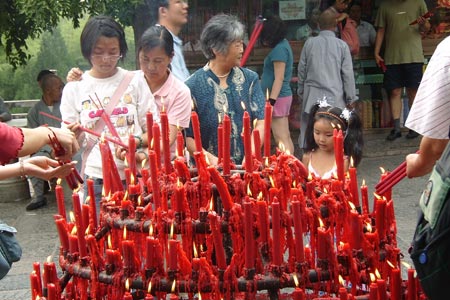
The brass urn is for pilgrims who offer red candles at the door of the temple in the
Giant Wild Goose Pagoda. Note that there are no white candles because white represents
grief and death and Autumn in the repertoire of colors. Red stands for royalty and empire
and celebration in the system of Chinese correspondences.
The story picks up from there. His narration follows his itinerary superimposed on Hsuan Tsang’s 629 CE travel.
It is an exciting book to read as much for the adventures, sometimes reaching seeming dead-ends, sometimes verging on dangerous side routes, as for the explication of Buddhist scriptures. Bernstein thoughtfully highlights philosophical discussions on the scriptures, draws wonderful cameos of people he meets, reflects on historic events and details, and shares relevant poetry, such as this one from the Tang dynasty:
Pear blossoms pale white, willows deep green,
When willow fluff scatters, falling petals will fill the town.
Snowy boughs by the eastern palisade set me pondering–
In a lifetime, how many springs do we see?
There is likewise, like a continuing and soft leitmotif, a romance with Zhong mei Li, a classical Chinese dancer he met at a film society event in New York city, who joined him at certain points in the journey and whom he later married.
Bernstein writes quite well. He is not as felicitous as James Hamilton Paterson (“Playing with Water”), the poet and fictionist, or Pico Iyer (“Video Nights in Kathmandu”), the novelist and journalist, but he succeeds in telling his experiences with candor and insight. There are maps of the different places he visited, indications of where he took a plane or a bus, preceding each chapter.
The book is an education in itself, about contemporary politics, ancient history, human nature, philosophical arguments, geography, and literature. It is a satisfying reading.
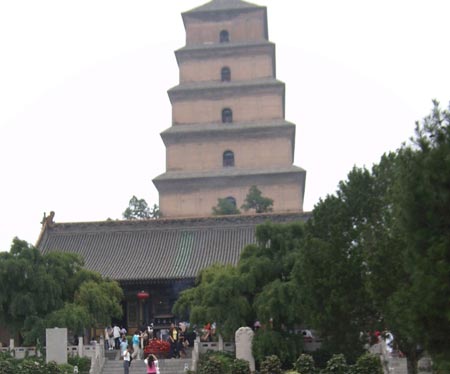
The Giant Wild Goose Pagoda. It was built in honor of Xuan Zang, the 7th century monk,who traveled to India to secure copies of the Buddhist scriptures from India. It was a16-year journey that Richard Bernstein tried to duplicate om his 50th birthday. Thepagoda houses the Buddhist scriptures. It is yellow, the color that suggests Earth, theCenter, and Balance. I took a few other photos, one of them the statue of Zuan Zang,but I cannot find them.
But there’s one disappointment I have. It is ultimately his failure to grasp the essence of the Eastern contemplative discipline and healing practice. One attempt to practice meditation ended in failure. It was quite a simple technique really, just focusing on the breath (and of course the dan-tian, the elixir field), the inhalation and exhalation, and counting. He could not make a go of it, and got distracted by images of the sanitary conditions in the community. Needless to say, it was a ridiculous effort, predictably half-hearted, and from what I have often observed, a very western phenomenon.
I wrote him a letter c/o the NY Times, in May 2001. He has not answered it. I think this e-mail letter captures the central theme of the book, the heart of what he was searching for but did not find because he was looking in the wrong places.
____________
Richard Bernstein
NY Times Book Review
Dear Mr. Bernstein:
I have just read your wonderful book, The Ultimate Journey. It is one of the best travel books I have read in a long time. You’ve skillfully brought together the travelogue, philosophical discourse, romance, adventure, and mystical quest in one volume. Thank you for giving me many hours of joy as I followed the trajectory of your journey and the monk’s.
May I call your attention to just two passages that, I think, point to a common misunderstanding of the East:
….Hsuan Tsang “wanted to reach a level of consciousness so high that it transcended the normal categories of human understanding — and at the same time, having achieved it, no longer to experience the desire that propelled him on his long and arduous journey in the first place. Is it possible? Did he do it? I doubt it. But then again, since I didn’t attempt to replicate that part of Hsuan Tsang’s journey — the part involving disciplined meditation and study — how could I know? Maybe he did realize his purpose and detach himself from it at the same time. As for me, I continue to read here and there in the Buddhist texts looking for the Truth that cannot be expressed in words…. p. 244
… I also believe… that there is a limit to the extent to which you can mold the specifics of your life, that there is no escape, not into the manufacture of Shaker furniture nor into the excitement of travel. The Truth, the Enlightenment, that Hsuan Tsang searched for in his seventeen years on the road was a philosophical one. I had pondered it, and though the Truth that I arrived at in my journey of several months was more pedestrian than his, yet to me it was just as valuable. It was that you do have to go home, home in all senses of that word — to a job, to the dross of routine, to time-consuming responsibilities and obligations, to aches and pains, to the hell that other people make for you sometimes. The truth is the existential one that therein, confronting the mortal realities, is where meaning and wisdom lie…. p. 335
No offense meant, but I have often wondered how somebody without any experience in “disciplined meditation and study” can ever understand the “Truth that cannot be expressed in words,” when they, especially the intellectuals, academicians, and philosophers, look for the unutterably profound experience of the east in passages from the scriptures. Aren’t the words the proverbial finger pointing at the moon? They are the yin of philosophy. We still need the yang of practice, the years or decades of “sitting quietly, doing nothing,” the mondos or dialogs, or the chanting of sutras and mantras to attain satori or enlightenment. Somebody can look and look at the sacred texts and he’ll probably not find what he is looking for. The “bliss” that searchers look for comes from within, from the stillness that a combination of the breath, alignment of the body, earth and heaven, concentrated focus, and sound may bring about, if you are lucky to be blessed with that magical moment. Often, as the sages tell us, enlightenment comes without effort, after years of patient waiting, when we are not looking.
I am not a Buddhist but I have done some of the meditative practices of the east (I consider myself a Taoist). From my experience, in deep meditation, qigong, martial arts, internal alchemy, or Tao-Yin, the expression “From words to images to silence” holds true.
I humbly submit that there must indeed be something beyond a humdrum job and routine, the cynicism of the rational mind, the hellish garbage that we encounter in daily life, the Sisyphean struggle of modern man. Many people who practice eastern healing and contemplative arts have seen that “something” even while they live in cities, even while they keep that 9 to 5 job, even while they live in the West. But it is essential to sit down, get the technique right, attain stillness of the self, achieve detachment from the chaotic world, and wait.
Again, thank you for your wonderful book. I wish I had taken the journey with you and Zhongmei Li.
Sincerely,
Rene J. Navarro
_________________
Ironically, the epigraph (from poet Constantine Cavafy, Nobel laureate in literature) of the book says: No ship will ever take you away from yourself.
Rizal: Zen Life, Zen Death
By Rene J. Navarro
Celebrating a Hero’s Sesquicentennial Birth Anniversary
This year is the 150th birth anniversary of Dr. Jose Rizal, the national hero of the Philippines, who was born on June 19, 1861. I thought it would be appropriate to post this essay in the website to shed light on an aspect of the hero’s life and genius.
show moreThis essay was first published in the Philippine News in San Francisco some 30 years ago. When Dr. Alejandro Roces, a famous journalist in the Philippines,read it at LaMama ETC, NY in 1980, he thought it should be published in the Philippines. He was giving lectures on Philippine culture and I was teaching arnis/Philippine stickfighting and appearing in director Cecille Guidote Alvarez’s Philippine Educational Theatre Arts League productions. We were part of the anti-Marcos campaign. I was told that the essay was published in “Malaya” (“Free” or “Freedom”) magazine, in Manila, but reportedly copies of the magazine that carried it did not reach the readers in the Philippines because the publication’s office was raided and closed by the Marcos government for alleged subversive activities.When the author went home for the celebrations of the February Revolution in1986 (see “February 1986” in the Writings section), Dr. Alejandro Roces read the article again and decided to publish it in the Manila Times Sunday magazine onthe anniversary of Jose Rizal’s death on December 30, 1986. This essay was also published in the Rapid Journal edited by Daniel Go of Manila and in the book “Arnis: Reflections on the History and Development of Philippine Martial Arts” edited by Mark Wiley under the Tuttle imprint (2001).
When I googled different Philippine martial arts websites, I noticed that my essay has been published by them without my permission.
There are many translations of Jose Rizal’s valedictory poem. The translation by Nick Joaquin, National Artist of the Philippines, is arguably the best in English. The National Historical Commission, Department of Education, Culture and Sports, Republic of the Philippines, has collected at least 100 of them in 2 volumes, some in Chinese, French, German, Hebrew, Hawaiian, Hungarian, Japanese, Behasa Indonesia, Greek, Romanian, Turkish, Russian, Latin, Korean, Sanskrit, Dutch, Maori, Bengali, Vietnamese, and many other languages.
Jose Rizal was a painter, sculptor, novelist, poet, patriot, musician and composer, anthropologist, polyglot, medical doctor, martial artist, martyr and genius. His novels “Noli Me Tangere” and “El Filibusterismo,” both written in Spanish, and described as anti-clerical and revolutionary, portrayed the conditions in thePhilippines during the Spanish era, but they are as relevant today as they were when they were written. He paid the highest price: he was tried and executed for them.
I do not know of anybody anywhere in the world like Jose Rizal.
Brief Note:
Jose P. Rizal was born in 1861 when the Philippines was a colony of Spain. He studied at the Ateneo de Manila and University of Santo Tomas. Due to his desire to further his education and the apprehension of his relatives that he would go to jail if he remained in the Philippines, he left for Europe and studied in Spain at the Universidad Central de Madrid. He spent some time in Germany (Heidelberg and Berlin), England, and France. He wrote 2 gothic novels — Noli me Tangere and El Filibusterismo — which were considered subversive by the Spanish authorities. He was also a doctor, a poet, painter, m.usician, a polyglot (he spoke or understood about 24 languages, including Greek, French, German, Latin and English), essayist, and martial artist. Because of his novels, he was banished to Dapitan in Southern Philippines. When the Philippine Revolution exploded in 1896, he was accused of being its instigator, subsequently tried unjustly by a biased tribunal and died a martyr’s death by musketry in Bagumbayan (now the Luneta). Before he died, he wrote his immortal valedictory poem which is now a classic in Spanish literature. He is one of the national heroes of the Philippines.
“My hands are shaking because I have just had a fencing bout; you know I want to be a swordsman.” Jose Rizal, age 18, to Enrique Lete, 27 November 1879.
EMERGING FROM THE DOJO where he had been studying jujitsu, Jose Rizal found the crisp air scented with flowers. It was the Spring of 1888 in Meiji era Japan. The landscape had suddenly been transformed from dead winter to a lively panorama of flowers everywhere. Beyond was Mount Fuji, snow-capped and majestic.
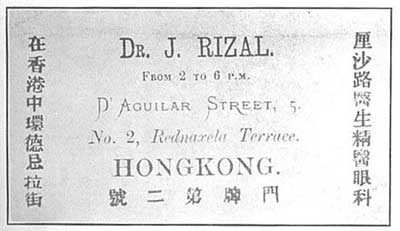
Dr. Rizal’s business card in Hong Kong.
He wandered all over Tokyo, seeing Kabuki and Noh plays, journeying past a Ginza starting to burgeon with emporiums and bazaars, past squat houses “walls made of paper,” to the temples and shrines of Kyoto and Nara and the Daibutsu at Kamakura, hiking through parks and gardens, listening to street bands, visiting museums and libraries, sometimes alone and sometimes with his dear friend, O-Sei-San, and always, his heart was agitated when he saw something new and exotic, and in Springtime, Japan was a tourist’s haven, with its rituals out of ancient lore.
The cherry blossoms had burst into white and pink amid the bright colors of Spring. As the storks keened overhead, the blooms touched with raindrops radiated with limpid softness in the sun. Immortalized in painting, music and poetry, brooded over by samurai and zen monks, who saw in the flower the symbol of life’s fragility, the sakura dominated the Spring festivals.
To the mountain village, this spring eve,
I come and listen to the monastery bell,
Watching the cherries in bloom,
And petals softly falling.
–Noin (10th century)
Rizal felt his body stirring as he walked the strange streets.
He had read the haiku and waka, in original Japanese, had admired the sumiye paintings (those spontaneous, unplanned and thoroughly intuitive sketches), heard the strains of the koto and samisen lamenting the fate of the sakura, and in the jujitsu academy he had heard of the meaning of the Spring rites. Like the sakura, the warrior’s death must be as glorious as his life. The samurai must live every moment intensely because death hovers perpetually over his head. Death and life both must be faced with stoic indifference.
Rizal sketched scenery and flowers and common folk in the zen way of sumiye, which he had started to learn from O-Sei-San.
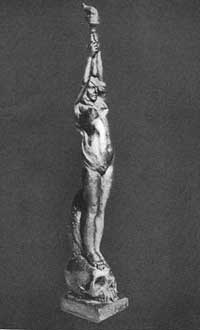
Sculpture by Rizal, a student:
“The Power of Science over Death”
With his background, Rizal must have reminded O-Sei-San of the ideal of bunburyudo, the combination of artistic and martial virtues a samurai aspired to, as exemplified by Miyamoto Musashi, famous swordsman, painter and poet of feudal Japan, and author of the military classic, The Book of Five Rings.
Indeed Rizal had the characteristics of a true warrior: he had a lifetime commitment to martial arts, an obsession with death, a contemplative mind, an intense involvement with life and nature, a spartan character and a great sense of loyalty and justice.
Icarus by Oillight
He had a difficult birth. His mother vowed to take him on a pilgrimage to the shrine of Our Lady of Peace and Safe Voyage in Antipolo as a gesture of gratitude. It was thought by the family that Rizal would die.
Death was to haunt him all his life. From childhood he had anxious premonitions and dreams of disaster. He recalled the story of the moth: “I looked toward the light and fixed my gaze on the moths which were circling it…The flame rolled its golden tongue to one side and a moth which this movement singed fell into the oil, fluttered for a time and then became silent…All my attention was fixed on the fate of the insect. I watched it with my whole soul…It had died a martyr to its illusions.”
In Madrid, Spain, he wrote a passage which prefigured his end. “Night. I don’t know what vague melancholy, an indefinable loneliness, smothers my soul…Two nights ago, that is 30 December, I had a frightful nightmare when I almost died. I dreamed that, imitating an actor dying on the stage, I felt vividly that my breath was failing and I was rapidly losing my strength. Then my vision became dim and dense darkness enveloped me — they were pangs of death.”
Separation, celebrations, ruins, even the landscape evoked death. Again from Madrid: “The trees are shedding their pompous dresses and converted into dry skeletons, complete the sadness of foggy days. A fine rain, an even finer wind, horrible, freezing, comes from the Guaderrama… a thick mist that wraps all objects with its whitish veil giving them a particular aspect and expression are the tones and lines of this penultimate month of the year, the simple notes of its funeral song intoned to the death of nature.” Madrid in 1985, when I visited, was exactly as Rizal described it.
Lifetime of Discipline
Like Yukio Mishima, Rizal was born a frail, sickly child. To compensate for his small size, he devoted himself to a regimen of exercise and body-building. He had a private pastime he called “higante” (giant), in which he would stand on tiptoe and stretch his body, legs and arms. He studied arnis de mano (stickfighting), dumog (wrestling), suntukan (boxing) and fencing (foil and rapier), which became lifelong disciplines to him.
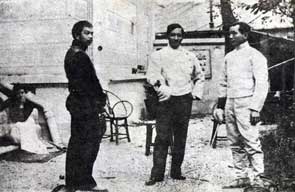
Jose Rizal in the middle with Juan Luna and Valentin Ventura.
Even in Europe, he pursued his martial arts interests with almost fanatical zeal, despite illness and near-starvation. In Spain he continued his study of fencing at the famous school of Sala de Armas y Carbonell. He spent afternoons fencing with Nelly Boustead, Juan Luna and Valentin Ventura.
Believe it or not, Rizal also pumped iron a la Arnold Swarzenegger. Dr. Maximo Viola remembered Rizal had boasted to the members of a gym in Berlin, Germany, that he would beat their strongest man within two weeks. At this time he had been forced to turn vegetarian due to persistent lack of funds. Said Dr. Viola: “to triumph in his desire he tried lifting great weights under an unaccustomed diet.” Although the smallest in the gym, Rizal did succeed in vindicating himself.
A contemporary in Madrid described Rizal: “He was then in his thirty-first year. The first impression one hade of him was of wholesome vigor and physical well-being. He was rather slender of build, but all muscle and sinew, compact, for he never remitted in his exercise.”
De Cadena
There is no record of the style of arnis Rizal studied. However, from his uncle he may have learned the prevailing system of stickfighting in the Tagalog region called pananandata or escrima.
Arnis de mano figured prominently in his college life, when he was called upon to use it against Spaniards who called his countrymen “chonggo” or monkey. (Filipinos paid in kind by calling the Spaniards “bangus” or milkfish.) Indeed there were frequent encounters between the two groups. Rizal became something of a street lord of a campus gang, ready to face a whole pack, one at a time.
Unfortunately, at one such encounter, he was deserted by the members of his gang called “Companerisimo” (Comradeship) and was pounced upon by a contingent of about twelve and was left bleeding and nearly unconscious in the street. Taken home, his wounds — and pride — were nursed by his beloved Leonor Rivera. Needless to say, he must have had some mushy entries in his diary that day.
The whole scene could have been a page from West Side Story, with the Jets on one side and the Sharks on the other, and a radiant Maria nervously waiting to minister to her favorite warrior.
Rizal was, however, not a hot-headed ringleader whose temper exceeded his prowess but a real expert. On one occasion, he and the best excrimador in Calamba, Laguna, his hometown, had a bout. Rizal was hit on the forehead. Requesting a return match two weeks later, he underwent a thorough preparation and won.
To reach that stage where he could defeat the town’s master practitioner, Rizal must have had tremendous speed, technique and calculation. He must have learned to link his techniques fluidly, without interruption, so that they became in the jargon of the art, de cadena, an unbroken concatenation of attacks, parries, feints and defenses, which left the opponent no breathing space. It is difficult for a lay person or an intellectual to understand this stage of mastery that is often described as mystical. The intense focus, countless repetitions, and the total concentration of body, mind and spirit bring the practitioner to a superhuman level of performance that is beyond words.
Mister Cool
Rizal became master of the foil, saber and duelling sword, and acquired a legendary reputation for grace and technique.
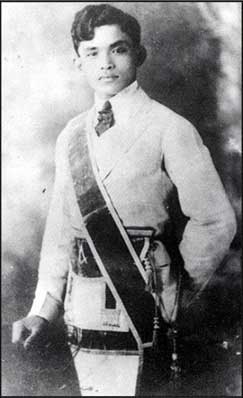
Rizal, a Master Mason on November 15,
1890 at Logia Solidaridad 53 in Madrid, Spain.
He also became an expert marksman. Witnesses from the period say that Rizal could shoot through the mouth of a bottle and put a hole through the bottom without breaking the bottle itself. From twenty-five yards, “he could pick the circles (‘oros’) of a gambling card.” Like many of today’s martial artists, Rizal could not resist showing off. He mailed a target board full of holes to Valentin Ventura, himself an expert shooter and fencer, who predictably wrote that he was impressed. Writing to Antonio Luna, Rizal said, “I am sending you a target containing ten bullet holes, it was seven and a half meters from me.” Then, he added in mock humility it seems to me, “I shoot slowly, but with perseverance I shall become a fair shot.”
Ironically, sometime later, the tipsy Luna made some reportedly unsavory remarks about Nelly Boustead. Something like “baka ang Noli mo maging Nelly.” (Perhaps, your Noli will become Nelly.) It was a cutting pun and Rizal took umbrage and challenged Luna to a duel. Nothing came of it though because Luna, now sober, apologized. I wonder if he was somehow intimidated by the reputation of Rizal.
Biographer Pedro A. Gagelonia surmised, “had the duel prospered, Rizal’s fate would have been jeopardized. It was a fact that he was probably better in the use of pistols than Luna but the latter was a better swordsman. In duels, the challenged party had the option of weapons, hence, Luna, logically, would have chosen the sword.” This was the consensus of the Filipino exiles in Europe, too, but Rizal had a different view:”Luna is a nervous and impulsive temperament. I am cool and composed. The chances are he would not have hit me, while I could have hit him at will, but certainly would not have killed him.”
Here, Rizal pointed a finger at three bushido (samurai) principles. First, know your enemy and exploit his weaknesses (Sun-Tzu). Second, avoid unneccesary killing. And three, strive for serenity. Rizal’s suggestion was, swordplay demands not just technical proficiency but also psychological balance. He used the words “cool and composed” which in martial arts mean a mind in repose. Like Sekiun and Takuan, Japanese masters of swordsmanship, Rizal emphasized the psychological against the merely technical.
Rizal: Warrior
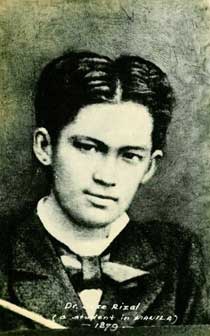
Rizal, a student at the
University of Santo Tomas, 1879.
Rizal’s martial qualities have understandably been eclipsed by his other accomplishments. Yet when he died, he had behind him at least 25 years of experience in the native regimen of arnis de mano, suntukan and dumog; 20 years in fencing and weightlifting; about 15 years in marksmanship.
It is hard for the general population to understand the kind of physical, mental and emotional peak a martial artist like Rizal achieves. When an escrima master goes through a pattern, his whole being is behind every movement, every stroke. Totally centered, he focuses all his faculties into that single strike. A master marksman reaches the same intensity. He blots out everything, including himself and his ego, and becomes one with the target.
Fighting with a master is a different plateau altogether. How to respond to an attack, which may be real or feigned, demands tremendous coordination of eye and body. When a stick is whipped, it travels about 150 miles per hour. At close range, this acceleration takes only a split second from inception to impact. A defender has to react instantaneously to avoid, divert or stop the blow. There isn’t much time to decide what specific technique the defender must employ — only his instinct, sharpened by training, can help him with a precise and, hopefully, appropriate answer — or else. Within that almost infinitesimal span of time, the martial artist determines different coordinates — the distance, position, direction not only of his body, legs and arms but also his opponent’s, and moves accordingly. How much more complicated it becomes when one considers that the forces constantly shift. And then again, what does one do in the face of a synchronized multiple attack?
The expert acquires a skill so spontaneous it’s like second-nature. S/He moves without hesitation. Neither fear of death or injury nor extraneous thought must intrude into his mind. He becomes, after years of discipline, a person who’s centered, one who has broken through the dualism of nature and the contradiction of body and mind.
It is not an easy passage to that level of expertise often described as mystical. A student has to endure pain and loneliness until body, mind and reflexes respond mechanically, until the weapon becomes a mere extension of the hand, until finally the discipline becomes “artless art.”
Back to Bothoan
Rizal lamented the loss of the ancient martial heritage. Said Rizal: “The ancient Filipinos had army and navy with artillery and other implements of warfare. Their prized krises and kampilans for their magnificent temper are worthy of admiration and some of them are richly damascened. Their coats of mail and helmets, of which there are specimens in various European museums, attest to their great achievement in this industry.”
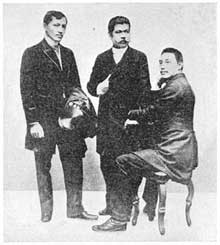
Jose Rizal, Marcelo del Pilar and
Mariano Ponce.
The ancient barangays had a martial arts culture. With the coming of the Spaniards and Roman Catholicism, it was slowly decimated. When weaponry was banned by the Spaniards, the Filipinos gradually forgot their ancient martial prowess and discipline. They began to adopt the new western culture and religion of the foreigners. Their values changed, too. A different tradition of piety, submission, class and status became incorporated into the native consciousness and behavior. By the time of Rizal, Filipinos in the colonized areas had been reduced to using sticks instead of the deadly kali weapons and the schools sometimes called bothoan, where the art of war, the techniques of weaponry, herbal medicine and assorted expertise were taught, had become a mere footnote in Morga’s Sucesos.
As if to remedy the situation, Rizal organized martial arts groups for Filipinos. Rizal’s public gym in Calamba (circa 1887) combined classes in wrestling, weightlifting, fencing, marksmanship and arnis de mano. It was probably the first integrated martial arts club in the country. He also proposed the inclusion of martial arts in school curricula. When he was exiled to Dapitan in Mindanao, he taught arnis de mano to his students as well.
Of course it is difficult to visualize Rizal, the intellectual giant, the renaissance man, as the resident sensei of a local dojo or even as an oriental guru but he did teach martial arts to Filipinos of his time, and not for divertissement and sublimation it seems. I suspect he also dreamed of resurrecting an ancient tradition — that of the Filipino as a warrior.
War in Miniature
No doubt his martial arts training taught Rizal the principles of war. As it is understood by martial arts teachers, sparring — with fists or weapons — is actually war in miniature. As on a battlefield, two adversaries size up eath other, using spies to study each other’s weaknesses, making strategies for victory, considering variables of combat such as speed, strength, size, technique, terrain, distance and timing. Like it or not, a practitioner who goes through the routine daily, as Rizal must have done, would develop certain reflexes and as important, an awareness of principles of combat which negate mere size.
The popular belief that a martial artist rushes into battle, without thought or preparation, certainly has no foundation in fact. An escrima student learns how and when to attack, to ascertain and exploit the vulnerabilities of his opponent, to create a beat (“kumpas”) by which he hypnotizes his foe, to distance himself through footwork and body weaving (“indayog ng katawan”), to create illusions of speed and height, to set traps and ambushes, to wait for his adversary to make a mistake and to initiate the action. He is taught not to be foolhardy or impulsive or temperamental. He must consider all elements, including his own resources and his opponent’s strategy, to win.
Requisites of Revolution
Like Sun-Tzu before him, Rizal believed that, “prudence and not valor is the first necessary quality of a general.”
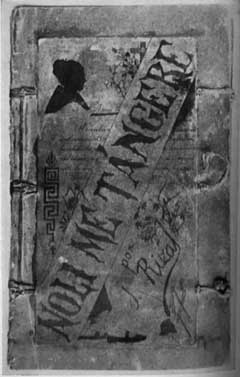
Photograph of the original of Jose Rizal’s
incendiary novel ‘Noli Me Tangere.”
Preparation, allies, timing, discipline — these were, to him , the prerequisites of a successful revolution. It bothered him no end that the Filipinos had inadequate weapons. He considered how long the logistics would last. Making contact with a Japanese minister who offered three merchant ships to ferry arms and ammunitions, he tried to borrow money for the venture but was rejected by a prominent Filipino.
Not the least of his concerns was, who would lead the rebels on the battlefield? He had met but did not know Andres Bonifacio. He dreamed that the noble Elias, the model hero in his novel, would lead the Revolution. He settled for Antonio Luna — yes, the hot-headed Luna — to “direct the campaigns in case hostilities broke out.” Rizal himself had sketched plans for fortifications in his travels; in fact he had written notes on military parapets with diagrams.
It is interesting to speculate what would have happened if a man like Rzal, trained in weaponry, a martial artist par excellence, had led the Revolution of 1896. He had rightly perceived the configuration of Asia, with Japan as the ascendant power and America lurking in the wings; had understood the weakened position of Spain in the face of the Cuban revolution and had correctly analyzed the role of the rich and the military in the struggle. Moreover, he appreciated the role of the masses, of materiel and of strategy in revolution, not to mention the need for unity and discipline.
A tantalizing speculation it is to cast Rizal into the role of a field marshal. However.
Strategy of Revolution
In his famous dialogue with Dr. Pio Valenzuela, Andres Bonifacio’s personal emissary from the Katipunan, the revolutionary society of the 1890s, Rizal expressed his desire to secure more weapons for the Filipinos before the Spaniards got wind of the revolutionary underground, was willing to lead the revolution and, apparently to augment his military knowledge, was intending to go to Cuba to observe military tactics, “to study war in a practical way, to go through the Cuban soldiery if I find something that would help remedy the bad situation in our country.”
Said Rizal,”I will never lead a disorderly revolution and one which has no probability of success because I do not want to burden my conscience with an imprudent and useless spilling of blood; but whoever leads a revolution in the Philippines will have me at his side.” In short, Rizal wanted a strategic approach, a revolution by maneuver and tactic, a position that is consistent with his lifetime training as a martial artist.
Zen Death
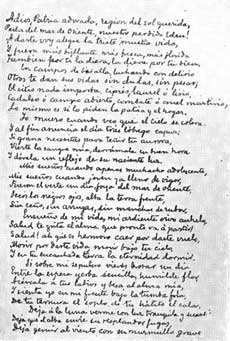
Photograph Of “Adios Patria, Adorada,”
Jose Rizal’s Valedictory Poem.
There are many explanations for why Rizal died cool and composed. It is said he had a clear conscience, he was at peace with God, or he was a patriot who was eager to die for his people.
I agree, but I like to believe also that it was his lifelong practice of the martial arts that gave him that feral nerve. Wielding a sword against an adversary or aiming a pistol at a taget, he had to steel himself, empty his mind, achieve egolessness and surmount the merely physical aspect of survival. He had spent years to attain what the Japanese call mushin no shin (“mind of no-mind”), that pinpoint concentration where intuition and reflex both responded instantly, without hesitation, where body and mind and spirit became one in the sword or the gun.
While the world tumbled about him, the gentle warrior went about his business of writing notes, saying goodbye, leaving legacies to his heirs, putting his affairs in order. As if nothing affected him. Even his request that he be shot infront or his incredible gesture of twisting around so that he would fall facing the Philippine sky evoked the grandeur or that idee fixe which, perhaps, only the warriors and samurai could have mustered.
Rizal wrote his immortal poem just before he died. Perhaps it’s no coincidence that before their death, the samurai of Japan wrote poetry, jisei, a kind of “parting-with-life-verse” in the words of D.T. Suzuki characterized by what is known as furyu, an appreciation of nature amid tragedy and annihilation.
It was perhaps no coincidence either that Rizal died the eternal stoic, pulse normal, eyes alive to the beauty of the dawn, mind lucid and rational. It was a beautiful death, an exit without regrets, a samurai would have been proud of it.
Here was a man. A genius who, at 35, had accomplished bunburyudo, the martial artist’s ideal exemplified by Musashi Miyamoto. Now, he faced martyrdom, the unconditional endorsement through death of his beliefs.
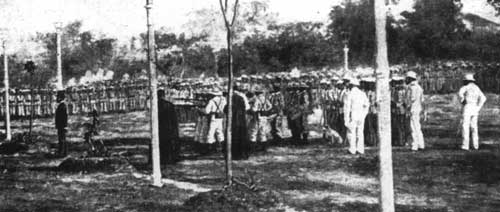
As shots rent the morning at Bagumbayan on December 30, 1896, he twisted his body and fell facing the sky.
For the samurai to learn
There’s one thing only,
One last thing —
To face death unflinchingly.
— Tsukara Bokudan (1490-1572)
____________________
Notes:
To avoid the clutter of excessive footnotes, I have worked certain explanations into the article itself. After all, this was written for a popular audience, not for academics and scholars.
*However, grateful acknowledgment is due the following which provided useful insights and data: D.T. Suzuki, “Zen and Japanese Culture”; Yukio Mishima, “Sun and Steel” and “Hagakure” (Hidden Leaves); Sun-Tzu, “The Art of War”; Yambao and Mirafuente, “Mga Karunungan sa Larong Arnis” (the first book on arnis de mano); Teodoro Agoncillo, “Revolt of the Masses”; Pedro Gagelonia, “Rizal’s Life, Works and Writings”; other materials published by the Jose Rizal Centennial Commission. These were the main authorities I consulted when I researched the article in late 1970s in the United States. Many materials have come out since then. Among them: Mark Wiley, “Filipino Martial Culture”and William Henry Scott’s work on the ancient barangays/pre-Hispanic Filipino.
*His physical training also made his death more poignant and beautiful since he developed a strong and muscular body. It is a traditional belief among warriors that if they are going to die for a cause, they should be young and strong. As Yukio Mishima said, “A powerful, tragic frame and sculpturesque muscles (were) indispensable in a romantically noble death. Any confrontation between weak, flabby flesh and death seemed to me absurdly inappropriate.” The cult of the romantic death — dying for a noble cause at the height of one’s powers — has many followers among the samurai and warriors. It is enshrined as one of the cardinal rules of Bushido or the warrior’s code. There is perhaps in certain cases the inarticulate death-wish.
Dr. Rizal was also obsessed with Elias, the Noble Hero. I suspect that this obsession had its origin in the Siegfried legend, in Wagner’s Ring of the Nibelung. In fact, a close reading of the Noli and Fili would reveal many German influences. But this requires another essay.
Copyright (C) 2001 Rene J. Navarro
RlZAL’S VALEDICTORY ADDRESS
{English translation by Nick Joaquin}
Land that l love —- farewell! O Land the Sun loves!
Pearl in the sea of the Orient: Eden lost to your brood!
Gaily go l to present you this hapless hopeless life;
were it more britliant, had it more freshness, more bloom:
still for you would l give it — would give it for your good.
ln barricades embattled, fighting with delirium,
others offer you their lives without doubts, without gloom,
The site doesn‘t matter: cypress, laurel or lily;
gibbet or open field, oombat or cruel martyrdom,
are equal if demanded by country and home.
l am to die when I see the heavens go vivid,
announcing the day at last behind the dead night.
If you need colour, colour to stain that dawn with
let spill my blood, scatter it in good hour,
and drench in its gold one beam of the newborn light.
My dreams when a lad, when scarcely adolescent:
my dreams when a young man, now with vigour inflamed;
were to behold you one day — Jewel of eastern waters! —
griefless the dusky eyes: lofty the upright brow:
unclouded, unfurrowed, unblemished, and unashamed!
Enchantment of my lite, my ardent avid obsession:
To your health! cries the soul, so soon to take the last leap;
To your health! O lovely: how lovely: to iall that you may rise!
To perish that you may live! to die beneath your skies!
And upon your enchanted ground the eternities to sleep!
Should you find someday, somewhere on my gravemound, fluttering
among tall grasses, a flower of simple frame:
caress it with your lips and you kiss my soul.
l shall feel on my face across the cold tombstone,
of your tenderness: the breath — of your breath: the flame.
Suffer the moon to keep watch, tranquil and suave, over me;
suffer the dawn its flying lights to release:
suffer the wind to lament in murmurous and grave manner:
and should a bird drift down and alight on my cross,
suffer the bird to intone its canticle of peace.
Suffer the rains to dissolve in the fiery sunlight,
and purified reascending heavenward bear my cause:
suffer a friend to grieve l perished so soon:
and on fine evenings, when someone prays in my memory,
pray also: O my Land, that in God I repose.
Pray for all who have fallen befriended by no fate:
for all who braved the bearing of torments all bearing past:
for our pitiful mothers, piteously breathing forth bitterness:
for orphans and widows: for those in tortured captivity
and yourself —- pray to behold your redemption at last.
And when in dark night shrouded the graveyard lies
and only, only the dead keep vigil the night through:
keep holy the peace: keep holy the mystery.
Strains, perhaps, you will hear — of zither, or of psalter:
it is I: O Land l love: it is I who sing to you!
And when my grave stands wholly unremembered
and unlocated (no cross upon it, no stone there plain):
let the site be wrecked by the plow and cracked by the spade:
and let my ashes, before they vanish to nothing,
as dust be formed a part of your carpet again.
Nothing then will it matter to place me in oblivion —
across your air, your space, your valleys shall pass my wraith,
A pure chord, strong and resonant, shall I be in your ears:
fragrance, light, and colour — whisper, lyric, and sigh:
constantly repeating the essence of my faith.
Land that Idolize: prime sorrow among my sorrows:
beloved Filipinas: hear me the parting word.
I bequeath you everything — my family, my affections:
I go where flourish no slaves, no butchers, no oppressors:
where faith doesn’t kill: where God’s the sovereign Lord.
Farewell, my parents, my brothers — fragments of my soul:
friends of old and playmates in childhood’s ravished house;
offer thanks that I rest from the restless day!
Farewell, sweet foreigner, my friend, my delight!
Creatures I love — farewell! To die is to repose.
Mi último adiós
¡Adiós,Patria adorada, región del sol querida,
Perla del mar de oriente, nuestro perdido Edén!
A darte voy alegre la triste mustia vida,
Y fuera más brillante, más fresca, más florida,
También por ti la diera, la diera por tu bien.
En campos de batalla, luchando con delirio,
Otros te dan sus vidas sin dudas, sin pesar;
El sitio nada importa, ciprés, laurel o lirio,
Cadalso o campo abierto, combate o cruel martirio,
Lo mismo es si lo piden la patria y el hogar.
Yo muero cuando veo que el cielo se colora
Y al fin anuncia el día tras lóbrego capuz;
si grana necesitas para teñir tu aurora,
Vierte la sangre mía, derrámala en buen hora
Y dórela un reflejo de su naciente luz.
Mis sueños cuando apenas muchacho adolescente,
Mis sueños cuando joven ya lleno de vigor,
Fueron el verte un día, joya del mar de oriente,
Secos los negros ojos, alta la tersa frente,
Sin ceño, sin arrugas, sin manchas de rubor
Ensueño de mi vida, mi ardiente vivo anhelo,
¡Salud te grita el alma que pronto va a partir!
¡Salud! Ah, que es hermoso caer por darte vuelo,
Morir por darte vida, morir bajo tu cielo,
Y en tu encantada tierra la eternidad dormir.
Si sobre mi sepulcro vieres brotar un día
Entre la espesa yerba sencilla, humilde flor,
Acércala a tus labios y besa al alma mía,
Y sienta yo en mi frente bajo la tumba fría,
De tu ternura el soplo, de tu hálito el calor.
Deja a la luna verme con luz tranquila y suave,
Deja que el alba envíe su resplandor fugaz,
Deja gemir al viento con su murmullo grave,
Y si desciende y posa sobre mi cruz un ave,
Deja que el ave entone su cántico de paz.
Deja que el sol, ardiendo, las lluvias evapore
Y al cielo tornen puras, con mi clamor en pos;
Deja que un ser amigo mi fin temprano llore
Y en las serenas tardes cuando por mí alguien ore,
¡Ora también, oh Patria, por mi descanso a Dios!
Ora por todos cuantos murieron sin ventura,
Por cuantos padecieron tormentos sin igual,
Por nuestras pobres madres que gimen su amargura;
Por huérfanos y viudas, por presos en tortura
Y ora por ti que veas tu redención final.
Y cuando en noche oscura se envuelva el cementerio
Y solos sólo muertos queden velando allí,
No turbes su reposo, no turbes el misterio,
Tal vez acordes oigas de cítara o salterio,
Soy yo, querida Patria, yo que te canto a ti.
Y cuando ya mi tumba de todos olvidada
No tenga cruz ni piedra que marquen su lugar,
Deja que la are el hombre, la esparza con la azada,
Y mis cenizas, antes que vuelvan a la nada,
El polvo de tu alfombra que vayan a formar.
Entonces nada importa me pongas en olvido.
Tu atmósfera, tu espacio, tus valles cruzaré.
Vibrante y limpia nota seré para tu oído,
Aroma, luz, colores, rumor, canto, gemido,
Constante repitiendo la esencia de mi fe.
Mi patria idolatrada, dolor de mis dolores,
Querida Filipinas, oye el postrer adiós.
Ahí te dejo todo, mis padres, mis amores.
Voy donde no hay esclavos, verdugos ni opresores,
Donde la fe no mata, donde el que reina es Dios.
Adiós, padres y hermanos, trozos del alma mía,
Amigos de la infancia en el perdido hogar,
Dad gracias que descanso del fatigoso día;
Adiós, dulce extranjera, mi amiga, mi alegría,
Adiós, queridos seres, morir es descansar.
Early Childhood
By Rene J. Navarro
Excerpt from my essay “Reflections on the diaspora, burung babi, a favorite uncle, Malayan fish head curry, and a trip to the mountains” in the anthology “A Taste of Home: Pinoy Expats and Food Memories” edited by Ed Maranan and Len Maranan Goldstein published by Anvil Publications, Manila, Philippines (2008).
I was born in Bamban, Tarlac, a small town across the northern border of Pampanga. There was a river flowing steadily beside a range of mountains. A tribe of Negritos was to be resettled near the highway later on, but after 1945, with the war just ended, we had run of the place. We kids would cut classes and go for a swim in the Bamban River or in the dam at the family farm. We would wait for the train that passed a few times during the day with a heavy cargo of sugar cane for the mill in town. Some older kids would apply a coat of heavy grease on the rails, the train would skid to a screaming halt and as it trembled helplessly in pain like a huge metal dragon we would steal from its caboose stalks of sugar cane to chew on. Many times we would flatten soda lids under the train wheels and make them into sharp buzz saws that we called garlit. Just once in a fit of audacity, I attempted to cross the railroad bridge and made it to the other side before the train came.
show moreIn town was an old, smelly warehouse in the Feliciano compound which doubled occasionally as a moviehouse. Phantom, Flash Gordon and Tarzan became a big part of the fare in this small town entertainment. Kids who could not afford to get in would find a sponsor so that they could sneak in for free, which was what I did often successfully. On the rare occasion that I could not get in, I would peek through a hole in the mildly electrified metal wall for the duration of the movie.
My grandfather, Ingkong Poli to us little kids, was a farmer, patriarch, raconteur. He made me buy old books during the town fiestas—an assortment of corridos and legends that he promised to read to me. As we sat at his feet in the living room of the clan house, he regaled us with stories about Juan Tamad, Matuang Tomas a Bingot (literally, Old Infant Tomas), Siete Infantes de Lara, Bernardo Carpio, and assorted powerful and miraculous beings who could jump from the ground to the roof of a house. I could swear from the distance of 60 years that we actually believed that they existed, not just in our imagination.
With a scout knife, Apung Poli carved slingshots and spinning tops from guava or mango branches that were models of the woodworking craft. He also presided over the circumcision of the adolescents of the clan at the Bamban River after we had undergone a period of initiation. Before the Big Event, we were taught the use of pandakaki sap for freeing the foreskin and assorted other “tricks” for our journey into manhood. Cousins and other distant relatives would gather periodically in odd places to compare notes about each other’s progress. The actual ritual was performed with an ordinary razor blade: a piece of guava branch served as a batakan or chopping board; another piece of wood was used to tap the razor and the job was done—unless Ingkong Poli for reasons of aesthetics or practicality thought that more of the prepuce had to be cut. Cousins Dan and Ray and I had survived a rite of passage together in a mystical brotherhood that nothing else in our young lives can compare to. Afterwards, the batakan shaped like a primitive phallus was thrust into the ground repeatedly, presumably as a symbol of coitus, and it was over. No anesthesia was used. None of that sterile hospital stuff for us either. We stuck to spit and guava leaves in the face of infection and swelling.
Ingkong Poli was firm, and had an unpredictable melange of rules which resulted in a memorable lesson or two for us children. One time he caught us in different stages of nudity as we exhibited our paraphernalia to each other inside the huge rice basket (buslo) under the house and gave our ears a painful twist. (Another punishment he inflicted was hitting you on top of the head with one single knuckle called “sintok”.) He loved to have one of us pulling his gray hair with two rice grain husks as he awaited the customers at the bigasan, the rice mill. Imagine how difficult that was for us; it was an undeserved cruel and unusual punishment for little kids. To relieve the tedium he told me stories about the Philippine-American War, the bravery of the ill-equipped Filipino soldiers and the quixotic General Francisco Makabulos, the hero of Tarlac. When he was in good humor, Ingkong talked about his exploits with women. When he began to nod and snore, I would invariably find a way to escape into the woods at the back of the house or to the market.
Ingkong was also a patient guide. He knew the different plants and herbs. We children picked up some of this knowledge—what leaves, fruits, barks and roots were good for cuts and wounds, what worked for diarrhea, fever, postpartum depression, bladder problems, what was edible, whatever. He even knew how to train a martin to sing and talk. Apung Poli taught me the method when I was seven—rub the bird’s tongue daily with a slice of betel nut—but just as my pet began to say the first word, he was unceremoniously seized from his bamboo cage by a hungry house cat and dragged into the darkness before I could recover from my shock at having witnessed the scene up close.
Sometimes Apung Poli would take me fishing using a net weighted at the outer edges with lead. When he cast it, the net would gradually flare wide from the center and spread out and for a moment one caught a glimpse of a beautiful spider web in midair. He did not catch any big fish, only the swordfish-like balulungi. Often Apung Poli would take one or two of us with him to his farm in Panaisan at the foot of the mountain where he cultivated rice, mangoes and vegetables (prominently eggplants, bitter melon, okra). We learned to look for wild roots— the fibrous singkamas, especially—and set different bamboo traps for birds and fish. We gathered pako, a wild fern, and aya, a Philippine spinach, susô and kamaru. It was important to have this working knowledge as a tool to survive when you have no food and are stranded in the jungle. Sometimes armed with a bolo, we would climb the mountain and cut lagundi for firewood and bring it down to town.
We pictured the mountains and fields as teeming with creatures and spirits and elementals who came down occasionally to haunt the streams or the trees. There were ghosts and tikbalang and tiyanak and duwende, some of them malevolent, lurking around the punso (the ant hill where dwelt the dwarf), or near the giant tree. We believed in encanto, and to protect ourselves, we would chant “bari, bari Apu.” I can upon my oath say that once on a hunt for spiders early at dawn, I had seen a few of them at the boundary where the town proper ended and the rice paddies began. Needless to say, I ran as fast as I could the moment they emerged from the mist with their thick fur, monstrous heads and huge claws.
I spent my childhood in that environment of innocence where myth and reality were intertwining threads of a dream life, nature was a habitat for spirits who knew—and rewarded or punished—our every move, and Ingkong Poli was a huge presence in our world.
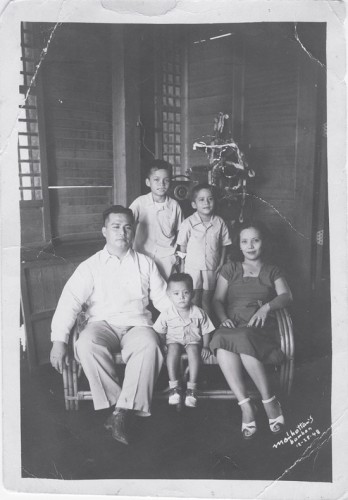
The photo taken 12-25-48 shows the family in the old house.
Seated from the left: Ricardo Y. Navarro, my father; Danilo Navarro,
my brother; Amelia J. Navarro, my mother. Standing are me and my
brother Florante. That forlorn-looking “thing” in the back
was actually our Christmas Tree.
We lived in a compound, with assorted relatives sharing space in a big house. There was a giant caimito, the star-apple tree—it yielded the biggest fruits I have seen of its kind anywhere—in the back, its branches overwhelming the house of Tatang Odon, my father’s older brother, and one of Ingkong Poli’s children. A patch of wilderness sat dangerously close in the backyard. At times a colorful gekko or a salamander would find its way into the tree or a poisonous snake would wander nearby. One time while my cousin Ray and I were up a tamarind tree, hundreds of snakes arrived and began working themselves into an agitated sexual frenzy on the ground below.
Not infrequently we would be taken to the local herbolario or hilot whenever we had a twisted ankle or wrist, and he would apply a magical oil, often on the opposite side of the injury (later in life, I learned about the principles of contralateral treatment in Chinese acupuncture) as he mumbled an incomprehensible mantra. We in the clan reverenced these healers as belonging to a higher species altogether, heirs of an ancient knowledge that was slowly getting lost and forgotten.
There were several colorful uncles in this extended clan. A couple of them had a secret life, which the family only talked about in whispers. Tatang Mulong, the kindest and quietest of them and as far as I know, the only one not cursed or blessed with the Navarro weakness for beautiful women, ran a rice mill called a kiskisan. It was he who let me in his workshop whenever I needed to load a seashell with splinters of lead, sharpen a scout knife, a buzz saw or an arrow or whatever it was that I fancied making. Tatang Sergio, who often made you feel you were never good enough whatever you accomplished, was the brilliant child prodigy and renaissance man of the family. At one time or another he became a guerrilla, choir conductor, a Sunday school teacher, a science teacher, a composer, family historian, dramaturgo, a singing coach, and a high school principal. He was at home with Handel’s The Messiah as he was with Christopher Marlowe’s Faustus. In another culture, he would have been a national icon, his achievements written up in magazines and textbooks, but he preferred to live in obscurity in our small town all his life. Tatang Crising (we called him Tatang Gara when he wasn’t around) was the youngest. A high school teacher, a perennial youth and a Narciso Bernardo—the legendary basketball star—wanna-be, he memorized long lines of inspirational poetry from Tennyson’s Ulysses to Wordsworth’s Ode to Intimations of Immortality. Tatang Dandong was the politician of the family, determinedly obsessed until his death to become mayor of the town. An Errol Flynn look-alike, he possessed the most beautiful voice among the brothers and with it, he used to serenade the young Japanese waitresses in Ermita with Japanese love songs he picked up during the war.
Tatang Odon was my favorite. He was a school teacher and a poet. To me, he appeared to live in an entirely different world and time. A romantic, he was intense, joyous and sad at the same time. During the war, he owned a set of horses and carretelas. He was a master chef and a butcher. Like my father, he could tell how much a pig weighed to the last ounce just by looking at it. He was also a barber who had the unique ability of cutting his own hair. Setting one mirror in front and another in the back, he would awe us kids with the precision of his scissors. What was remarkable was he also loved a different cuisine from the wilds. We did not know where he got the knowledge (probably from Ingkong Poli), but he knew how to trap birds, snakes and monitor lizards, of which there were many in the woods beyond the house. (This passion earned him the name “Barag,” the Pampango word for bayawak or monitor lizard.) I should not forget to include bats. Come to this, he had installed a net at the end of a long bamboo pole which he used to snare the bats flying out of the church belfry when the bell was rung at angelus. During the postwar, it was a convenient way not only to stave off hunger but to taste an unusual dish (and adventure) as well.
I was not aware if the snakes, bats and lizards had any nutritional value at the time. But my brother Flor still recalls that they made a good, tasty dish. It was only later on, in my middle age, when I was studying traditional Chinese herbology at the acupuncture school outside Boston that it occurred to me that Tatang Odon may have been into something nobody in the family suspected, i.e., the wild animals had an effect on the body that was healthy and erotic. After all, of all his siblings, he was the one who had the biggest family.
When Tatang Odon Navarro and his wife Indang Chayong moved to California upon the petition of their son Ray, excellent longganisa, tapa and burong babi found their way occasionally to our table although we lived across the mainland in New Jersey. When he died in his early 90s he left a poetry manuscript. Unfortunately, Tatang Odon’s recipes are lost to the clan. They would have been a rare legacy. Ingkong Poli’s stories and songs are probably lost, too. But that’s often the fate of our heritage: it is not considered important and valuable enough to preserve and to continue, and usually dies with the person who carried it.
The clan children were into kurang-kurangan, patintero, timbang preso, coyut and hide-and-seek. Spiders as well, which we collected in matchboxes and made to fight on a short baton of thin stick. We made kites from bamboo, string, glue and manila paper, some of them the giant gurion, and conducted aerial dogfights in the open field. I was also into gambling with sigay (shells) which I adroitly loaded in my favor with lead so that when tossed onto the ground they would always make me win. I was unbeatable in town. I won a lot of colorful rubber bands that way. I could have gotten rich when I was 8 but I did not appreciate the value of money at that age.
Perhaps there wasn’t much to eat—after all, it was after the devastation of the war and one or two times early on we had to fall in line outside the US camp for C-rations—but there was in my memory a list of food that we enjoyed. Aside from the supply of tin cans of corned beef, salmon, spam, and pork and beans which my resourceful parents brought from the black market through Clark Air Base and Fort Stotsenberg, we had goat ribs cooked with kalibangang; the pork dish called bulanglang which was flavored with ripe guavas and either kangkong or kamote tops; bringhi, a derivative of paella, with chicken, prawn and sticky rice; pakbet with slivers of pititsan, crispy pork skin; pakó (fern) salad; lelot balatong (toasted mung beans with rice congee); kamote tops and kalabasa flowers cooked with fermented fish or shrimp; monggo soup with ebi (dried shrimps), slices of ginger, garlic and bitter melon leaves; tender bamboo shoots (available from the surrounding areas) quickly sauteed in a wok with garlic and patis; and last but not least there was frog soup with pepper or malunggay leaves and ginger. For dessert we had tibok-tibok, suman bulagta and suman sa ibus, bobotu, duman, ginataan/sampelut, etc. Frequently, we kids would go to the pineapple field of Apung Pitong, who had come home after working in the Hawaiian plantations. When he wasn’t around, we treated ourselves freely to his manzanitas, avocados, green mangos (dipped in vinegar and siling labuyo), and cashew nuts.
When I was about 7 or 8, I picked up Tatang Odon’s fondness for game and learned to use a sling shot to hunt birds. On occasion, I would bring a kingfisher or two back from my solitary escapade in the marsh. I also learned how to dress bats and cook these into adobo. I caught the bats in our attic with the use of a pole. Bats are dressed like snakes; you pressed a knife on the neck and stripped down the skin from top down. With a bamboo trap which I wove myself, I learned to catch birds in their nests. In retrospect, it was a cruel procedure because sometimes the birdlings died along with the mother.
Wild ducks, manok labuyo and hogs and deer were brought down occasionally from the mountain. It may have been this exposure to an exotic, rare cuisine that brought back memories when I saw that frozen piece of expensive deer meat at this butcher’s shop in Manhattan.
No, I did not progress to catching reptiles because by the time I was 11 my father decided to move the family to the capital for his law practice. The world of my childhood was lost to me afterwards because it was no longer there in our new home.
Only on two occasions did I again experience returning to that environment. Both trips were taken with my father to the remote mountains somewhere between Tarlac and Batangas. He was seeing a tribe of Negritos who had retained him to represent them in their fight to take title to their ancestral land. We had traveled for a day across rivers and mountains, into forests, on precipitous terrain. As night fell, we arrived at a clearing between a mountain and a river, past what I imagined were crocodile-infested lakes. There were huts lighted by paritan. A deer had just been shot and it was being dressed over a camp fire. A piece of the liver was grilled and its blood still dripping, the chief gave it for me to eat. That night my Dad and I slept on a bed of hay on the flatbed of the 6×6 truck under a clear cold night sky and the stars.
I returned to Bamban a couple of times and visited Panaisan, Ingkong Poli’s farm, but the enchantment was gone. The mountain that had loomed large in my memory was reduced in size, the dam where we learned to swim was now but a small stream. The mango trees had been cut down. The old house where I spent my early childhood was gone, too. Even the concrete stairs that sheltered us from the bombing during the war was razed. Nothing was left of the landscape I remembered so well. The spell of the past was lost.
It is puzzling how events happen that way. Sometimes we cherish a memory and we keep it alive for a long time; and then somehow for no discernible reason it evaporates like mist. Suddenly our world changes. A familiar place is different now. We wake up in the morning and things are not the same. But I wonder if we realize that we must have changed, too. Perhaps we have grown up and matured and now see with different eyes. Or perhaps we have become skeptical of other dimensions, or earlier beliefs and values. Who knows what we have gone through, what we have become, what the world has done to us. Who knows where the spirits of the earth we communicated with have disappeared to.
I discussed some of these points with Obin Siswandi of Bin House, Bali in late February of 2006. We concluded that the nature spirits are still there but we have to create the environment for them to appear again.
February 1986
By Rene J. Navarro
My old files were stored rather haphazardly in boxes in the basement. They smelled of mildew and humidity after years of neglect. Photographs stuck together, staples and paper clips were rusted, magazines were frayed and crumpled.
They were thrown at random in boxes in the course of moving from one residence to another and they were not classified. Indeed they had grown so bulky through the years, things I kept that I couldn’t throw away for one reason or another like old clothes one had outgrown.
I decided to sort them out a few weeks ago and bought a drawer for this purpose. For a while the boxes just sat in the living room, smelling musty. When I finally plunged in I noticed that some of these “things” were records of the past 20 years: letters, flyers, articles (published and unpublished, under various pen-names),photographs, programs, Marcos Era documents.
Mementos of Exile
There were a couple of letters from Nelson Navarro and Loida Nicolas Lewis, several PETAL/TWITAS flyers, photographs of Cecille Guidote and Dr. Alejandro Roces as they waited for free Shakespeare Festival tickets to the “Pirates of Penzance” at the Delacorte Theatre in Central Park.
There was a flyer for a Philippine Festival including a summer workshop for Filipino children, lectures in Philippine culture by Mang Anding, a demonstration/lecture on Jose Rizal and arnis de mano by me and a Lino Brocka movie (“Bayan Ko”).
There was another flyer for a production honoring Macli-Ing Dulag, the slain native chieftain of ountain Province, at LaMama ETC, home to many Filipino programs, on the lower East Side of Manhattan. I choreographed the fight scenes and appeared in them.
There was the original narration for “Kasaysayan”, a theatre/dance number, one of the first acts of defiance against martial law performed sometime in November 1972 at the Washington Square Methodist Church in Greenwich Village. The typescript was somewhat blurred but readable and it showed handwritten corrections. Aside from the Filipino group, there were Barbara Dane and Suni Paz who contributed working class, ethnic and protest songs to the program.
There were a few back issues of the defunct “Ningas-Cogon” magazine and the Philippine news, some reports (on Human Rights violations in the Philippines, the Narvasa findings on the assassination of Benigno Aquino) and manifestos.
And there were articles and manuscripts, a few on martial arts but mostly political satires and philippics written by Reynato Yuson, Michael Santos, Alejandro Reyes, Antonio Puno (all my pen-names ) during the period of Exile, the aptly named Second Propaganda Movement; also poetry and translations from Tagalog into English. I read through the 4-part series “God Looks Down from Heaven”, a satire after Dr. Jose Rizal, and “All This and Imelda Too,” journal entries from the 70’s, published in the Philippine News.
Organizing in America
I looked at all those keepsakes of a past thinking of times and people. The demos in Washington, DC and Fifth Avenue, New York, the community work, and the long discussions. The untiring dedication and creativity of the countless people who politicized and organized the Filipino communities from coast to coast. The different organizations who put their differences aside and presented a united front against the dictator. The long, tiring rehearsals to mount a show under the inexhaustible and moody Cecille. The problems surrounding the raising of Filipino children in America. The Marcos regime.
Never Again
I was taken by surprise, startled by the memories they evoked. I felt contradictory emotions, a little sadness but also a great joy. My anger at the dictatorship reverberated strongly still, I realized, but I felt a great relief again that that era had ended: it must not happen again. Never ever again.
The regime of President Ferdinand Marcos lasted about two decades — long enough for a whole generation to grow up. The whole corpus has not been exhumed, but what we have seen is a shocking and unbelievable picture of deception, corruption, terrorism, greed and callousness. When his regime ended, there was widespread jubilation.
I remember that in late December of 1985 I filed my resignation with legal services to take effect at the end of February 1986. I did not exactly know what I was going to do, I was thinking of something, but I was not sure. It was a sad decision for it was the work I had done since 1978, first in Long Island, New York and then in Northwest New Jersey, and I thoroughly enjoyed it, and lawyering was what I was trained for. Working with the poor, handling Welfare, Unemployment, Landlord and Tenant and Social Security cases–it was something that fulfilled my dreams as a lawyer.
But when President Ronald Reagan was sworn into office, he recommended a zero budget for legal services. Other social programs were adversely affected. What followed was a demoralization in the staff. Many suffered from what we in poverty law called legal services burn-out, an emotional dead-end where the job had lost its initial excitement and one felt a sense of futility and meaninglessness.
Going Home
In the heady days of February 1986, like many Filipinos, I closely followed the developments in the Philippines. Every night on the late news I switched channels to see what each station was showing. I also bought several newspapers. Even as I worked my final weeks in legal services, my mind was miles away. It was time to be back home again after sixteen years. Many Filipinos refused to go home until democracy was restored and they were waiting excitedly for that day. Nestor Gener, an artist, classmate and close friend, died in America waiting for it (I delivered a eulogy at his funeral). A cousin had been planning his eventual homecoming for at least ten years. Finally it appeared that the Philippines was on the brink of liberation and the day of return was near.
As the crisis deepened in the Philippines, our attention was riveted to the television programs showing Filipinos taking tothe streets, guarding ballot boxes, protecting what was gained with their bodies and their lives. Those were intensely emotional times.
We knew something totally significant was happening, was building up but the end was difficult to predict. Thousands of Filipinos formed barricades along Epifanio de los Santos Highway outside of Camp Crame and Camp Bonifacio, stopping tanks with their bodies and praying, persuading the soldiers to turn their back on the dictator. The memories now come in halting slow-motion, courageous images that captured the imagination of peoples everywhere and doubtless influenced the freedom movement around the world.
Marcos Falls
Scary, fearful, uncertain moments but before we knew it, Ferdinand Marcos was reeling from the blows, he was down, swollen face and all and then he was escaping the Palace. Meantime, Corazon Aquino was being sworn in. The Fight was won.
All the emotions, all the fearful and angry years under the terror were let loose in a mixture of tears and exultation.
The day we had all waited for had arrived after all the repressions, the violations of human rights, imprisonments, the tortures, the disappearances, the salvaging, the fears, the terrors, deceptions, the rapacity and greed of the Marcos regime.
It was of course an ironic joke that many of the people who grabbed he limelight and the credit during those days were the very people who implemented the Marcos program. But apparently not too many cared…the Filipinos were in a forgiving mood…differences could be settled later on.
Many of us hastily booked flights. Friends who were prominent in the anti-Marcos coalition in the New York area were flying home. We were calling each other. What are your plans? When are you going home?
I cancelled a few engagements, an arnis de mano workshop in New England, and begged off from a poetry festival. I said goodbye to a few friends. A Pennsylvania newspaper wanted to do a feature article about my return home and asked me to send in my impressions for their op-ed page (I understand that my field reports triggered a boycott of the newspaper by a local VFW because of my position on the US conduct in the Philippines but the editor published them anyway).
All I needed was a few more bucks for pocket-money to travel around the islands and buy the traditional pasalubong (homecoming gifts) for relatives.
Another Miracle
A few days before my departure, a martial arts school quickly scheduled a 4-hour arnis workshop for me to teach; with 50 students attending, the income wasn’t bad. The day before my departure I won a few hundred dollars in the lottery. I was willing to believe in miracles, God was intervening in my behalf. I was really flying high.
For the two months I had scheduled to be in the Philippines I made plans to see the old hometown in Tarlac, relatives in Luzon, my martial arts teacher in Cebu, friends and classmates in the University of the Philippines and visit familiar places, perhaps, Baguio, Pagsanjan, Banawe.
There was a lot of territory to cover, news to catch up on,a land that was deeply missed, and a big occasion to celebrate.
Touring Manila
When I arrived in Manila, it was quite muggy and warm. I ventured into the streets of the city. Much had changed. MetroManila itself looked different. Luneta seemed forlorn and shrivelled up; the Tai Chi Chuan groups I used to play with at dawn had dwindled or disappeared; in their place was a kind of aerobic class dancing to loud music. Chinatown looked stripped: its cobbled streets dug up and replaced with concrete.
There was an elevated train running the length of Avenida Rizal, the main street of the city. Young children, male and female alike, some as young as ten, were escorting foreigners in the streets of Ermita or begging. It seemed that there were more bars and cocktail lounges every block than I remembered. New buildings had sprouted in erstwhile farmlands. The air was unbearably polluted.
The old Rizal Theatre and its old neighbor Sulo Restaurant in Makati were now surrounded by hotels, department stores, restaurants, bookstores, and multiplex cinemas.
It may have been my imagination, but there was an atmosphere of camaraderie and celebration all around. Old political allies and comrades were meeting in the open again. Enemies were getting reconciled. Exiles were flying in from different parts of the world– Europe, China, the United States.
Rendezvous in Manila
The Psinakises and Esclamados, prominent anti-Marcos stalwarts who lived in California, I had heard so much about but never met, were in town, Rodel Rodis from San Francisco was arriving, some of the old hands in the PETAL were already in Manila. Two Filipinos who were marooned in China when Marcos suspended the writer of habeas corpus in 1972 had returned and were already doing the rounds of the reunion and party circuit– Ericson Baculinao was going to make an appearance at our fraternity gathering, Chito Sta Romana another China expert was speaking at a college gathering somewhere.
Nelson Navarro, an exile in the US, was in town too.
Alejandro Roces was writing again, editing the family newspaper, The Manila Times, with my oldtime Philippine Collegian adviser, Hernan Abaya. Maximo Soliven was back in harness after being blackballed by the Marcos press boys. Luis Beltran, who reportedly raised fighting cocks to survive during the Marcos era, raised his voice again.
The political prisoners were not only getting their release papers and regrouping, they were also being honored in the upper reaches of the elitist society. There were plenty of speeches.
Nick Joaquin, the premiere writer of the country, had just written a commemorative on the February Revolution. Longtime London resident Chit Navarro, who Wrote the “Untold Story of Imelda Marcos,” was doing the rounds of interviews — for another book? Ninotska Rosca and Belinda Aquino, former faculty at the University of Hawaii, were reportedly coming too. Heherson Alvarez and Cecille, exiles for more than ten years in the United States, with their two children in tow were looking for a house and planning to resume a life that had been cruelly interrupted.
Spring in Manila
It was like, well, coming up for air after a long time underwater. Manila was quite festive. It was Spring. Numerous newspapers, many of which were barred from publishing during the Marcos era, sprung to life again overnight. Famous names were being interviewed on TV. The mass media, the “freest in the world”, were back in full force, still loud, vigorous and long-winded.
College friends and classmates from 25 years before were now up there in public service (they were either coming in or going out), many were in the judiciary or in legal practice. Some I saw delivering commentaries on TV or writing newspaper articles. Some were college professors. Many were rich, very rich, balding, with gray hair and paunches, invariably married, with children now grown-up.
Cafes were standing room only. The Peninsula Hotel lobby in Makati was swarming with people who were there to see and be seen. The Calesa Bar and Restaurant at the Intercontinental was also packed. The air was resounding with songs of victory and promise but also with loud arguments on the country’s future.
The Cultural Center was scouting around for a more proletarian fare. Van Cliburn, Imelda’s favorite cultural icon was too arty-arty; bring in the heirs of Bertolt Brecht and Amado Hernandez.
Many of the Marcos diehards, especially those reported to have made millions beyond their demonstrated legal income, went in hiding, well, they lay low in the meantime.
Synchronicity
In retrospect, the last days seemed karmic. There was an almost clockwork precision in the events, a kind of inevitability. History was being made to happen and somebody (or something) up there was choreographing it. There were Roman Catholics who believed it was the Virgin Mary. Manila’s astrologers, charting the course of the planets, asserted that the fall of Marcos was inevitable from the convergence of astral energy. Marcos must have thought the fault was not in his stars; it was Cardinal Sin who intervened.
Afterwards, looking back, we wondered: Suppose Marcos did not leave? Suppose he ordered his soldiers to attack earlier in the proceedings? Suppose Cardinal Sin did not ask the people to go to EDSA? Suppose…. There were a legion variables any one of which could have changed the course of history.
We knew the jubilation wasn’t going to last forever. Nobody ever claimed it was going to be a lifetime picnic. We knew reality was staring us right in the streets where we danced to celebrate the occasion. Imelda’s 20-foot fences and Potemkin Villages couldn’t hide the ugly deceptions of the Marcos government, and there was urgent work to be done. But the courage, patience, determination and selflessness that brought about the triumph of the February Revolution deserved every toast, every party, every congratulation we could muster. And so we sang and partied and drank a toast to the living and the dead, to the courageous nun who prayed on her knees, the anonymous woman who offered a flower of peace to the heavily armed soldier, the mother who brought a basket of food and the thousands from different sectors of society who joined hands at EDSA; we saluted the soldiers and Juan Ponce Enrile and Fidel Ramos (despite suspicions they turned on the dictator just to save their skins); we paid homage to the countless workers who laid the foundation for the February Revolution; we remembered those who perished in battles and those who disappeared; we gave our heartfelt thanks to the TV crew that broadcast the messages from the barricades; not to mention the scoundrels, the Johnnys-Come-Lately, the opportunists, the “higups” and the “sipsips,” and the operators for we knew they were there too.
Cebu and Bantayan
From Manila I went to Cebu to see an old college friend and further my training in arnis de mano (Philippine stickfighting). While I studied arnis I lived with a family in the outskirts of the city, in the Labangon, Punta and Tisa area. I was told that a couple of years back an activist priest, a certain Brother Hermano, while doing grassroots work was taken by military men and was not heard from again. Everybody in the house I stayed in was out of work because the unions, suppressed during the long Marcos era, decided it was time to go on strike. Many in the neighborhood were unemployed, including the arnis master who was a security guard in a warehouse.
It wasn’t much different in the island of Bantayan, off the northwest tip of Cebu, where I spent a week or so with my friend and teacher, Johnny Chiuten, wrapping bread at his bakery and studying more arnis de mano with an old master. There were 7 or 8 young workers, most of them female, tending to the store, sorting and packing bread, sometimes doing housework. They considered themselves lucky to be employed and have a place to stay and food to eat. A few people I talked with wanted to go to Manila — to “do anything.” Many people were not working, just hanging around in the marketplace, sometimes drinking tuba or beer, or shooting basketballs in the town plaza. A few couples I talked to had 8-10 children.
Lecturing on Martial arts
Back again in Manila, I gave a lecture on martial arts at the lovely home of interior decorator Edith Oliveros; Anding Roces took the time from his busy schedule to introduce me to the invited audience of journalists, educators and students. All of a sudden I found my picture splashed in a few publications, lionized as a martial arts master to my endless embarrassment.
I visited with some more relatives who, it turned out, were themselves unemployed. They had the obligatory college education and work experience but there just wasn’t any job available. Even the restaurants were not hiring any more waiters and dishwashers, department stores were not taking any more salesclerks and stockboys.
Dismantling the Old
It was time for the country to dismantle the remnants of the cruel regime, establish (or re-establish) a democracy, create a more just society and strengthen the constitution against dictatorial tendencies and machinations. At the moment it seemed the democratic impulse was predominant because of the fear of another dictatorship; but it was also clear that the country needed a political and economic restructuring in the face of the unbelievable poverty and hopelessness, the gap between rich and poor, the rampant corruption, and the bulging government machinery that became a dumping ground for political proteges, friends and relatives.
When I left MetroManila was still buzzing with excitement. I returned to Manila in December 1986 with my family to show the children the old country they had not seen since they were small. When they came back to Pennsylvania, I stayed behind. I travelled to my old hometown to see relatives. I taught an instructor’s workshop in arnis de mano in the University and a few Taoist meditation courses and went back to Cebu and Bantayan to take further lessons in a style of stickfighting called Lapunti Arnis de Abanico. I took the bus to Baguio City and then across Pangasinan to Mt. Banawe and saw the appalling denudation of the mountains. The Manila Times reprinted my essay “RIZAL: Zen Life, Zen Death,” which was originally published in the Philippine News.
Diminished Crowd
At the celebration of the first anniversary of the February Revolution, thousands attended but it was a very much diminished crowd. We wore our yellow shirts, carried Laban banners and placards, sang “Bayan Ko,” marched at Edsa and the Luneta. The euphoria was not gone but it was not the same. The RAMBoys were giving President Aquino a lot of headaches. It was the season of the coups. Demonstrations were getting to be a regular fare on TV. The coalition that toppled Marcos was splitting in several places. The Cory charisma was fading.
In mid-1987, before I came back to the United States, people were already talking about lost opportunities. The intelligentsia was debating whether the constitutional convention in its implicit fear of another dictatorship had hamstrung the president. Marcos followers were back, political alignments were being adjusted. Commentators were talking about the clannish nature of Philippine society (actually somebody called the Filipinos tribal) and predicting a gory denouement to the ongoing power struggle.
I wonder now, seven years after the fall of Marcos, if something could have been done– by the government and the people who played a big role in the February Revolution– to channel that great outpouring of emotion into a mass movement of reconstruction.
Days of Heroism
Those were days of heroism: in an inspiring period the Philippines seemed united in a momentous undertaking, a grand and eloquent statement of a people’s fight for freedom and triumph, despite the odds. The February Revolution was one of the numerous heroic moments in Philippine history, a milestone attained through its ideals of sacrifice, courage, selflessness, unity and determination.
I think of February 1986 and notwithstanding today’s pessimistic picture, I can see from that shining hour what the Filipinos are capable of doing.
Here’s yet another toast to those times and those brave people!
February 1993, Weston, Massachusetts.
Honoring the Sacred
By Rene J. Navarro
“Literally, our bodies are made of stardust, from stars that died billions of years ago.” Michio Kaku* in his book “Parallel Worlds: A Journey Through Creation, Higher Dimensions, and the Future of the Cosmos” (Anchor Books: NY 2005)
A research in Japan revealed that water reflects the energy and emotions around it. Photos taken of water under varied conditions showed different configurations and shapes. The conclusion seems to be that if you have a good or bad spirit, the water will show it.
Master Lao Cang Wan, a Chinese qigong master who used to teach at the Tao Garden in Chiang Mai, Thailand, did a ritual with mantras and his sword hand over a glass of water or plate of food to invest it with qi or transform its nature. It is a Taoist and Buddhist method of saying grace.
The point is that, we — our energies, our thoughts and movements — have an effect not only on ourselves but possibly on our environment.
show moreIn our own everyday life, whatever our religion or faith, we can use varied ways of honoring the sacred or transforming the environment. One way is to create an altar in one corner of the house and make it a point of pilgrimage and worship. We can install images, icons, crystals, rocks or whatever we believe can be our focus or a center of our energies, mantras or mudras. We can light a candle or incense there at certain times of the day and then assume a quiet attitude for, say, 30 minutes to an hour. Doing qigong and meditation is another method.
But it is not enough just to do the process mechanically. We should focus our full attention, calm our spirit, slow down our pulse, feel the sacred in ourselves and spread this around the room. We can make an offering to the spirits. We can send a message of appreciation to God/Universe/Tao, whatever it is we believe in, that mysterious world that is often beyond our understanding. We can also send positive wishes and blessings to people and places.
We can do a short (sometimes it can go on for an hour or so) ritual every day in the week. If you are traveling you can do it in any place when you have the luxury of time. It is indeed something we can observe in everything we do, isn’t it? You can just pause for a few moments before you do anything and contemplate the value and sanctity of life or whatever it is you do.
In Tibet, artists meditate before they start painting. They consider each work as sacred, as a continuum of the divine. It is understandable when we consider that we are not just material/physical bodies, but spirits as well. How wonderful it would be if writers, composers, poets, craftsmen followed the Tibetan practice.
It is too much to expect everybody, including ourselves, to honor each moment and place as sacred, but there are no doubt certain special occasions that call for it. Aside from the birth of a child or death of a loved one, there are times when we can observe a “prayerful” stance or attitude. Different cultures and societies call for different responses to events and experiences.
In the practice of martial arts, when you do Tai chi chuan, whatever the style or form may be, you can take time to go inward into the deepest self. You can become aware of the different directions and certain energy points. You can focus on your breathing, body, or what you are thinking or feeling. And then when you reach stillness, you can do the form very, very slowly, like a sacred ritual, sensitive to the flow of qi, the energy, in your extremities at first or the dantian and then around yourself. Each technique and posture has a different energy field, and you can try to be aware of that as you go through the form. When you finish, you can stay in a stationary position for a while and focus on what has happened to you, enjoying the moment.
Whatever form you do, Shaolin, Wudang, or karate, try to replicate this procetss. In reality, no specific movement is required, just a posture of quiet and stillness and soft breathing.
You can also do a modified version of it outside when you are in the woods or by a lake or the sea or mountain/top. You can face a body of water or a tall tree.
In certain power spots like Banahaw in the Philipines, you can find a place where the energy is strong and do your practice. In Egypt, qigong exercises in the Temple of Karnak and Luxor and inside the pyramids bring out extraordinary vibrations. You can experience some startling results there. In the Iao Valley in Maui, you too can have an extraordinary experience of the sacred. Likewise in other places like Glastonbury and Stonehenge and the Stone Circles of Scotland. Many different energy vortices can provide tremendous memories and bring you to a different space. Find a special spot for yourself anywhere you are.
The sacred in ancient times referred to most everything. The trees, rivers, lakes, mountains, stars, weapons and jewelry even. Humans had their own spirits, so did animals. Many ancient practices and beliefs — agriculture, hunting, relationships, hierarchies, constructions — were influenced by and connected to the heavens and the mystical. The belief in the other world, in something that animated the universe, whether it was a god or a planet, diminished in the course of history, for one reason or another. Perhaps it was rationalism, individualism and science. Reverence for nature and belief in the after- or other-life slowly gave way to the idea of conquest, of human dominance/humanism, possession and reliance on the physical/material.
While science and rationalism gave us the blessings of knowledge and research and prosperity, there were likewise drawbacks like, for instance, the plunder of natural resources, the conquest of Third World peoples and countries, the exploitation of labor, pollution of the earth, to name a few.
How we rectify the inequities and balance the different choices and priorities we have is, probably, one of the most critical human dilemmas in modern times.
A first step to restore and reclaim our human values and respect for nature is to develop our concept of the sacred. We have to learn how to slow down, breathe slowly, close our eyes and go inward, embrace the circle of our awareness, and keep still, and open ourselves to something new and something ancient and eternal.
In this frantic and competitive world, we rarely stop to think how lucky we are to be alive, to be here on this earth in this present incarnation. How we are gifted with the blessings of the planet. How bounteous the resources are. How joyous it is to be with friends and relatives. Often we don’t realize that along with the blessings, we have responsibilities. We desecrate and profane even the most important events in life with our thoughtlessness and greed. We skip from one moment to the next without being mindful of what we are doing.
Remembering that the world is a sacred place, the body is sacred (a temple it is called in the scriptures of different religions), what we feel and project is sacred, can make a difference in the world. Whatever we are made of — water, stardust, clay — we can make each gesture, each activity, a sacred moment in our life. In Thailand, even the simplest wai, a Buddhist bow of the head with both palms together done by both monks and laypeople, signifies an acknowledgment of the divine spirit in others.
To be sure, we cannot always expect others to behave as we would like them to. There is infinite diversity in the world; there are members of the species who live with unrefined energies and work under a heavy karma of past and present lives. There are people who will apparently do harm to others and to the environment, who will selfishly impose their own values on others and grab more than their share of wealth while the rest of the world is starving.
In martial arts, specially, there will be practitioners who will not represent the best in our humanity; in fact, they will pursue activities that may be the worst that the disciplines can offer and we cannot do much about it… and you begin to wonder if “martial” art is just that, nothing but martial, and of the worst kind at that. Nothing really but learning to beat or bully somebody.
On the other hand, even now, many masters both men and women are coming out — from China, Indonesia, the US, India, the Philippines, to name a few — to share their authentic secrets with serious students and searchers. They are presenting disciplines that cover many different areas that were hitherto considered esoteric. There are more opportunities for learning true arts nowadays. Masters who in the past kept their teachings to close relatives and trusted disciples are now making their lineages accessible to larger audiences. They are just now showing the hidden facets of knowledge that their ancestors cultivated, many of which indicate that martial arts are not just physical but energetic/healing and spiritual as well.
We can learn to observe and encourage discernment and discrimination in the choice of our teachers and guides. We can help show whose teachings have the higher level of sophistication and subtlety. Ultimately, we can raise our consciousness beyond the physical and material by pursuing disciplines that touch different aspects and dimensions of reality.
Over time, perhaps not in the present or immediate future, there can be positive change when the circumstances are right.
If the fluttering of a butterfly’s wings can affect the weather on the other side of the planet, we too can influence the earth, no matter what it is we do.
* Dr. Kaku is a professor of theoretical physics at CUNY and is cofounder of string field theory.
LOOKING FOR YANG CHENG-FU*
By Rene J. Navarro, Dipl. Ac. (NCCAOM)
Studying Tai Chi Chuan in the Philippines in the late 60’s, I saw a form, slow, smooth, flowing, hypnotic, elegant. It did not look like it had any power but I saw and felt in the movement an energy that seemed to vibrate into the bones. A strange sensation to me who, at that point, had been steeped in the hard, vigorous and physical Southern Shaolin Temple Wu-Shu style.
For several years, I had been taking private lessons with Johnny Chiuten, a Shaolin Kung-Fu master who was a student in the university like me. But when he left for Cebu, southern Philippines, to manage his family’s bakery on a tiny, dusty island called Bantayan, he became almost inaccessible. Before he left he recommended me to his master Lao Kim, a legend in the Philippine Kung-fu underworld who at the time was in semi-retirement from public teaching. They were both famous as fighters, tough and powerful practitioners of the hard Shaolin style. They taught me fist forms that emphasized toughening the muscles and bones, hitting the forearms and digits on hard bags.
The leap from hard Shaolin to soft Tai Chi was difficult for me to understand, so was the idea of deriving power from gentleness and the mystical Chi.
show moreMultifaceted system
Tai Chi Chuan is an ancient Chinese discipline, one of the priceless treasures of Chinese civilization, along with calligraphy, painting, and acupuncture. It is an internal system of healing and energy work, a dance, a philosophy, a meditation, a spiritual quest, a way of centering and therapy.
But Tai Chi, as the art is sometimes called, is actually a martial art as well. It is therefore not an ordinary dance, or a relaxation exercise. It is indeed, despite its deceptively harmless movements, a sophisticated fighting system. It can be used and was designed to immobilize, maim or to kill.
The basic movements must have been invented at least two thousand years ago but the system itself was developed sometime in the 13th century by Chang San-Feng, a legendary Taoist monk in Wu Dang Mountain in China. Chang was a Shaolin monk who lived in the monastery in Loyang for 10 years. He probably studied Damo’s Yi Jin Jing, the secretive system of neigong that is sometimes associated with the mystical powers.
It was said that he learned the dance in a dream (shades of Tartini!); another story showed him devising the movements from the fight between a crane and a snake that he had seen in his backyard.
Different systems grew, some in temples (Wu Dang Mountain and the White Cloud Temple in Beijing are the most prominent) and others in families (Chen, Wu, Sun and Yang especially) around China.
Yang Family style
Yang Family style Tai Chi Chuan is the most widespread system. Its origin, like ancient Tai Chi, is shrouded in mystery and legend. One story (considered apocryphal by authorities but perpetuated in the popular literature) says that Yang Lu Chan studied it by disguising himself as a servant in the Chen family household and spying on the practitioners at midnight (this version has a couple of variations, one of which has him as a servant who could not speak and the other that he joined the Chen family as a servant when he was a child).
Another story has it that he was already an accomplished Shaolin Long Fist martial arts master who joined the Chen family to learn their system. Still another story (not necessarily the most reliable) has him studying, not the Chen family style, a southern Shaolin style (“Cannon Fist Boxing”) that later became known as Tai Chi Chuan but another style taught by a mysterious boxing master who was visiting the Chen’s. A story that crops up occasionally in the literature is that he also studied with a Taoist monk.**
Whatever the truth behind the confusing claims, the Yang Family style as it is known today was developed by Yang Lu Shan’s grandson, Yang Cheng Fu, who revised the family style to make it more simple and accessible to the public. In the 20’s and 30’s up to his death in 1936 he propagated it as he traveled around China. Among the masters who learned the style from him were his oldest son Yang Sau-Chung (now deceased who was 28 years old when his father died), Tung Ying-Chieh (deceased), Chen Wei Ming (deceased), Tin Shao Lin (Shanghai) and Cui Yi Shi (Beijing).
I studied a version of the Yang style Tai Chi Chuan solo form at the Hua Eng Athletic Club in Manila’s Chinatown in 1968. It was Yang style handed down through the famous master Han Chi Tang who was visiting from Taiwan in the early 60’s. (I learned later that his daughter Han Linlin teaches martial arts in Cambridge, Ma.) Han, who taught Tai Chi Chuan and northern Shaolin Boxing at Hua Eng Athletic Club in Binondo, Manila, reportedly studied the art with Yang Cheng Fu in Shanghai, possibly in one of those workshops in the 20’s and 30’s. There was no formal teacher when I joined the school in 1968, but there were veterans who helped. A few advanced students studied the sword form with Han Chi Tang. I don’t remembering seeing Han or any of his students doing any other form of Yang Family Tai Chi Chuan aside from the Solo form and the Sword.
Han’s interpretation of the Solo form modified the original in a few places — the opening (his is similar to the Hsing-I), the Wave Hands like Cloud and Needle at Sea Bottom, among others.
You went to the morning class and followed the movements. If you had a problem with the sequence, you asked one of the other students. There was pushing, stationary one hand and two hands and moving two hands. Chan Bun Te, who managed the school, made occasional but excellent corrections. After a couple of years, the class thinned out as many of us took Tai Chi lessons with Liu Yun Hsiao, the grandmaster from Taiwan, who was in town for a year or so teaching internal systems.
I also went to the Luneta Park by the Manila Bay and joined a group of practitioners who met at dawn almost everyday. A few times I led the group, perhaps the only Filipino who ever did.
Like many practitioners, I learned only the long empty-hand form, basic Push Hands and read the Classics of the art. At the time, there wasn’t much information about Yang Family Tai Chi Chuan. Johnny Chiuten who studied the Solo form with me became a serious practitioner of the art when he realized the possibilities of the style. What I learned and read was enough to give me an idea of the depth of the internal style. I was tantalized beyond belief. I fantasized about studying with Yang Cheng-Fu, who was said to be able to emit power from his body without the slightest movement. I thought if I learned with a real master for a few years…. The idea of receiving the secret Transmissions from an heir of Yang Cheng-fu, of learning what the art is all about…. From that time I tried to keep an eye open for such a master.
Newly arrived in the United States, in late 1970, I had no teacher. But I did the Tai Chi Chuan long form on a regular basis along with my Shaolin fist and weapons forms. After learning Tai Chi, I began to understand its possibilities — for health, longevity, relaxation and combat.
I observed the famous Cheng Man Ching who had a school at the foot of Manhattan Bridge on the Bowery in New York. He had a reputation as a formidable fighter. His short form of 37 movements was derived from the Yang Family classical fist form of 108 movements. It was said that he studied with Yang Cheng-Fu but I did not know what forms or for how long. His students did the short fist form, stationary push hands and the sword form. I would stand on one side and watch the players do the form or push hands. I did not talk to anybody, I just watched. Later, Cheng wasn’t around when I went to watch.
Leung Shum, the Eagle Claw master, impressed me. I studied Wu Style with him for several months. He was an excellent teacher but I never did finish the form possibly because I thought it was the same as the Yang form. I dropped by to see a few Tai Chi masters in New York. In San Francisco I observed a couple of instructors doing their forms.
I went to China in 1983 to take intensive training in contemporary Wu-Shu. I saw a number of Tai Chi Chuan masters but nobody who made a strong impression on me.
Taoist Arts
I started studying with Mantak Chia of the Healing Tao in late 1983 and learned his Tai Chi Chi Kung form, a still more abbreviated version of the short Tai Chi form. It was a version of the original 13 movements. Chia put a lot of emphasis on analyzing the internal mechanism of the Tai Chi movement. His was a compact form but very difficult to master. I also learned a short fast form from him.
In the summer of 1986 I visited Boston. I called up Gunther Weil and Rylin Malone, friends from the Healing Tao who were teaching at Harvard, for dinner. I had not seen them since the last Healing Tao Retreat in North Andover, Massachusetts, in 1985.
We agreed to see each other outside the Copley Square Hotel. They took me a short distance in their car to a building near the Chinatown exit of the Mass Pike to a Tai Chi school. Another Tai Chi Chuan school, I said to myself.
There were students practicing earnestly in the courtyard behind the school on the first floor of the Mass Pike Towers. Sword and Saber, Two-Person Set, Staff, Long Form, Fast Form and a type of stationary two-hand maneuver that included grasping, pushing and trapping, much of which I had not seen before anywhere.
A Karmic Encounter
I was introduced to the teacher, Gin Soon Chu, who smiled a lot but did not speak much. At the time I had read widely about Tai Chi Chuan, but I did not see anything about him. He was, as far as I was concerned, just one of the many teachers that I had to include in my list. I sat down to watch the proceedings. Although the sequence of movements was similar to the Solo Form I had studied at Hua-Eng in Manila, theirs looked stilted, awkward. I was wrong; I realized that they were doing the postures differently. It was the first time I had seen Tai Chi postures done that way anywhere I had been — in the Philippines, Hongkong, China, California, and New York.
Afterwards there was a kind of Push Hands, using a maneuver that was basically stationary, from a Press position until somebody was uprooted. It was called Dynamic Push Hands to distinguish it from its soft, yin counterpart. The teacher pushed, too, showing an incredible strength that belied his age and size. He was bouncing people back to the opposite wall, 20 feet away, or up in the air with no visible effort. I was impressed. It was a power I had not seen before. I wondered if it had something to do with the postures of Tai Chi Chuan that I had found awkward.
I knew instantly that he was the Yang Family Tai Chi Chuan master I was looking for, as good a manifestation as any of the spirit and abilities of Yang Cheng-Fu, the father of modern Tai Chi Chuan. Later, I learned that Gin Soon Chu studied with Yang Sau-Chung, the first-born and heir of Yang Cheng- Fu, in Hongkong. A lineage instructor, he knew the curriculum of authentic forms handed down by the Yang family and had been authorized to teach. I decided I was going to study with him. But it was a long drive from Pennsylvania to Boston, some 5-6 hours one way. Gunther offered his house for me to sleep in while I was in town. Nothing came of it though because I had too many things to do at the time.
Studying with a master
It was 3 years later that I finally had the chance to study with Gin Soon Chu. When I decided to pursue acupuncture, he was the reason I chose to relocate in the Greater Boston area. He was even more impressive when I saw him again in 1989. He was not only bouncing people, he was tying them in knots or stopping them cold WITHOUT TOUCHING them. I asked the advance students how this felt and they really could not explain, except to say that it was like something erupts inside or the muscles get stiff or a wall seems to have materialized in front. Just like that. You’ll never know unless you experienced it, they said. I was told it was pushing on the level of Jing, beyond Qi. It was a release of vital energy. The alchemical change from raw Chi to primal Jing.
It is 1998 now. I’ve been through 4 corrections of the Solo Form and finished several other forms, including the Chang Chuan, Staff/spear, 2 sets of the Knife/Broadsword, the Sword and have been working on the 2-Man Set. I am still receiving corrections to my forms, especially the Solo form and the Sword Form, there doesn’t seem to be an end. These forms are like heirlooms to me, received from a teacher who received them from his master, and on through the ancestral line. It has been a productive and happy education for me.
During the 6 years that I was studying acupuncture and herbology, the lessons with Gin Soon helped give me a center, a sense of wholeness and focus. I have likewise felt a great improvement in my energy.
The different forms emphasize and reveal different aspects of the art. Each form also sheds light on the form before it so that as one progresses, the different techniques acquire a deeper and larger dimension. While it is true that the Solo Fist Form is a self-sufficient form for some people, it is also true for me and many practitioners that the other forms complement it and bring it a step or two further.
Gin Soon Chu has been a joy to study with. He is completely childlike, cery gentle and serene. And unbelievably awesome. When he does a form, most everybody stops to watch.
His school, founded in 1969 is observing its 29th anniversary, the oldest Tai Chi Chuan school in Chinatown and in the Greater Boston area.
Some of his students have been around for 10-20 years and they still come to study. A number of them, like Linda Sugiyama, Sarah Freed, Hwon Kim (who has opened his own school in Manhattan), and John Conroy (who has been teaching for sometime in Providence, Rhode Island) have developed powerful techniques too, one could see it in the way they do their forms and in the impact of their techniques. To me, they represent the potential power of Tai chi chuan of which many so-called masters are embarrassingly clueless.
I am still a child learning the rudiments of an art. Pushing 60, I don’t know how much time I have to learn all the forms Sifu Gin Soon teaches and how deeply I can go into the forms. There are still Yang Cheng-Fu’s personal Sword and the Spear forms, among other forms. And there are, I heard, the secret Yang Family forms – reportedly the basis of the modified Solo form that Yang Cheng-Fu introduced in the 20’s to make Tai Chi Chuan popular and easier to learn.
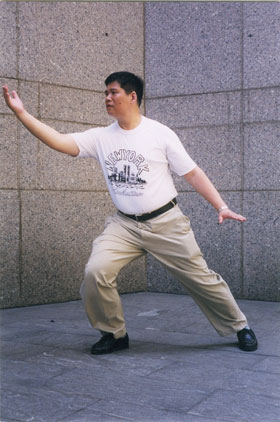
Parting the Wild Horse’s Mane: Master Vincent F. Chu,
son of Chu shigong and heir to the Yang Family
transmissions. Fong shifu, as he is often called by his
many students, has been studying with many Yang Family
Tai chi chuan masters as he collates the different versions
and forms, including the different frames (small, medium,
large), speeds (slow, fast and mixed), styles (Snake, Tiger
and Crane) and the internal facets of the art (like the
influence of Damo on the system). He has a very profound
knowledge of Tai chi chuan.
I see the other students, especially the veterans, and I wonder if I’ll ever be able to develop their abilities. A couple of them would often give me advice on my movements or general Tai Chi Chuan development. The training is quite tough and demanding, the Push Hands routines especially so. With Vincent Chu, Sifu’s son, or Fong as we fondly call him, who is a master in his own right, Push Hands is a serious business; it is the crucible for developing high level techniques. Fong subjects most everybody to an unforgettable treatment that goes right to the bones.
The Push Hands training is no doubt the most difficult of all with the 34 or 35 Fa Jing techniques. The Yang Family techniques as transmitted by Sifu, are the most varied and most challenging I have seen in my long search. A combination of yielding and power, softness and hardness, the techniques include a wide repertoire of energy discharge. It is a perfect example of what the classics call “steel wrapped in cotton” because it is so effortless but so explosive, so soft and yet so hard.
Sifu has an obvious mastery of Push Hands. On a few occasions, he would demonstrate different aspects of it, including maneuvers with the elbow, shoulders, hands, fingers and chi manipulation from a distance. I’ve seen him do Push Hands many times and I am always fascinated by it all.
Often Sifu ties me up in knots too. While Pushing, he would reach one or other part of my body and something happens, a burst of energy it seems, and my breathing pattern changes. Something inside moves me to assume a posture or do a movement. I twitch, I feel like choking, a rush of energy moves through me.
When I am asked how it feels, all I could say is, It is difficult to explain; you have to experience it to know it.
Both father and son have incredible Jing power and the legendary “empty force” that we often associate with the Yang Family Tai Chi Chuan masters.
Gin Soon Chu is Sifu to his students. I never heard anybody call him a master and he never demanded it, although he is definitely that.
You’ll find him at his school, eyes shining brightly. He is childlike and playful and gentle. A genuine master of the art, he is the fulfillment of a personal quest that began 30 years earlier 10,000 miles away in another continent.
*Revised 5/23/10.
**The contradictions in the narrative are possibly not typical of Chinese history. It is difficult to determine what actually happened through the centuries: myths are often mixed with facts and oral tradition. Especially in martial arts, families and adherents embroider the story until it becomes fanciful and incredible and simplistic. Even in political history, many things are swept under the rug or expunged from the records. Consider the Cultural Revolution and the Tienanmen Square Massacre!
Gin Soon Chu Federation school is at 33 Harrison Street (2nd floor), Boston, MA 02116. Tel (617) 893-3451.
For information on Grandmaster Gin Soon Chu: www.gstaichi.org
For information on Master H Won Kim:www.nytaichi.com
Q&A
Part 1.
What is Miao Tong Dao?
Scene: A quiet evening in a hotel in Huangshan in October of 2007. David and I were smoking cigars. It was after dinner and we had just finished the class for the day. We were talking about why certain masters, despite their achievements, are so patently … well, it was the word we used: a … holes.
Well, I am ahead of myself. David is David Verdesi, lineage disciple of the Lei Shan Dao/Thunder Path Damo lineage (through Jiang shifu) and the Long Men Pai (through Wang Liping). I wrote about him in the article “Journal of a China Journey: Thunder Path in Huangshan.” For more information about David, go to www.zhengzongdadao.com
I have known David since he was 15 or 16 back in the Healing Tao retreats in the Catskills, NY in 1993. He used to join me for practice in the morning. We have spent time together in Chiang mai, Thailand; Java, Indonesia; New York City; Istanbul, Turkey; and different cities in China teaching each other. I have attended his seminars in some of these places.
show moreLike me, he has seen a lot of masters in the East and the West. Some of them have extraordinary abilities, many of them have tremendous knowledge and experience. They practiced martial arts, qigong, internal alchemy or whatever. We had seen demonstrations of rare power and talent. But David and I wondered why so many of the masters (definitely not the ones we met in Huangshan) lack human qualities, refinement and virtues, why they lie and cheat and exploit people … and why they are so egotistic and selfish and why, especially the martial arts teachers, are they so brutish and sadistic?
I wrote in the article “Thunder Path in Huangshan”:
…For me, at my age, what I want to pursue is training in … stillness and clarity … perhaps, in the cultivation of the heart. I don’t know what it may entail, I do not know its consequences, I am still at that stage when I am exploring the different paths. Searching for peace and quiet within is probably the most difficult quest in the world because the senses and the mind are always picking up something, always being ambushed by desires and thoughts. The way to emptiness is full of obstacles because the world is teeming with temptations and the inner self is itself a constant battlefield. Of course, power is important — imagine what a person with a pure heart can do with it — but it can also fall into the wrong hands. Love — and healing — should be the foundation of life. There is too much meanness and cruelty and egotism, even in everyday life, not much patience, acceptance, forgiveness and accommodation. Like success, fame and fortune, power can distract us from our intended and true goals -– our destiny — on earth. We have seen masters who have been derailed from their intended mission because they were blinded by the blandishments of the world or misled by their own greed; and those who seek power often get bogged down in showing off and blatant exhibitionism. Either way, the route of power, unless guided by a pure intention, is invariably vain and corrupting.
David emphasized the need for “prayers” … or an attitude of reverence and wonderment for the sacred in our lives. Whatever it is we believe in, he said in Huangshan, we have to honor the divine. We are indeed just like the shamans in the Chinese character for“ling” or spirit — we can only mediate between heaven and earth to bring down the blessings and grace from above.
David and I talked about finding an alternative route for human transformation … was it the Miao Tong Dao? A path that will lead us to the spiritual, the divine, the authentic road to real possibilities … whatever you call it is not important … but something –- a method, a technique, a tradition – that will bring enlightenment and illumination … and evolution to a higher level of living.
David and I went our separate ways after Huangshan. He went back to Rome and I returned to the US. In one of my letters, I asked him: What is Miao Tong Dao? He did not answer. I returned to China in August of 2008 and spent almost 6 months in Hangzhou teaching English and waiting for David to start the group that planned to congregate in West Lake, Hangzhou for real instruction and training with the masters. But he was unable to come to China. He went to see his master in Korea, one of the many he was studying with, and it seemed like he had fallen on the other side of the world or at least off the internet.
Meantime, back in the US, I kept myself quite busy (and happy) with my Daoist practices, pursuing a path (lower case) that is less traveled, and for sometime, intrigued by David’s mention of and our discussion of the Miao Tong Dao, undertaking a research into what is probably one of the most arcane subjects in Sinology: What was the meditative practice of Chuang Tzu/Laozi? Did it have anything to do with Miao Tong Dao? I have been pursuing an answer that may never be found in the extant literature. Perhaps the answer has been lost forever due to the burning of books in the reign of Qin Shihuangdi (the First Emperor of China) or the Manchu expungement of the sacred Daoist texts and scriptures. Where will I find the answer? Sometimes I feel that I may never find it. But there is joy in the seeking. I have the 3-volume Daoist Canon (a friend gifted it to me on my 67TH birthday), and volumes and documents that I have collected over the years. I have just started reading the general introduction to the Daozang written by Kristofer Schipper, arguably the leading scholar on Daoism in the world and I am now into the 3rd chapter of “Blue Dragon, White Tiger: The Rite of Passage in Daoism” by Michael Saso. Here and there I find a clue, but nothing specific, yet. Saso, professor emeritus at the University of Hawaii – Manoa and a Daoist priest, wrote an essay on “Chuang Tzu Nei Pien” (included in “Experimental Essays on Chuang Tzu” edited by Victor Mair) about his field trip to Taiwan and it suggests credible interpretation of Chapters 1, 2, 3, 4, 5, and 6.
Reading the Laozi, we can also find many verses that point the way. Chapters 1, 2, 3, 6 and 16 and of course 40 and 42 are among the more promising guides.
Many studies have been written about the Dao De Jing. There are anthologies about it, among them one edited by the scholars Livia Kohn and Michael LaFargue. Roger Ames and David Hall have written a great translation (Dao De Jing: A Philosophical Translation)with a long introduction and an illuminating section on the meaning and varieties of “wu.” Jonathan Star has presented a bilingual appendix and a glossary of words. DC Lau has given us Wang Pi’s version and his own interpretation of the Mawangdui A and B. So somewhere perhaps there is an answer. The texts speak of “wu,” “ziran,” quietism and emptiness, “fasting of the heart and mind,” compassion, “sealing of the senses.” Laozi’s meditative practices may lie hidden behind the Dao De Jing, the words he left behind before he disappeared into the western mountains, or the Zhuanzi; they just have to be read very closely with an open mind and heart … meaning, in the language of hermeneutics, with vision and a willingness to listen to all possibilities. I have not found in the books an answer to the original question : What is Miao Tong Dao? Perhaps it is just a name. Perhaps it is just another label for an ancient Taoist meditation. Perhaps, when David has the time, he will give me the answer.
Part 2.
What is Miao Tong Dao?
I posed this question in a previous issue of Rapid Journal but did not give an answer.
I have just arrived from a month of serious and hard training in Lei Shan Dao/Thunder Path (www.zhengzongdadao.com) in Rome. Six hours of daily training broken into 3 hours each: from 11 am to 2 pm and then 6 to 9 pm (or sometimes 10). Often we did 2 hours of sitting practice. Lei Shan Dao belongs to the lineage of The Magus of Java and Jiang shifu of Huangshan, China.
David Verdesi conducted the classes. While I was in Rome, I also worked on the transcripts of his seminar on Miao Tong Dao. He studied with Shifu Ji, a mysterious Taoist master in Korea, who counts as disciples famous personages around the world like the Dalai Lama.
I believe I got an answer to the question that is the subject of this article which refers essentially to the meditation/qigong practice of Lao-Tzu/Laozi some 2500 years ago. For lack of space, I can only provide a partial answer.
There are basically two ancient texts involved in this matter. One is the Dao De Jing and the other is Zhuangzi. The former has several chapters that are relevant to the question. One of them is Chapter 15:
The masters of this ancient path
Are mysterious and profound
Their inner state baffles all inquiry
Their depths go beyond all knowing
Thus, despite every effort,
We can only tell of their outer signs –
Deliberate, as if treading over the stones of a winter brook
Watchful, as if meeting danger on all sides
Reverent, as if receiving an honored guest
Selfless, like a melting block of ice
Pure, like an uncarved block of wood
Accepting, like an open valley.
— Tao Te Ching: The Definitive Edition, translation and commentary by Jonathan Star.
In this verse, we have a list of six “virtues” or moral attainments that are the earmarks of the True Man/Zhen Re in Miao Tong Dao: deliberate, watchful, reverent, selfless, pure and accepting. Wing –Tsit Chan, another famous commentator and translator, has a list of seven which are phrased differently:
Cautious, like crossing a frozen stream in the winter,
Being at a loss, like one fearing danger on all sides,
Reserved, like one visiting.
Supple and pliant, like ice about to melt.
Genuine, like a piece of uncarved wood,
Open and broad, like a valley,
Merged and undifferentiated, like muddy water.
How do you achieve these virtues? Chapter 16 (in Jonathan Star’s translation) may provide an answer:
Become totally empty
Quiet the restlessness of the mind
Only then will you witness everything
Unfolding from emptiness
See all things flourish and dance
In endless variation
And once again merge back into perfect emptiness –
Their true purpose
Their true nature
Emerging, flourishing, dissolving back again
This is the eternal process of return
To know this process brings enlightenment
To miss this process brings disaster
Be still
Stillness reveals the secrets of eternity
Eternity embraces the all-possible
The all-possible leads to a vision of oneness
A vision of oneness brings about universal love
Universal love supports the great truth of Nature
The great path of Nature is Tao.
Whoever knows this truth lives forever
The body may perish, deeds may be forgotten
But he who has Tao has all eternity
Many ancient traditions in Asia follow different but often intersecting paths: the path of the spirit, the path of power, the path of enlightenment, the path of longevity, the path of knowledge, the path of immortality, and the path of combat.
Miao Tong Dao follows basically the path of enlightenment. It seems “emptiness” is a crucial prerequisite for this path. There are many passages in Daoist literature that emphasize emptiness. Zhuangzi picks it up when he talks about “fasting of the heart (xin translated into English as heart-mind):”
“Fast, and I will tell you (the secret),” said Confucius. “Doing something thought out in the heart, isn’t that too easy? Whoever does things too easily is unfit for the lucid light of Heaven.”
“I am of a poor family. I have not drunk wine or eaten a seasoned dish for months. Would that count as fasting?”
“That kind of fasting one does before a sacrifice, it is not the fasting of the heart.”
“I venture to inquire about the fasting of the heart.”
“Unify your attention. Rather than listen with the ear, listen with the heart. Rather than listen with the heart, listen with the energies (qi). Listening stops at the ear, the heart at what tallies with the thought. As for ‘energy’, it is the tenuous which waits to be roused by other things. Only the Way accommodates the tenuous. The attenuating is the fasting of the heart.’ “
Translation by A.C. Graham.
To me, there is a whole repertoire of practices (not described here) associated with Miao Tong Dao, among them, cultivating stillness, spontaneity, naturalness, selflessness, love, compassion and of course emptiness.