Kang Li Kun: Grandmaster Lao Kim
GM Lao Kim started training in a Buddhist Temple in Fujian, China in the 1880s during the Qing Dynasty when he was 6 or 7 years old. Manchu soldiers massacred his family; he was saved because he hid in a latrine. When he emerged from his hiding place, he walked among his dead family. A couple of Buddhist monks who were begging in the village took him to the temple in the mountain. He was adopted by the abbot and since then trained in Buddhism, including a Shaolin style of martial arts that was influenced by the 5-Animal system. The 3 main forms included: Dragon Tiger, Plum Blossom and Red Boy Praying to the Goddess of Mercy.
Kang Li Kun is one of the 10 fist forms I learned from Grandmaster Lao Kim in the late 1960s at Hua Eng. It is a basic set, i.e., he taught it to beginners along with the Sap Ji Kun/#10 form.
Kang Li contains the 5 different fists: Dragon, Tiger, Leopard, Snake and Crane. The form also shows the different footwork/stances: Horse, Bow and Arrow, Scissor, and Cat in their variations, Each segment of techniques is done in a different direction: forward, side, diagonal, backward, reverse. The form is foundational but it contains a wealth of advanced techniques like what GM Johnny F. Chiuten called “Positional Sparring.” GM Chiuten taught me several fist forms but not Kang Li. I do not know what Kang (or was it Kung? ) means but Li means strength.
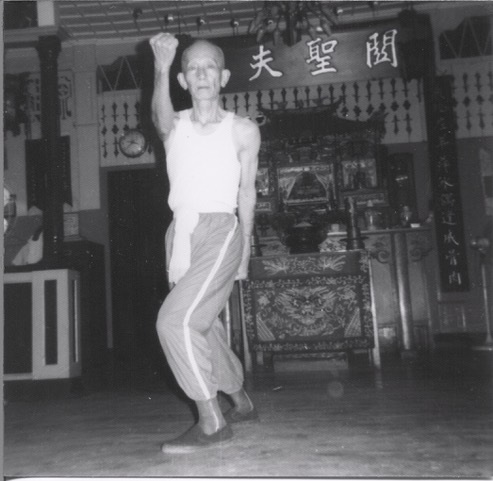
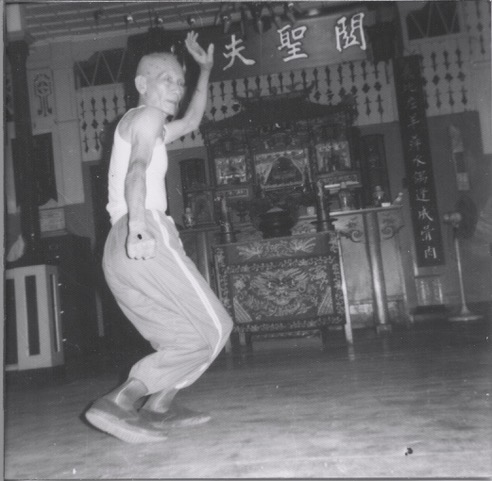
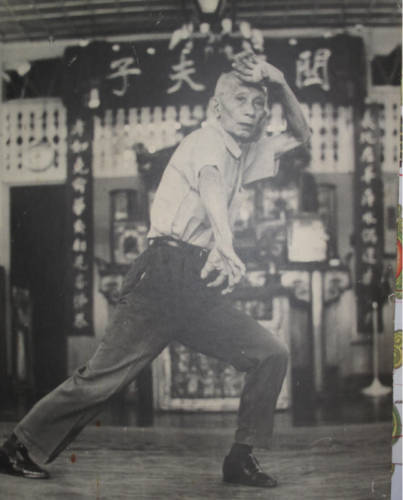
Note: GM Lao Kim was supposed to do 3 sets of a technique but he skipped one of them. Guess which one.
Performed by Master Gordon Chu, an instructor at and son of the founder of the Gin Soon Tai chi Chuan Federation in downtown Boston, the Dao/Broadsword form is the first out of 3 forms that are taught at the school. The curriculum covers different fist and weapons forms, including the 108 solo fist, staff-spear, Jian/Sword (2 forms), Talu/Great Pulling, San-shou/2-man sparring, Tai chi chuan Chang Chuan/Long Fist, and Push Hands. The school is open every day, except Sunday. It is located at: 33 Harrison Avenue (5th floor) in Boston’s Chinatown. For more information about the school, please go to: www.gstaichi.org
For more details on the video below, see this blog post: Diary 3/2/25: Dragon Tiger Video Ching See San
Tai Chi Chuan San Sou – Two Man Sparring Form
Here is a video of the 2-Men set, one of the traditional Yang Family Tai chi chuan training methds for learning the martial applications. The transmission originally came from legendary Yang Chengfu who passed it on to his eldest son and successor Yang Sao Chung. Gin Soon Chu, my teacher in Boston’s Chinatown, learned it from one of Sao Chung’s students, Lai Hok Soon (no relation).
H, Won Kim and I learned the form from Gin Soon Chu in the 1990s. Gordon Chu, the son of Gin Soon Chu, who teaches at the school in Boston, and I use to show the 2-Men set at demonstrations in Boston back in the 1990s.
Sifu Kim, the second disciple of Gin Soon Chu, has been authorized to teach the complete art in New York City since 1997.
Here is his bio from the website:
Sifu H. Won Gim has been training in the Classical Yang Family Tai Chi Chuan since the spring of 1982, under the guidance of Grandmaster Gin-Soon Chu, who is the second disciple of Great grandmaster Yang, Sau-Chung. After 15 plus years of training, Sifu Gim received the permission from Grandmaster Chu to teach the complete Classical Yang Family Tai Chi Chuan (see Curriculum) in New York City. Currently, Sifu Gim is the only person who has received this permission from Grandmaster Chu for NYC.
On September 5, 2010 SIFU H. Won Gim officially became a disciple of Grandmaster Gin-Soon Chu.
Sifu Gim supervises all the levels of his classes & teaches every student personally. With a firm belief in the value of a dedicated training, his traditional training methods & modern approaches present a unique way of attaining & understanding of the powerful internal principles of the Classical Yang Family Tai Chi Chuan, physically & intellectually.
All are welcome to observe, interact, & experience the remarkable internal power of Classical Yang Family Tai Chi Chuan with Sifu Gim & his students.
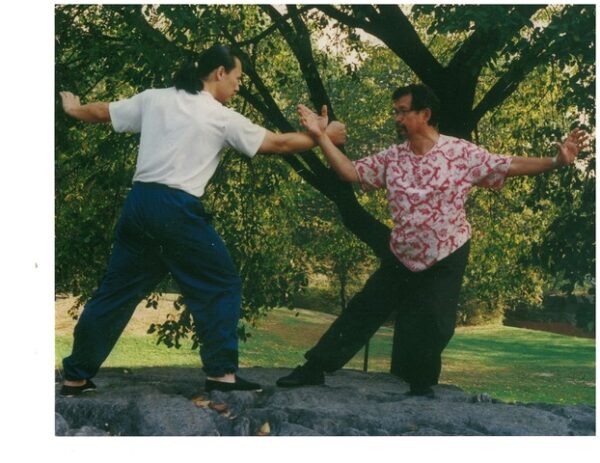
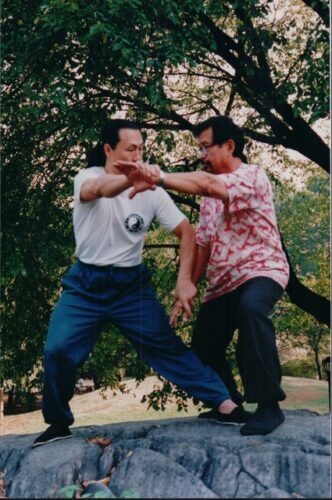
Photos below: H. Won Kim and Rene performing the opening movement of San Sou/2-Men Sparring set in Central Park, NYC, at the millennium. The 2-Men Sparring set has also been demonstrated by Vincent F. Chu and Tom Tetrault in another video available online. Photos copyright (2000) by: Laura Billingham Photography.
H. Won Kim in the Fist Under the Elbow posture of Traditional Yang family Tai chi chuan Chang Chuan/Long Fist. The rare form shows both alternating slow and fast movements. It’s not like the slow movements of the Solo Fist 108 form done fast. The movements of Tai chi chuan Chang Chang are entirely different and contain many kicks and jumps that are not in the slow 108 form. The Sansou and the Chang Chuan/Long Fist are two of the essential forms for learning the authentic martial and fajing/discharge of Jing applications of Yang Family Tai Chi Chuan. They are available in affiliate schools of the Gin Soon Chu Tai chi Federation.
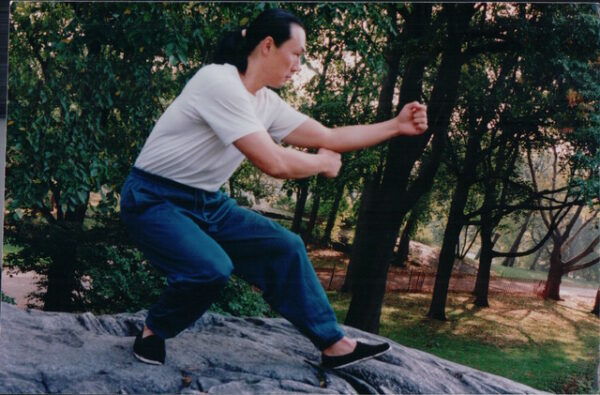
Lay monk Lao Kim studied at the Fujian Buddhist Temple during the Qing Dynasty, perhaps in the 1880s. His story is in my book “Of Fire and Water: Alchemy and Transformation” (Tambuli Media: 2023). I learned the form from him at the Hua Eng Athletic Club in Binondo, Manila’s Chinatown, in the 1960s.
Here is the video for “Offering”
Thanks to Manny Maramara for the videos of GM Lao Kim.
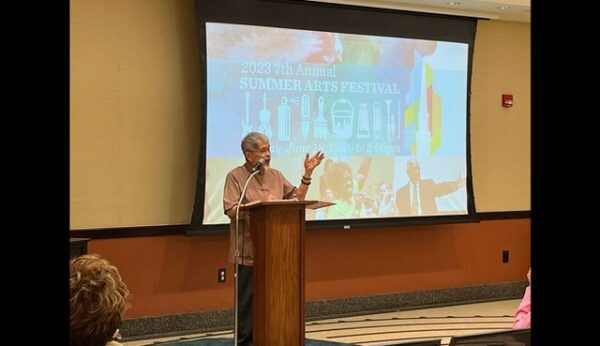
Here is a video of my poetry reading at the Marble Summer Arts Festival on June 22. I read 4 poems from my book “Ascension and Return” (Tambuli Media: 2019): Treating Father with Acupuncture,” “Clearing the Life,” “Sulu: 1074” and “Return.” It was held at the Labyrinth on 5th Avenue and 29th Street.
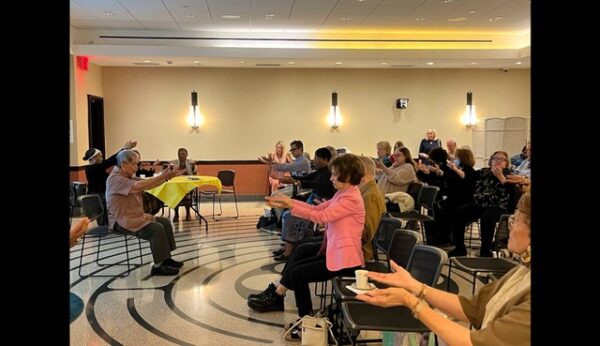
I also led the audience in the Babaylan Prayer, a series of movements drawn from shamanic rituals, to close the event.
Here are photos of my numbers from the same program last year.
Red Boy Praying to Guanyin, the Goddess of Compassion
Sorry, the video quality is poor. It was originally made on Super 8 film and transferred to VHS and finally to DVD. How it came to my possession is a long story that we’ll skip in the meantime. The performer was my classmate Ching See San, who also demonstrates the advanced Dragon Tiger form in this website.
This rare martial art form, one of the three signature forms from the Dragon Tiger Fujian Temple Kungfu system was taught by Buddhist lay monk Grandmaster Lao Kim (AKA Goon Tiong) in the Philippines in the 1960s. Several of us studied it with him: Johnny F. Chiuten, Dr. Jose Santiago “Dr.Joe” Laraya, Ching See San, my brother Florante and me. Dr. Joe and I also studied it with GM Chiuten. It would be a great experience to read the whole epic “Journey to the West” by Wu Cheng’en depicting the adventures of Monkey and Tripitaka and his guardians but I am sure it is daunting to go through the 100 chapters. However, there is a passage in Chapters 42 nd 43 of the epic that explains the “Kuanyin Twist” posture. It seems like Red Boy, a really bad character with superpowers, was in the habit of attacking the Monkey King/Sun Wukong and Boddhisatva Guanyin, among other victims. No amount of punishment could stop him from doing it. So, as a last resort, Guanyin put metal bands on his head, wrists and ankles. Whenever Red Boy misbehaved, Guanyin uttered the magic words and the bands would constrict. He would go through such excruciating pain, he would put his hands together and stand in the Guanyin Twist and
beg for mercy.
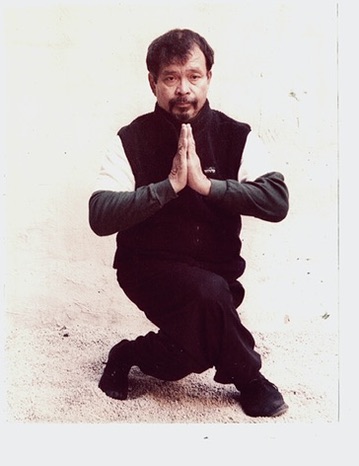
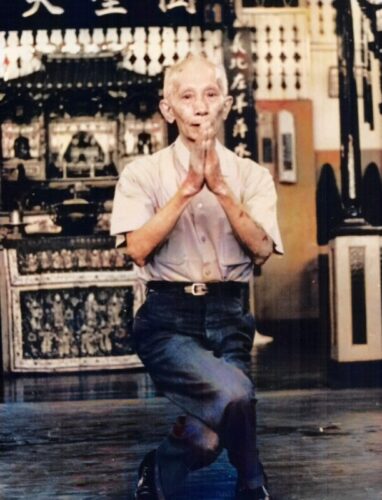
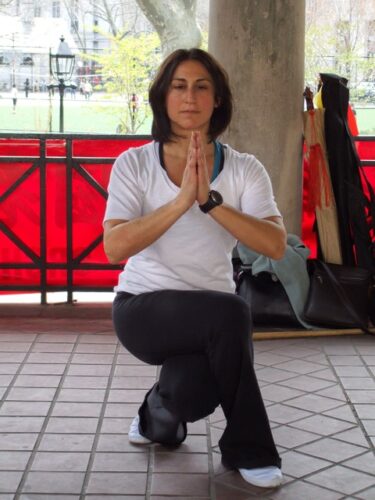
For a long time I did not know what the martial art form meant or depicted. Even when I read the novel, the Red Boy episode passed by me as I failed to make a connection to Lao Kim’s form. Perhaps it was because the Chinese name of the form was translated as Fairy Child Praying to Guanyin. It was when I looked at my old notes and saw the Chinese name – Hong Zi – that I realized who the name referred to. It was not Fairy Child but Red Boy, after all. So I went back to do my research and discovered all these references to Red Boy, not Fairy Child. There are many paintings of the Red Boy Praying to Guanyin on the internet, just in case you are curious. I have one from a calendar that was issued abut 3 decades ago.
Here is a rare video of GM Yang Sao-Chaung, teacher of Gin Soon Chu. It is the only film record of Yang Sau-Chaung doing a form.
The Guandao
There’s a lot about General Guangong (and his weapon) in books, magazines, film, theatre and on the internet, so I’ll be brief. The story about him is drawn mostly from the epic Romance of the 3 Kingdoms, a novel attributed to Luo Guanzhong. The setting for his life happened during the late Han Dynasty (200 BCE to 330CE). General Guan is arguably the most popular idol/god in Chinese iconography, adopted by Confucians, Buddhists and Taoists alike. It seems that his statue – bearded, red-faced, ferocious – is everywhere, at homes, temples, altars, restaurants. (I have four of his statues in my house.) He is depicted as the god of wealth but he is definitely much more… I studied two martial forms for the Guandao, one in the Philippines with my Shaolin master Lao Kim, a lay monk in a Buddhist temple in Fujian Province during the Qing Dynasty in the 1880s or 1890s, and the other in Cohasset, Massachusetts with Shifu John Loupos of Wah Lum Praying Mantis (now Jade Forest Kungfu) in the late 1990s. The latter is what’s featured in the video below. I also have a video of John Loupos doing the form so masterfully I am too embarrassed to watch it because I can never do it as well, no matter how hard I tried. Caveat: I honestly admit that my video of the form was made just a week or so after I finished the form. So there are obviously movements that are rough and hesitant. In short it is essentially what a BEGINNER’S FORM is supposed to look. Kungfu is an art and we often learn slowly, step by painful step. Martial forms are a type of dance. Usually we start off learning stationary postures first, and then movements one or two at a time until after a several lessons we complete the whole form. With many countless repetitions, perhaps we can develop a better familiarity with the dance until, in the language of Zen, it becomes “effortless art.” It’s called “gong”or”kung,” time plus serious and patient labor. If you do the form 1,000 times you’ll probably see a moment when everything seems to be right, there’s “flow” and smoothness, and you’re happy with it.


This version of the Green Dragon Halberd alludes to some of the images of the hero: General Guan riding his horse, General Guan sharpening his halberd, General Guan chopping the legs of a horse, General guan stroking his beard, General Guan dropping his halberd and catching it in mid-air, General Guan fighting an imaginary enemy and cutting him in half, etc. NB: Please do not do any of these movements without the assistance of a qualified instructor.
My interest in this particular halberd form has a bit of a story behind it. In 1980 sometime I was invited to be a judge at a martial art tournament in Long Island, NY and I saw a master perform the Guandao. I was immediately awestruck by it. I learned later that it came from the Wah Lum Praying Mantis school. About 10 years later, at a Healing Tao summer retreat in the Catskill, NY I met John Loupos, a Wah Lum instructor, and I asked him about the halberd. He said that he knew the form. In a strange synchronicity, I was due to move to Boston to study at the New England School of Acupuncture. So, we to an arrangement for him to teach me the halberd and I’ll teach him arnis de mano/Philippine stickfighting — and for him to find me a rental apartment close to his school in Cohasset, Massachusetts. If you do not know him, there’s a ton of background about John on the internet. He is one of the most versatile masters I have the honor to know and study with. The halberd I used in the video was made of heavy steel. John changed the wooden handle with a metal piece.
Thanks to John Loupos for teaching me and filming the form at his school in 1990 and to Manny Maramara for making the video better and providing other technical assistance.
For your convenience, here are a couple of links about General Guan:
study.com/academy/lesson/guan-yu-god-of-war-life-death
www.chinahighlights.com/travelguide/china-history/guan-yu