Blog

Bali: Temples, Offerings, Initiations

Elephant-Cave-Temple

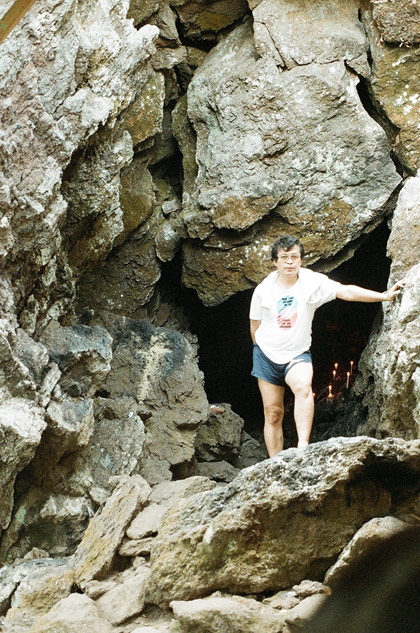
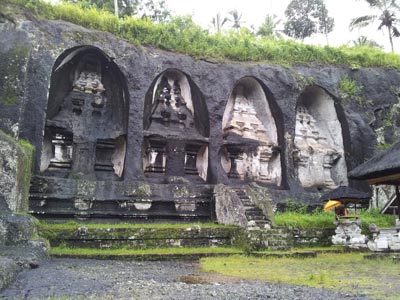
Like China, Bali has these temples carved on the granite side of a mountain. China’s are however Buddhist while Bali’s are Hindu. It is advisable to read up on Hinduism and the sacred texts and epics — Mahabharata, Ramayana, Upanishads. If you have no familiarity with the literature, you’ll probably miss a lot when you travel to Bali. Photo taken by KJ Lau of HK who said it was the cliff at Elephant Temple. I do not know if it was Gunung Kawi Royal Monument or Pura Tirta Empul. I visited the temple with Nikolay and Marina, but my camera battery was discharged. Marina promised to send me her photos when she gets back to Russia in March.

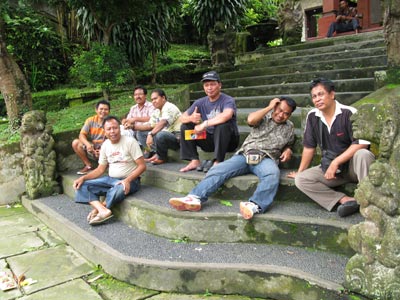
temple_steps

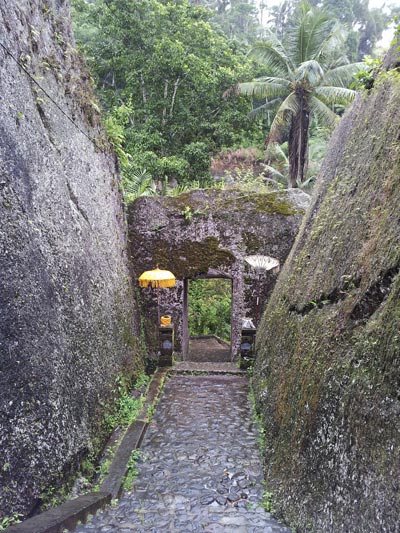
There are 350-odd steps, so you need strong legs. I do not know if climbing the steps would earn you forgiveness or merits as in the Batu Caves of Kuala Lumpur, Malaysia. Bring joss sticks to light at the different altars in the temple.

ElephantCaveTemple

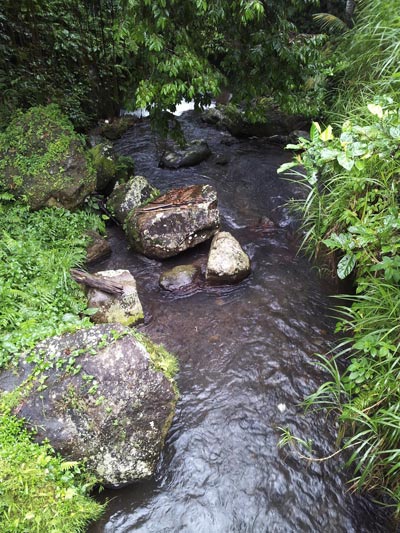
The river runs through the complex. Bring a bottle to fill with the water: it is considered healing and sacred. Like Mount Banahaw, the holy moutain in the Philippines, pilgrims take the water home to bless the house, friends and relatives.

TempleShore

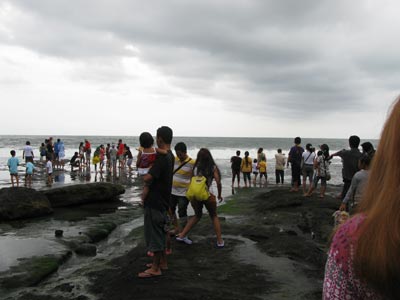
Pura Tanah Lot. There is a temple complex by the shore. When this photo was taken, the tide was high and multitudes of pilgrims (and tourists) arrived to celebrate the festival of Shiva.

Ganesha

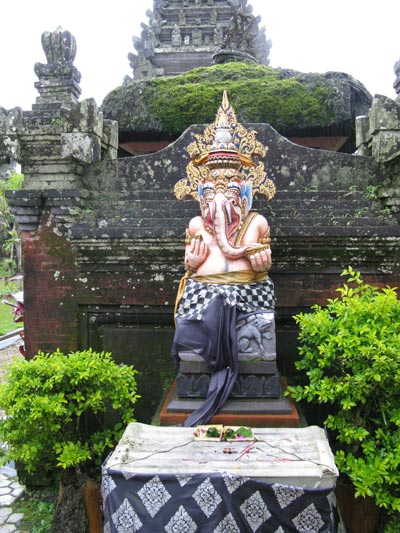
Ganesha, the elephant god, often sits at the entrance and gates of temples and buildings and houses. The god of beginnings, initiations and the arts, Ganesha has a rather complicated history: how he got to have an elephant head and trunk, multiple arms and different functions, etc. and why he is one of the foremost icons in the pantheon. In different cultures, there are different representations of the gods/goddesses in the pantheon. In Egypt, Hathor is represented as human with the ears of a cow depicting her as the symbol of nurture, fertility and motherhood.

ManShriofferings5.

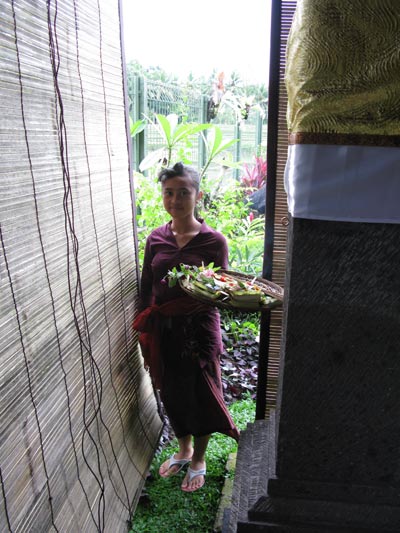
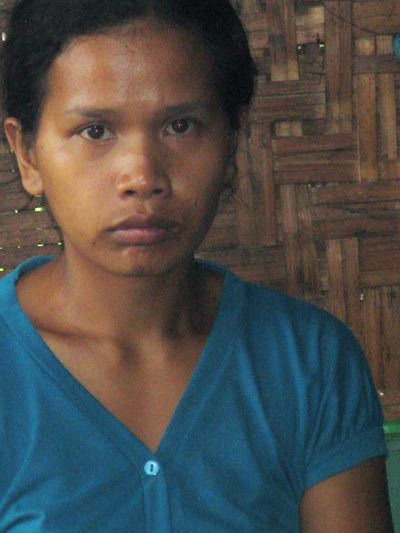
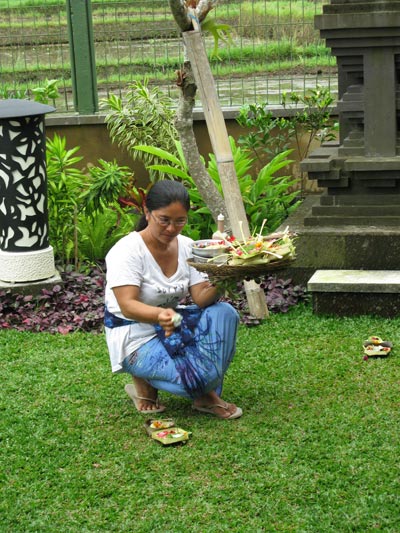
Man Sri was our help. She shopped in the market for grocery — duck, chicken, pork loin, banana, avocado, mango, mangosteen and other necessities — and cooked. She learned how to use the ginseng/renshen and wolfberries/gu ci zi I brought from the US. A few times I got her to buy fresh durian and when its distinctive perfume suffused the kitchen, she helped me eat it. Balinese durian, smaller than the Thai, was the best I have ever tasted anywhere. Durian aficionados seek it and brag about its texture and flavor. Man Sri and I sat in the terrace and chatted. She talked about village life, her personal history, and karma. From the nearby village, the music of the gamelan would drift in through the afternoon silence.

Man-Shri-offering3

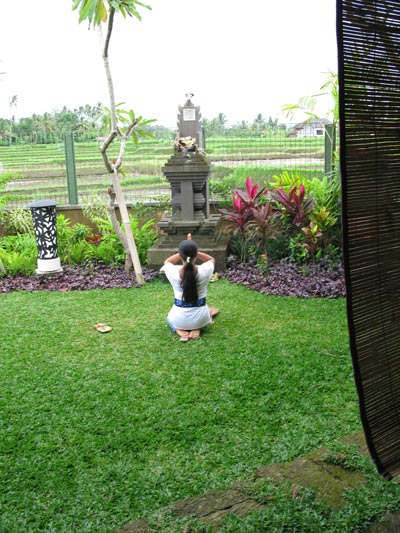
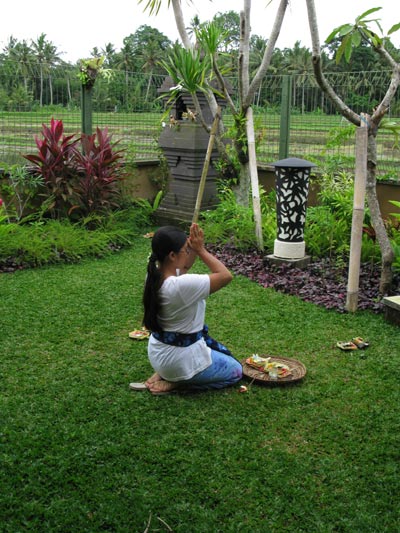
Every morning, Man Sri carried a basket of flowers, steamed rice, rice wine, and fruits, offerings to the land, the gods and goddesses, and the ancestors, and I would see her transformed into a high priestess, her long black hair flowing down the small of her back, belted with a sash and a colorful sarong wrapped around her waist, and she would sprinkle the rice wine around her, go on her knees, chant a sutra, and with palms joined together in prayer, raise them over her head. She gave me bottles of wine (rice and coconut) and everybody in the house had a toast just before I left. Sadly, I had to leave them behind. Her husband, a wood carver, made a dragon cane for me in celebration of my 72nd birthday this year of the Water Dragon.

Man-ShriOfferings


ManSriKitchen

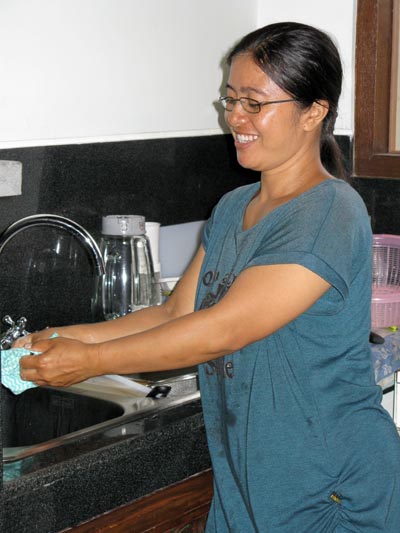
That’s Man Sri in her incarnation as the cook in the kitchen.

Shaman-at-Initiation

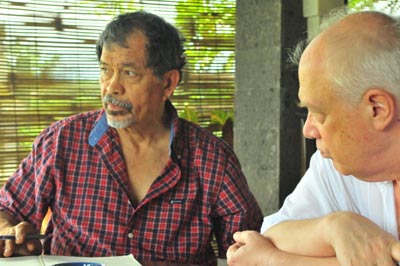
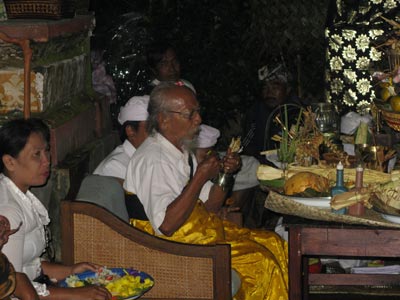
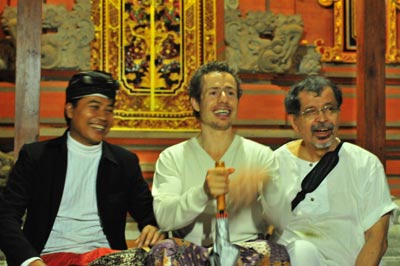
Look at this Hindu priest-shaman-healer. He presides at this initiation attended by a whole community. His voice hardly rises above a whisper but I could hear his chant from a distance. There is something about his presence, a charisma, a mystical aura that captivates his audience and followers. When we arrived, he bowed to us, shook hands and offered a cigarette and a cup of coffee. I bowed to him and kissed his hand (a traditional practice in the Philippines when one meets an old relative). He clasped my hands in both of his, a gesture that characterized our relationship. One night, after a cleansing at another temple, he held my hand, looked into my eyes and surprised me with, “Shantih, shantih, shantih!”

Courtyardtemple

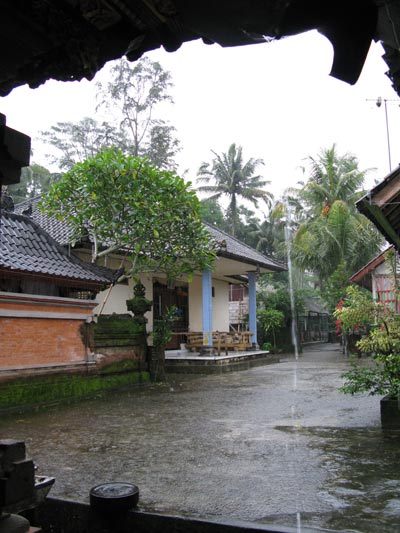
At a courtyard of a small temple in a deserted road about an hour from Ubud, we gathered for an initiation and cleansing. There was a gecko that kept barking every now and then as the shaman chanted, and gave his blessings. Outside, the patter of steady rain and the explosion of an occasional thunder and lightning.

Offerings

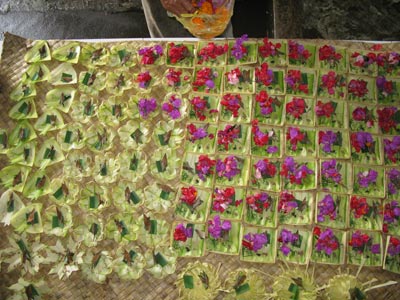
A woman prepares the offerings every day. She weaves a hundred small baskets with coconut leaves, fills them with flowers and food (usually rice). It is a tradition observed religiously everywhere in Bali.

MarinaNikolay

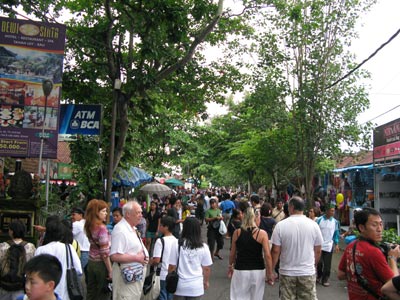
Marina and Nikolay at the crowded entrance to the Pura Tanah Lot Temple (Tanah/Land, Lot/Sea) dedicated to the goddess of the sea Betara Tangah Segara. It was a high holiday in the Hindu world, the Festival of Shiva, and pilgrims and tourists were going to the temples all over the islands. At Pura Tirta Empul, pilgrims were bathing in the spring pool for cleansing, blessing and rejuvenation.

Initiation-rites

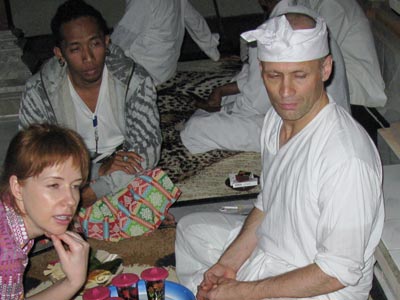
David and Rene with Indonesian disciple at a initiation ceremony.

MarinaPierre

Marina and Pierre at the initiation rituals intently listening to the stories of an Indonesian about a shapeshifter-shaman who could transform himself into an animal, usually an eagle, right before your eyes.

BackyardSpirit

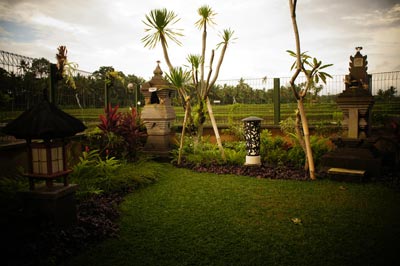
You’ll see them all over town, in front and back of houses and buildings. They are dwelling places for the spirits to rest on their travels. A kind of way station or hospitality homes for the other world.

Dateline: Ubud, Bali, Indonesia. E-Mails and Adaptations.

January 21, 2012.
We were sitting on the balcony this morning in Sawah Indah (Beautiful Rice Fields) when David Verdesi* said that Ian Baker, the writer and explorer, is arriving in Bali. In February 2006, Ian was in Bangkok and was supposed to join us in Java en route to Borobudur to do a documentary for National Geographic. David and I were visiting John Chang, the famous Magus of Java, at the time. I did not know anything about Ian Baker, but David told me stories about him. David also had an autographed copy of Ian’s book “The Heart of the World: A Journey to the Last Secret Place.” The Preface by the Dalai Lama says it is the search for the lost land, the legendary Beyul Pemako. That’s “the hidden land shaped like a lotus,” located somewhere in indescribably difficult terrain in no- man’s land in the borders of China, Tibet and India. No doubt a fascinating story and from the blurb Ian’s exploration sounded better than an Indiana Jones adventure. Hey, the search for Shangri-La is an ancient and continuing human obsession, isn’t it? We waited for Ian … and waited and waited. Meantime, in the idle hours in Java, I read the book, arguably one of the best in the genre of travel literature, up there with the works of British writers Colin Thubron, Laurence Durrell and Simon Winchester. Finally, we got the news that Ian could not come because his mother took sick in Thailand. When I got back to the US, I bought myself a copy of the book from Strand, my favorite bookstore, south of Union Square in Manhattan. I read the book all over again page after page through the detailed geography, impressive research and felicitous prose. I learned that there was a National Geographic DVD of the exploration, but I could not find a copy. I bought Ian’s other books — “Tibetan Art of Healing” and “The Dalai Lama’s Secret Temple: Tantric Wall Paintings from Tibet” – indispensable keys to Ian’s oeuvre. The former is an excellent source of information about Tibetan healing, with extraordinary paintings and sketches of different techniques, the model of the body and different organs. The latter particularly is rich in the materials of the esoteric meditation called “dzogchen” (the teachings of the Great Perfection) and probably more than any other book shows perhaps for the first time the mysterious and mystical wall paintings that are supposed to guide the Dalai Lama on his road to enlightenment. It is sad to read that His Excellency, the present Fourteenth Dalai Lama, because he had to escape from Tibet, was unable to set foot on the Lukhang (Lu/serpent deities, khang/temple)/Serpent Temple in the middle of the lake behind the Potala Palace. Contemplating the murals – in reality a veritable manual of high Tibetan Buddhist meditation – during the Dalai Lama’s retreat appears to have been an obligatory ritual. ** They were painted by mysterious artists after the Fifth Dalai Lama (1642-1682) had mystical visions apparently due to his encounter with a Lumo (female Naga).

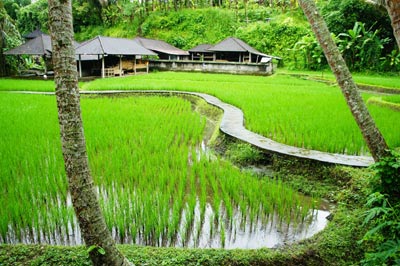
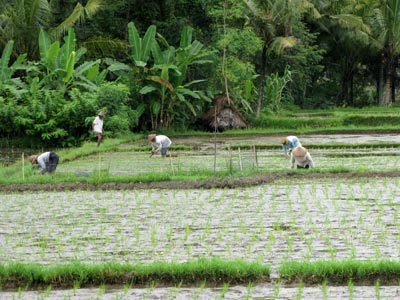
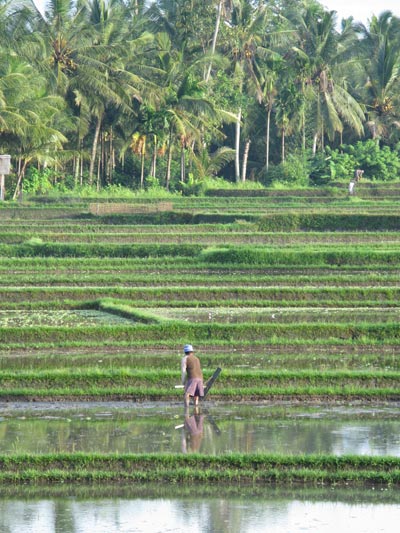
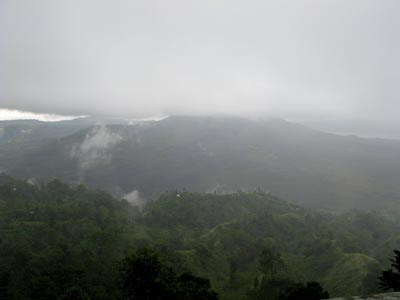
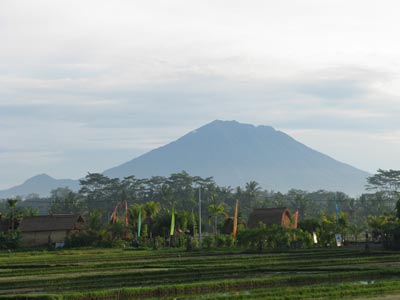
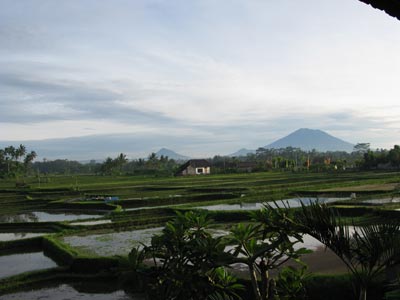
Since I arrived here in Bali on the evening of January 5, 2012 we have tried to avoid the tourist route, focusing on the training and visits to the masters. It was a good idea that David rented a house at the end of a road leading to the rice fields outside the town. We’ve had the benefit of quiet and privacy and a pleasing landscape, with a view of the coconut groves and the distant volcano.

The ceremonies have really been quite moving. The big initiation attended by the community was itself a magical occasion. I thought of how the community was bound by this faith, united in the charisma and qi of the old master, and in the culture and religion of the islands. It was, I realized, something that was missing in a westernized culture.

Sometime when we first visited at his village home and temple, the old priest asked me, through Agung the guide and translator, if my country had the same tradition. I said, No. It was difficult to explain that my country, the Philippines, was colonized, first by Spain (Roman Catholic) and then by the US (Protestant), and took a different historical route, that we have been westernized, that among other things, we have Christian processions and masses instead of the ritual Hindu dances, that we Have/had a western education …

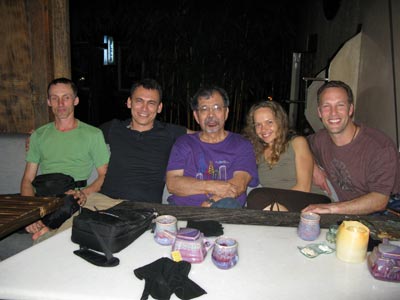
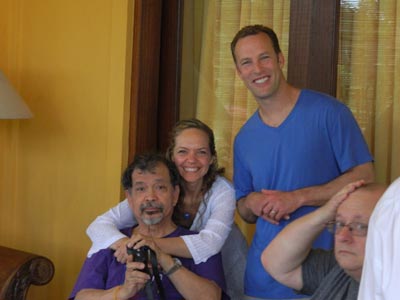
Last time we – David, Pierre, Ana, Nikolay, and me – went to the village an hour by car from Ubud, the old shaman gave all of us his blessings. As we said goodbye, the old man held both my hands in his and said, “Shantih, Shantih, Shantih.” It took me by surprise and touched me deeply. He often took particular attention to hold my hands on the four occasions we visited him. The old shaman had become a familiar figure after our third visit. I had sat with him as he wrote the mantras and demonstrated mudras of his lineage, heard the explanation for the rituals that he conducted.

It was different in many ways from my encounter with the Magus of Java John Chang who had this overwhelming power called yin-yang gong or the mating of the yin and yang in the dantian that resulted in a strong electrical current. Weda, his nephew, commented to me that the power was not spiritual. I was of course surprised to hear him say that and I thought about it for a long time and I concluded that I wanted something else … as I expressed in the concluding paragraphs of my essay “Thunder Path in Huangshan” — I wanted something else … peace and love and clarity and stillness. It is what I truly believe in. Here, in Bali, I’ve seen it in the animist Hindu culture. There is an milieu here that is harmonious, soft and gentle … I found that they have a faith in the sacred. I feel that my belief — as expressed in the essay “Honoring the Sacred” — has finally found people who are animated by it.
There are obvious similarities, of course, between Bali and the Philippines — in the language for instance. It is close to Capampangan, the language of my region north of Manila. We share the same or almost similar words – nasi/rice, bulan/moon, batu/stone, masok/entrance, ribu/thousand, dua/two and so many more. We also are similar in racial and physical characteristics. But at the same time, I notice the big differences in the religion and culture. The Philippines is westernized and Christian. It is a simplistic quotation, I admit, but the remark, “The history of the Philippines is 300 years in a Roman Catholic Convent and 50 years in Hollywood” says a lot. Despite the years of foreign occupation and internecine warfare, Bali’s culture seems intact: dances, movements, martial arts, arts and crafts, statuaries. They know their sacred and religious texts.

I’ve tried to articulate my thoughts and mixed feelings about my country where sadly, there are times when I feel like a misplaced stranger in my own home.

January 16, 2012.
I have just been through the worst nightmare of a traveler — losing his credit/debit card. I had brought what I thought was sufficient cash for the time I will be in Bali, but turned out there were other unexpected expenses when I arrived. So I decided to ask my son in the US to inform the bank that I am in Bali and will probably use the card. After all the procedures he went through, I could not find the card. I emptied my wallet and my bag. It was nowhere to be found. I drafted an e-mail to my son but did not send it hoping my card will turn up, after all. We were at the performance of the Ramayana, and I tried to focus on the show, but my mind was on the credit card. I recognized some of the characters — Rama, Sita, Hanuman, Garuda … David, my host, took me home and he and a few other companions proceeded to another shamanic event, a trance dance, in town. On the off-chance the card was in my bedroom, I went upstairs and turned the bed sheet over. Lo and behold, it was there staring at me. It was the most beautiful sight in the world at that moment. So I am here, alone, in the big house listening to Saint Saens’ Carnival of the Animals and the cacophony of the frogs and the crickets and nursing a cup of hot espresso coffee.

In 2006, I was invited by David to Java to see the famous Magus. (You can look him up on youtube for his incredible demo and read about him on my website under “Thunder Path in Huangshan.” Kosta Danaos has written about him in “The Magus of Java: The Teachings of an Authentic Taoist Immortal”. Laurence Blair has also mentioned him in a book “Ring of Fire: An Indonesian Odyssey.” I read the book in Bali. ) After close to a month, David left for Thailand. Weda, a nephew of the Magus, invited me to go to Bali with him. He said we were going to meet a strange shaman, a shape-shifter who could change into an eagle right before your eyes. I had heard about something like it from a friend who had seen it in Malaysia. Of course, I was skeptical about it. Anyway, I was supposed to check into a beach hotel, but when we arrived in Bai, Weda ordered the driver to take us to the home of his relatives in Kuta. His aunt and her husband were in the pool. There was construction (of a museum for batik, silk and other arts and crafts I heard later) going on. There were several houses in the compound. The man emerged from the pool, came up to me, and said, “Mr. Navarro, it will be an honor to have you stay with us.” I did not know what Weta said in Bejasa but I was surprised of course and did not know what to say, except give my thanks. I was given the use of a house, a car and a driver. Weda was told to sleep in the library. I said, he can stay with me.

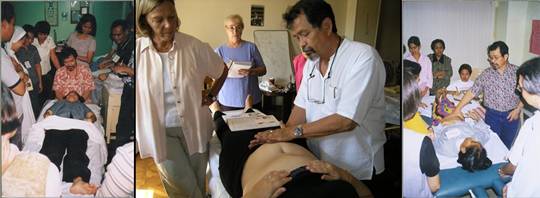
One of the places I was advised to visit was a Hindu temple where an old Hindu healer was in residence. He was doing healing when we saw him. There were about 10 foreign guests, apparently students of his, who sat in a semi-circle in front of him as he took them on one by one. He used a small and thin foot-long wand to poke at different parts of the body. I recognized them as acupuncture points. The patient would grimace and/or make a sound as the old man pressed this or that spot. And then it was my turn. I noticed that the probe he used was a wooden stick, shiny from use and in the shape of a snake. He spent about 10 minutes exploring some of the famous acupoints as I moaned and groaned from the pain. When he was done, I went back to my seat. “You have sinus problem,” he remarked. “Yes,” I said. “Do you want me to treat you?” “Yes,” I said. Upon which, he went to his desk. With his back turned to me, I could not see what he was doing. He came up to me and said, “Close your eyes.” I closed my eyes. Then, he spit on my face. “Keep them closed for 10 minutes,” he ordered. Everybody laughed. As the saliva dripped down my face, I smelled the odor of peppercorn and I felt a clearing in my sinuses. It was, I thought, a different healing modality! Something I or anybody else, no matter what the intention, could not have done in the US.

In retrospect, I realized that it was an approach that was based on a different paradigm. Each healing system has almost invariably its own foundation, its own reality and rationale … its own perception of the body. So the diagnosis and treatment are different too.

Remember that there is usually a payment required if you are going to see a healer. Inquire ahead of time how much it is. If none is required, it is good practice to make a donation just the same. I do not know if it is current, but here is information from the business card of the healer I saw in 2006:

Name: Tjokorda Gde Rai
Puri Negari
Singapadu Tengah – Sukawali 80582
Gianyar – Bali – Indonesia
Telp. (62 – 361) 294585

January 18, 2012.
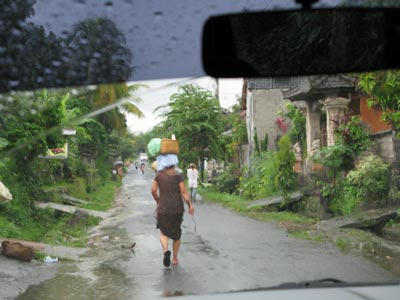
Yes, I am still enjoying Bali. Most of my time is dedicated to the training. No touristing for me here. Whatever extra time we have is spent attending rituals and meeting masters. It is an incredible place, especially if you have connections with the community and if you live outside the city. David rented a house adjacent to the rice fields at the end of the road. When I wake up, I can hear the gecko barking in the dark and the roosters announcing the sunrise. I go to the terrace and see this young woman Man Sri, our help in the house, looking like an ancient priestess, long hair flowing down to the small of her back, carrying a basket of flowers and fruits and palm leaves, her daily gift to the land — coconuts, bananas, rice, the rivers and lakes and mountains — and the gods and ancestors and she goes on bended knees, palms together above her head, and chants quietly facing the spirit house. “There’s nothing that is not sacred on this island,” David said. When you drive an hour to the hinterlands, past the rice terraces and the farms, the small villages, and the coconut and banana groves, past the quiet temples and deep valleys, and the wood and stone carvers, you’ll see a queue of women on certain holy days carrying baskets on top of their heads, walking to a sacred temple. It was one of the first scenes that astonished me the first time I visited Bali with Weta in 2006.

I was struck by the natives’ familiarity with their culture and religion. Even our taxi-driver, whom I invited to dine with us, knew the religious texts and the gods. He talked about Arjuna and Hanuman. He was like a scholar giving a lecture on his academic specialty. It was quite an experience listening to him. It was like hearing an ordinary man in China talking about Sun Wukong/ Monkey or the Romance of the Three Kingdoms or a waiter in Greece telling stories from the Odyssey or Iliad. I am happy that the big corporations like Walmart haven’t gobbled up the island and its arts and crafts — batik and silk industry, singing bowls and bells, statuaries and woodwork — and dumped mass- produced and consumer goods Made in China. Watching the performance of the Ramayana, I was impressed with two small girls dancing the legong, a long choreographic number, replete with different stylized movements. They must have trained for a long time. I can just see them emerging later as popular folk artists or national treasures. NB: I did not see any McDonald’s in Ubud or anywhere else in Bali, but I saw one somewhere on one of our excursions to the beach. It had the familiar (and vulgar) arch standing 2 stories high!

January 23, 2012.
Ian arrived at the house yesterday. I was in downtown Bali having my camera batteries re- charged at an electronics store. When I got back to the house 3 hours later, Ian was still there waiting for David. I said hello and he introduced me to his companion Rob. I told him that we were supposed to meet in Java in February 2006. He could not remember. Instantly Ian and I fell to talking about what we were doing: He was researching Tibetan yoga for his new book and was going to interview David. I said I was studying Lei Shan Dao with David and practicing Traditional Yang Family Tai chi chuan. When David came down, we went to a fancy French restaurant, ordered our dinner, and as we settled down, Ian asked David to answer some questions. We listened to David’s mesmerizing talk about Tibetan yoga, lost secrets, nei dan/internal alchemy and the incredible masters, what had happened to his Chinese connections, the Huangshan hermit Xuang Kong, Wang Liping of the “Opening the Dragon Gate” fame and the Magus of Java John Chang. Rob talked about powa, the Tibetan Buddhist technique of transference of consciousness. Ian mentioned the wai dan/external alchemical formulas of some masters he had studied with on his explorations in remote places in Asia. We swapped information back and forth, bantered, laughed and guffawed. The 12-odd tapas-like dishes materialized and disappeared. (I am not familiar with French cuisine. Is there a name for those small servings? ) One was flavored with fresh jackfruit, another was raw squid with the lingering taste of an elusive herb, still another was tuna tartare with the piquancy of a tropical spice and yet another was a fish native to Balinese waters. I should have taken notes, but I enjoyed the conversation so much, I forgot to record anything, not even with my still-functioning camera. It was the most engaging, memorable and informative conversation I’ve had within memory. Ian said it was like the movie “My Dinner with Andre.” The dinner was also the most expensive I have ever had in my 72 years on the planet. But hey, I had no regrets! It was all worth it. Nobody in the world could have contrived the night in his imagination.

Later, we took Ian and Rob to their hotel. We promised to get together again. But it wasn’t meant to be. Nicolay and Marina, the Russian couple famous for their psychic research, had invited me to tour Bali with them. Meanwhile, David had to leave for another island to see a master with incredible powers. And I did not know where Ian and Rob were.

Post Scriptum:

January 24, 2012.
Just before I left for the airport for the flight back to JFK Airport in NY, David called. He was quite excited by his new discovery and experience. He arrived at his destination in the evening during the celebration of the Festival of Shiva, a huge holy day in Indonesia. He had not eaten anything and was mustered into an overnight sitting meditation that ended at dawn. The master had given him a powerful initiation, zapped his dantian with unbelievable heat, and basically adopted him. It was all he could report at the time, he said. There were certain important details he could not talk about on the phone. And then he had to go because he was being called back for the continuation of the training. It had been going on for the last two days, non-stop. I wondered if he had eaten yet!

Wayan, the taxi-driver, picked me up early. Nikolay and Martina hitched a ride to town. I dropped them off at a museum. Meeting them was another serendipitous synchronicity in my life. It was a gift that I did not expect. We attended shows and initiations. We participated in the fire rituals. We had breakfasts together. We visited temples and museums. We spent more time together than I had anticipated. In fact, we spent more time with each other than anybody else. Who knew that I would be able to study (and see a psychic phenomenon) with these exceptional Russians when I came to Bali? As arranged by David, Nikolay gave me lessons and I gave him treatments over a period of two weeks. When we said good-bye, I knew I would miss them. When I hugged Nikolay, I said: “My friend and teacher.” He almost simultaneously said, “My doctor.” When Marina and I hugged each other, I felt her gentleness and stillness. There was nothing else to say.
On the long drive to the airport at Denpasar, I remained quiet, deep in contemplation of my “fortune,” what I had gone through and experienced and the wonderful people I had encountered in Bali. Wayan stopped at a batik store. I picked up some sarong and a piece of woven batik material Ava, my granddaughter, asked me to bring. At 11 she designs and sews her clothes.

I treated Wayan to dinner at a restaurant, one where you could sit barefoot on colorful cushions at low tables and watch the fish in the pond. He ordered fried rice/nasi goreng while I had a deep-fried fish and spicy pickle. We slowly ate and nursed our Indonesian beer. There was nobody else around. He hummed an Indonesian tune. He told me that many people would come to this place with their families on weekends and holidays. They would fish in the pond and grill what they caught. I asked Wayan about his family, how were his kids doing in school. He gave me the usual answers: they were doing well. I thought of the cultural context of his remark. I sensed the stoicism born of his awareness of karma. In some societies, people prefer not to say they are doing very well – or that their daughter is beautiful or son handsome — because it might bring down the anger or jealousy of the gods on them. Sometimes they won’t say the truth about their life because of pride or a sense of privacy. I asked him to write his address in my journal so that we could keep in touch.

When we reached the airport, I asked Wayan how much I owed him for the limousine service. He said in his halting English, “Anything you like.” When he picked me up from the airport on my arrival, he charged me the equivalent of $30 or $40. It was actually cheap considering that the airport was very far. He explained that he waited a long time because of the rain and the delayed luggage. He was usually specific about the fee – often between 300,000 and 400,000 Rupiah — when he took us on our expeditions around the island. But for the first time, I got a vague answer. I felt that he and I had crossed a boundary in our relationship.

February 15, 2013.
There’s a 13-hour difference between Bali and Pennsylvania. It took me a while to recover from jet lag. I preferred Singapore Airlines or Thai Airlines, but I could not book my flight with them. I had to take Qatar Airlines through Travelocity … and it was very expensive, perhaps because I decided to go to Bali only two weeks ahead. It took about 30 hours, including layovers, to get to Denpasar International Airport in Bali. JFK to Doha (approximately14 hours plus 8-hour layover), Doha to Singapore (11 hours and 2- hour layover), Singapore to Bali. From Denpasar back to JFK was the same route, except the layover at Doha was reduced to 3 hours. I arrived at JFK at about 2 pm. Between customs and immigration and my luggage, I missed the 3:30 TransBridge Bus to PABT in NYC. I had to wait for the 7:30. By the time I got home and settled down, it was past midnight.
*For more information about David, go to www.davidverdesi.com

** Caveat: In his introduction to the book, HH the Fourteenth Dali Lama Tenzin Gyatso says: “Originally, the Tantric practices illustrated by these murals were revealed only after years of study and meditation under a qualified teacher. Without understanding the context of compassion, the awakening mind and the emptiness of inherent existence within which they function, the methods of Dzogchen and the Highest Yoga Tantra could easily be misunderstood. Nevertheless, I believe that these paintings can be a source of profound inspiration even for those who have had no previous exposure to Tibetan Buddhism.”

APA Seminar, Pennsylvania: DragonWell QiGong

DragonWell QiGong

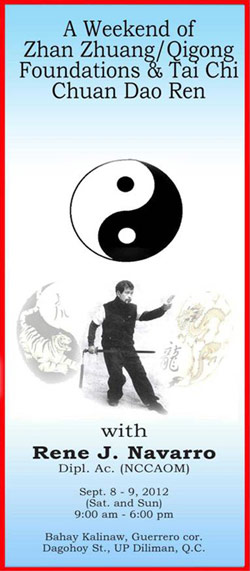
With Rene J. Navarro, Dipl.Ac.

Sunday, March 4, 2012

10:00 a.m. – 6:00 p.m.
Won Institute of Graduate Studies
Sponsored by the Association for Professional Acupuncture in PA

About Rene Navarro:

An internationally known teacher, Rene J. Navarro, Dipl.Ac. (NCCAOM) has been involved in the martial arts, healing, acupuncture, daoism and self-cultivation since the early 1960’s.  Rene’s studies have taken him to Indonesia, where he met the Magus of Java, and Huangshan, China, where he encountered the incredible hermits of Lei Shan Dao.  He has written articles and poetry about his travels and studies and has taught students with similar interests all over the globe.  He graduated from and was a faculty member of the New England School of Acupuncture, and also was a certified instructor of the Healing Tao with Mantak Chia.  He has traveled the world and studied with many masters; for more information about his remarkable life, go to www.renenavarro.org.

About the Workshop:

DragonWell QiGong includes the 3 Breaths, the Inner Smile and the 6 Healing Sounds, which are traditional practices in China. They are part of Taoist self-cultivation for healing and longevity.  DragonWell QiGong is a healing sequence that incorporates different postures and movements that come from the traditional repertoire.  This course will enable the practitioner to heal the organs, develop stillness and focus, grow qi, and strengthen the physical and energetic body.  It will also enable practitioners to share these practices with their clients.

Sign up for this 7 NCCAOM PDA point (pending) class now!
$135 for APA members (NJAAOM, MAS, ASNY)
$150 for Non-members
Please bring your license # with you for PDA’s.

Go to www.acupuncturepa.org for Registration Form and Directions.
Janice MacKenzie, L.OM., Seminar Coordinator – acujanny@verizon.net

Fairy Child Praying to the Goddess of Mercy Kuanyin Workshop

[singlepic id=4 w=520 h=440 float=none]
Fairy Child Praying to the Goddess of Mercy Kuanyin

Saturday & Sunday, Jan 28-29 2012

10:00 AM – 6:00 PM

DANY Studios

305 West 38th Street

New York, NY 10018

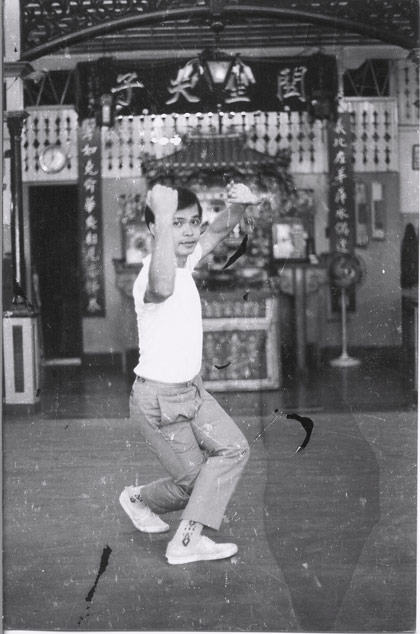
Rene J. Navarro learned this rare and mysterious heirloom from Lao Kim and Johnny Chiuten, both grandmasters of the Shaolin system, in the Philippines in the 1960’s.It is one of Rene’s 3 favorites from the Buddhist transmissions of these famous teachers. The 2-day seminar will cover basics first – stationary and moving stances, breathing, hands techniques and movements – and then the form. The emphasis will be on the correct execution and the yin aspect of the movements. Good stamina, flexibility and focus will be required of the Participants.

Courses is $150 for Saturday only, $250 for both, $20

discount for seniors and students.

IT IS NOT POSSIBLE TO DO SUNDAY ONLY

$25 discount for registration by 1/15/12!

To register,

Call 212-243-6771, e-mail taosharon@earthlink.net

or visit http://taosharon.com/specialevent.html

An internationally known teacher, Rene J. Navarro, Dipl. Ac. (NCCAOM) is a licensed acupuncturist, published writer and poet, healer and alchemist. In a quest that spans 50 years of training and many countries, he has studied with: Lao Kim and Johnny Chiuten (Shaolin); Gin Soon Chu and Vincent F. Chu (Traditional Yang Family Tai chi chuan fist and weapons); Mantak Chia (Healing Tao); David Verdesi (Lei Shan Dao); Mat Marinas (Arnis de Mano); Kiiko Matsumoto (Japanese acupuncture); Jeffrey Yuen (Chinese medicine), among others. He has 3 poetry collections: “Du-Fu’s Cottage and Other Poems”; “Ascension and Return: Poetry of a Village Taoist”; and “The Weaver Girl and the Shepherd Boy.”

Register Early

Taiwan – CKS Park

Chiang Kai Sek Park is literally a huge area with several buildings and gardens. You can get lost if you agree to see a friend without specifying which exact spot you are to meet. Which actually happened to me. There is a western type garden with trimmed bushes and trees and straight walk. There is also a Chinese garden with trees, pathways, a pond and a bridge with a long walkway with a roof, winding path and several Chinese buildings. There is also in it an unusual walk covered with stones where a few people walk barefoot to stimulate the acupoints of the feet, popularized in the West as reflexology. I guess you can walk on all fours to stimulate the palms too … or lie down to stimulate the acupoints of the back. The man who demonstrated his technique to me ran from one end of the path to the other, a distance of about 50 feet, within a minute without pausing. He said he was 65 years old. Since over-stimulation of the soles of the feet can drain the energy, I wonder how long he does it. I saw him a couple of times over the span of 2 hours.

You’ll find several exercise groups who have staked their territory in different places. You’ll see them in the same spot doing their routines almost every single day. There are some who would rather do their regimen alone, say, under a tree or by a pond. I saw one, his or her head covered with an unusually big hat that drooped over the entire face, who practiced I think for at least 2 hours without moving from the same spot directly under the canopy of a tree. Perhaps s/he did not like to get distracted like meditating monks who wore hoods. S/he made no sound and only the arms moved.

I was curious about the status and quality of Tai chi chuan in Taipei. One of my teachers in Manila’s Chinatown in 1970– Lao Yun Hsiao – was a Taiwanese. My first Tai chi teacher at the Hua Eng Sporting Club Chan Bun Te’s master – Han Ching Tang so often featured in Robert Smith’s books – was also a Taiwanese. There were several groups of Tai chi chuan practitioners in the Chiang Kai Sek Memorial Park. One was doing contemporary Wu-Shu Chen Tai chi (both fist and sword), which I did not see when I was in town last October 2010, on my 70th birthday. At the time, to my astonishment, I had a glimpse of Adam Hsu, a famous Pa-Kua Chuan teacher in the West who has since then moved back to Taiwan, jogging. Another group practicing on the CKS Hall itself was doing a traditional Yang Family Tai chi chuan form, a version that I haven’t often seen anywhere else. I should mention that in October 2010 and this time around (Sept 2011) I saw a man carrying an apparently heavy backpack who for at least an hour walked up and down the CKS Memorial Hall that has about 100 steps. That was all he did. I thought of talking to him but he never did stop to rest or look at anybody.

Whenever I visit a country with a big Chinese population, I usually inquire if there is a Tai chi or qigong group and drop by to observe them. I saw a small group in Rome, just a short distance from the Termina railroad station. There was an old man there doing a Yang Family Tai chi chuan form, an old version that he probably picked up in the park. In the Philippines there are several parks in MetroManila where the Chinese congregate for traditional practice in the morning. Many of them do Wu-Shu Tai chi, the stylized form, choreographed under the Communist regime. Usually, there is also a ballroom dancing group, which is often bigger than the Tai chi or qigong group, 10 to 1. It may be an unjustified conclusion but I think that Tai chi and qigong may soon be overtaken by ballroom dancing in the number of practitioners in the near future. When I asked my students in China if anybody did Tai chi, they said no, it is old-fashioned, and they preferred basketball. (Asked where they go to meet friends for dinner, they also said that they go to McDonalds or Burger King.) The westernization of China has apparently resulted in a disturbing identity crisis and a higher incidence of obesity in children.

I went to another park, a smaller one about 30 minutes walk from the hotel. There was nobody doing Tai chi. There were four or five groups and the qigong they did was probably contemporary because they did it with western musical accompaniment (like the song 500 Miles). There were two large groups of ballroom dancers however. Most of the time, they did tango to the tune of the old music from my childhood, “Jealousy” (“ … every night you tortured me…”). There were two groups doing exercises on the monkey bar.

Very often I would find Filipino men and women who work as domestics in the country. Whether it is in Rome, Cyprus, London, Hongkong, Malaysia, etc. they would be in the park taking care of their wards — usually older people. We would recognize each other and without missing a beat, talk in Pilipino, the national language of the Philippines.

At the CKS Park, I saw birds I had not seen before. They came in pairs and would do their quick acrobatic mating in the air. In Xihu/West Lake, Hangzhou, there were long-tailed magpies that kept chasing each other frantically and tirelessly among the top branches of a tall tree. It gives me a feeling of gratitude when I see birds and squirrels freely cavorting in parks frequented by people. In a park in Shanghai, I saw birds in bamboo cages hanging from a tree; they were pets valued for their colorful feathers and plaintive voices. Every now and then I would see them hanging from the rafters of a restaurant while their owners had breakfast.

Taiwan – Taroko

Taroko is a part of the Hua Lien region of northern Taiwan. It is a mountainous terrain that is famous for its landscapes, marbles and stones. It is good to take the morning plane going there and return to Taipei on the afternoon train. That’s exactly what a group of 8 did although I heard that a Japanese man was probably left behind on the way back because we and the travel guide did not see him board the train or get off in Taipei.

After you arrive, you ride a bus and are taken to the first stop, a marble marker across from a red bridge. The marker has some calligraphy saying that this is Taroko. Everybody seems to carry a camera in this group and each one takes multiple photos of the place at each stop. From the gateway, you are taken from place to place, each spot an awesome scenery — dizzying cliffs and gorges, still or raging rivers (from the recent typhoon), temples on the marble mountainsides, and waterfalls. The cliffs have stunning textures, sometimes with caves, always with unusual patterns.

The mountainous range — there’s not just one single mountain or two, but many, each one with a cloud-covered summit. I wanted to do meditation and Tai chi but for an 8-hour visit, the time wasn’t enough even for doing one form. I probably should have decided to stay for 2 days at least. Camping is available, so for those who have plans of going there, it is something that should be seriously considered. On my trip to Huangshan/Yellow Mountain in 2007, 3 full days were allotted. I was able to trek up and down several peaks, do several sets of the Classical Yang Family Tai chi chuan form, walk up to a peak at 4 in the morning and watch the sunrise.

Even a remote region like Taroko, the roads and bridges are first-class. They reminded me of the roads and bridges of China and Thailand, countries that as far as I know have spent much of their budgets on infrastructure and not on external wars. The subway and train complexes of Taiwan and China are also excellent. One time in 2007, my friends and I took a taxi from Tunxi to Hangzhou. It took almost 5 hours to navigate the trip. Amazingly, the wide 4 lane highways, sometimes going through tunnels and passing unpopulated mountains, were all newly built.
Taiwan – Wedding & Tea Master

A Chinese wedding banquet at the Sheraton Hotel. Roger, the bridegroom, wore only his one suit. Very often however, in the course of the proceedings, the bride changes 3 times. In this case, at first Aishuan put on a white gown, then a pink one, and lastly, at the end of the banquet, she wore a red one to greet the guests. From my experience attending at least 7 Chinese Wedding Banquets, I noticed that there is a variety of dishes, at least 20, and that doesn’t include the appetizers. Many of them are excellent. I have tasted lobster, hairy Shanghai crabs, turtle, duck, sharkfin soup, sharksfin soup, razor clams. On my 70th birthday, Aishuan’s mother spent a day shopping and a day cooking. The list of dishes included, among others: black chicken with herbs, pig’s trotters, taro cake, sticky rice, dried fish roe sandwiched between oriental pear, and steamed snapper. At a party, if you plan to stay sober and not stagger to the taxi queue,  be sure not to say “gan bei” at a toast because that means “bottoms up.”

Taiwan.-Aishuan-and-Roger.-

Taiwan.-Aishuan-Wedding

Aishuan.-Wedding

Aishuan.-Wedding.-CW,-RN,-R

It was my last day in Taipei. I was “sauntering” in the neighborhood and saw this small tea shop. There were people inside having tea. I was invited to come in. An old Chinese was presiding over the ceremony, serving the most expensive tea I have ever tasted in my life. The teas were something like 10 to 20 years old. I cannot find the adjective to describe them. After exchanging information, he asked me to do a bit of Tai chi. While I did the first section of the Classical Yang Family Tai chi chuan solo form, he chanted a sutra that sounded familiar to me. Then he wrote something on a piece of paper saying that Tai chi will clear the mind. There’s more but I can’t translate it. It was great sitting right across from the master whose qi and stillness, especially when he closed his eyes, and presence just permeated the tea shop. He served more of the expensive tea and then he chanted again, this time a longer sutra which was also vaguely familiar to it. That “accidental” encounter was probably the highlight of the whole journey. Oh yes, I bought a rather cheap tea — compared to the $400 -500 kind — at $136!

taiwan-tea-shop

taiwan-tea-shop-group-shot

Manila

1. Ed Maranan, Carlos Palanca Hall of Fame Awardee for Literature, to my right. His sister Ellen is to my left. I was his guest at the dinner ceremony.

Manila Palanca

2. Group shot of writers at the Carlos Palanca Memorial Awards for Literature ceremony at the Peninsula Hotel. In front of me (seated) is Alfred “Krip” Yuson, professor of English literature at the Ateneo de Manila University.

Manila.-Palanca.-Group-shot

3. Seated from left to right: RJN, Krip and Edgar.

Manila.-Palanca.-Krip,-RN,-

4. RJN, F. Sionil Jose, and Edgar. Frankie S. Jose is a national artist for literature. I met him a few times in the course of 50 years in conferences, at his bookstore Solidaridad, and at the PEN congress in Cebu City. He was the speaker.

Manila.-PalancaRN

5. Edgar Maranan, who invited me to the ceremony, receiving his prize in the raffle in the amount of P50,000 roughly equivalent to $1200. Before the winner was announced, Ed said that he never won anything. I said he will win. A few moments later, his name was called from the stage. Coincidence?

Manila.-Palanca.-Ed.3.

6. Ed and Rene with Mikael de Lara Co and his wife. Mikael, an award-winning poet, read “Immigrant” by Lourdes Marie S. La Vina, prize-winner in poetry.

Manila.Palanca

Post scriptum:

Ed and I first met in London about 7 to 8 years ago. He invited me and Patrick Rosal, a prize-winning poet from the US, to read at the Philippine Centre at the time. Ed and I used to have dinner together with Paolo Coghe of Sardegna, at a flat in Barnes overlooking the Thames. I cooked, Ed brought a bottle of wine. We had memorable and extended conversations about politics, religion and literature (sorry, nothing about sex, GBS).
Ed and I have met since then in Manila. He was my guest at my seminar on Tai chi chuan last time I was in Manila during my 70th birthday. To receive a Hall of Fame recognition, a writer has to have won at least 4 first prize awards in the main categories.

It was the first time Alfred “Krip” Yuson, a professor of literature at the Ateneo de Manila University, and I met although he and I have known each other through our literary work for years. He probably recognized me from my photo somewhere and approached me to say hello. Great to finally meet you, Krip. A much-awarded writer, fictionist and poet, Alfred has included my poetry in the books he co-edited: “Eros Pinoy: Erotic Poetry and Art in the Philippines,” “Father Poems,” and “Love Gathers All,” a book of love poems published simultaneously in Singapore and the Philippines. Believe it or not, Krip honored me with a complimentary cameo appearance in his award-winning novel “Voyeurs and Savages.” Please note that I was neither one of the voyeurs nor savages he was writing about. If you are curious about this bit, tell me and I will send an excerpt. It is amazing to appear with my real name in this work of “fiction.”