When Yang Lushan/Losim was supposed to be eavesdropping in on the secret classes of Chen Chanxing, what did he see? The records, true or false, indicate he saw fist forms and Push Hands. There is no indication that weapons – long or short – were practiced. When Zhang Sanfeng developed his own version of Tai chi chuan, it was a fist form that he choreographed. No mention of weapons at all. How many fist forms were there? When were the weapons forms developed and included in the curriculum? How did the curriculum develop? We’ll probably not know for sure.
According to the Yang Family, their curriculum had no staff form. What they had was a spear form for 2 people but because of an “accident” – reportedly somebody was stabbed with a spear – the family began using a staff. GM Gin Soon Chu developed a staff form based on the spear form of General Lubu. How did the spear form of General Lubu come into the Yang Family? We have no information. It is not part of the public curriculum, i.e., it is taught only to the family. The other styles of Tai chi chuan have their own fist and weapons (single and double) forms.
Which brings us back to the question: How did the curriculum of fist and weapons develop in the course of history?
I cannot answer the question and I do not know of anyone who has addressed the question either. But probably we can conclude what the public Classical Yang Family Tai chi chuan curriculum might have been from what Gin Soon Chu taught in Boston. Master Chu was the second disciple of Grandmaster Yang Sau-Chaung, the heir and eldest son of Yang Cheng Fu. Therefore, he is arguably as close to the Yang Family as we could get. Here is a list of the courses that he taught when I studied with him.
*The Traditional Yang Family Tai Chi Chuan curriculum:
1. Solo Fist form (108)
2. Tai chi walking
4. Dalu/Great Pulling
5. Staff-Spear (single and paired)
6. Broadsword form #1, Broadsword form #2, Broadsword Form #3
7. Sword form #1, Sword form #2
8. Push Hands (Stationary and walking, one hand, two hands, etc.)
9. Fajing/Discharge of Jing
10. Sanshou/2-man fighting
11. Tai chi chuan Chang Chuan/Long Fist
12.Tai chi Fast form
Caveat on #12: it was not listed in the curriculum but it was taught as a separate course by Vincent F. Chu, the son of Gin Soon Chu.
It is possible, even probable, that there are other forms – fist and weapons (like General Lubu’s spear) and internal work– that were not included but the list, add or subtract a form or two, is a good indication of what was covered by advanced students.
I could be wrong but Gin Soon Chu was most probably the only disciple in the Yang Sao-Chaung lineage who taught this list. There were other disciples but I have seen no indication that they learned the same curriculum. From the record, Chen Weiming (he mentioned what he studied in his books) apparently learned the solo fist form/108, the Broadsword #1, Sword #1 and Tai chi chuan Chang Chuan. There’s no available evidence that other students outside the family learned Tai Chi Chuan Chang Chuan studied it with Yang Cheng Fu. But it is possible disciples like Fu Zhongwen learned it, too
I look at what Gin Soon Chu studied, not only from the Yang Family but also from other masters, and I am truly amazed. In an interview with Vincent F. Chu, Gin Soon’s son, there is this list:
RJN: List the forms (Tai Chi Chuan fist and weapons, meditation, and chi-kung) he studied
with GM Yeung (Yang) Sau-Chaung and other master(s).
VFC:
A. Chi Kung or Gong-Exercises
a. Center Harmony Chi Kung
b. Three Circles Exercise
c. Yi Jin Jing
d. Ba Duan Jin (Eight Piece of Brocade)
e. Circular Standing Qigong
f. Internal Martial Art 8 Postures
g. Tai Chi Small Knife
h. Dragon Claw
i. Tai Chi 13 Stances
j. Micro-Orbital Meditation
B. Traditional Tai Chi Chuan Solo Forms
a. Medium Frame Solo Form
b. Large Frame Solo Form
c. Small Frame Solo Form
d. Crane Form
a. Tiger Form
b. Snake Form
c. Tai Chi Chung Chuan
d. 108 Techniques Tai Chi Chuan
C. Push Hand Exercises
a. Stationary Step Single Join Hands
b. Stationary Step Double Join Hands
c. Dynamic Stepping (Stepping on the flowers)
d. Dynamic Step Single Join Hands
e. Dynamic Step Double Join Hands
f. Great Pulling (Da Lu)
g. Opening and Closing
h. Four Corners and Four Directions
i. Dynamic Push Hands Exercise
D. Weapons
a. Tai Chi Knife: A/B/C/D
b. Tai Chi Sword: A/B/C/D
c. Tai Chi 13 Spears Set
d. Small Flower Spear
e. General Lu Bu’s Halberd
Explaining a few of the more obscure forms, Master Vincent Chu said:
a Three Circle Exercises is a group of exercises involve the upper body, middle body and
lower body to lubricate the bodily joints.
b. Internal Martial Art 8 Stances is a standing exercise with 8 positions of bird, snake,
tiger, dragon, heaven, earth, wind and cloud.
c. Tai Chi Small Knife (dagger) is a technique to apply the thumb as a weapon.
d. Tai Chi 13 Stances is an exercise divided into static and dynamic with 13 positions.
The static condition is to condition the body and the dynamic condition is for fa jin
exercise.
e. Dragon Claw is a grasp technique by applying the fingers. Any part of the body can be
a target, not the bodily joints only as in the eagle claw.
It is a comprehensive encyclopedia of martial and internal arts. Going over the list, I noticed that a few others are not included. For instance, dit da/ traumatology or the art of healing injuries which I saw Chu shifu doing on Linda, a disciple who had an injury on her hand from Push Hands during one afternoon when there was no class. He also learned and taught the list of 28-odd fajing methods and demonstrated them in public. I know that Chu shifu also studied pressure points striking because in a couple of lessons, he showed me some of them!
Another question: What are the practices that constitute the essential or core practices of Tai chi chuan that lead to mastery? What practices would you consider the minimum courses or exercises that you could call Tai chi chuan? There is so much in the spectrum nowadays. One woman told me she was studying Tai chi. When I asked her what she was practicing, she said she did not know the name(s) but she demonstrated a couple of postures, one of them resembled Embracing the Tree. Seems like TV adverts are showing different exercises that are labelled Tai chi chuan. The repertoire is so varied that it makes me wonder how Tai Chi Chuan is defined now.
When I saw my first Tai chi chuan teacher Chan Bun Te in 1987, he told me that Microcosmic Orbit and Sexual Practice were important in the study of the art. This was a revelation to me confirming what another teacher Mantak Chia had told me also. So, as Tai chi chuan evolves it seems to have “picked up” a few disciplines along the way like a snowball. The masters were not just practicing strictly Tai chi chuan exercises, they were incorporating other regimens that apparently brought their abilities to a higher level.
So from the most simple “Chair Tai chi” to the internal Microcosmic Orbit and other more difficult meditations, the art has come into the public consciousness as a kind of inclusive discipline and covers expanded materials. I have seen many websites that advertise Tai Chi Chuan classes. One showed movements that I have not even remotely associated with Tai Chi Chuan before. Another website said the Tai Chi Chuan teacher studied Tai Chi and karate without specifying the style, forms and/or lineage. Still another website mentioned that the teacher started studying Tai chi in 1984 with a couple of Cheng Man Ching’s “senior students” and became an instructor in 1985. There is, in short, a strange vagueness and a lack of transparency in the teachers’ credentials and the materials of Tai Chi Chuan. So it seems you could get away with a few claims and nobody is going to know any better nowadays.
The Lineage of Yang Sau Chaung/Shou-Chung, heir and first born of Yang Cheng Fu:
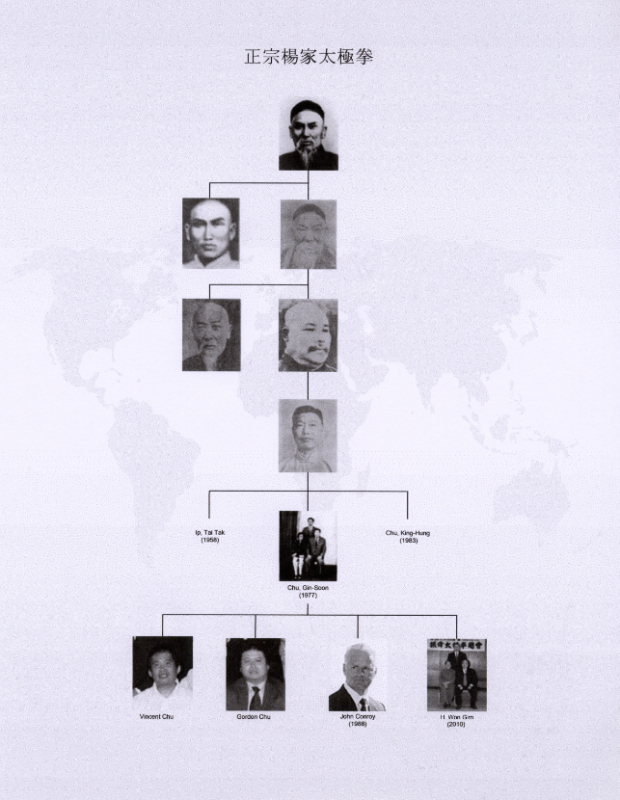
Here are the names of Yang Chengfu’s children and their birth dates:
- Yang Zhenming (Yang Shou-chaung / Yang Zhenming) (DOB 1911)
- Yang Zhenji (DOB 1921)
- Yang Zhenduo (DOB 1926)
- Yang Zhenguo (DOB1930)
Yang Chengfu was born in 1883 and died in 1936. His son Yang Sau-Chaung was already a famous master and acknowledged as his successor when he, Chengfu, died. If we admit that Sau-Chaung started studying Tai chi chuan when he was 8 years old, that would mean he trained with his father for a long time. Possibly at least 15 years, perhaps. He became his father’s assistant since he was 14/15 years old and started teaching on his own when he was 18. You could see from the birth dates of his other brothers that he was the only one of them who had the real opportunity to carry on the family tradition because the other brothers were too young to have studied, much less mastered, the curriculum. Yang Zhenji was 15, Yang Zhenduo was only 10 years old and Yang Zhenguo was 6 when their father died. How much did they study by the time their father died?
Another question: What did each one of them study with their father? I believe that anyone who claims to be a disciple should come up with a list. A claim of discipleship and/or study should at the very minimum provide details of the work or the curriculum covered. Clearly, you cannot simply say, “I studied everything” and leave the details to guesswork and the imagination. From the information we gathered, Yang Sau-Chaung the oldest son inherited from his father at least the curriculum his disciple Gin Soon Chu (above) taught in Boston. Was there anybody else whose knowledge of the system was comparable to his? There are possibly other things that are not on the list but that list in itself is staggering. I read that there are practitioners who claim to be the lineage holder of Yang Family Tai chi chuan. You could draw your own conclusion as to who, among the brothers and disciples, was the real lineage holder. Not to disparage other claims, but in my humble view, it was the oldest son Yang Sau-Chaung who was the lineage bearer of Yang Family Tai chi chuan and the tradition was carried through his disciples.