My introduction to Chinese martial arts, called Kungfu at the time, started with my first master Johnny F. Chiuten in1964. He had trained with the old lay monk Lao Kim in Manila’s Chinatown. He was teaching my room mate in the university right there in our dorm room. Whenever I returned at dawn from the printing press after working on the school newspaper, I would see them practicing there. One day, eating in the school cafeteria,
I joined Johnny at lunch. He asked, Why are you not studying with me? Surprised, I think I kind of stuttered, I did not know I could study with you. We scheduled a first lesson that weekend.
At the first session, he told me to stand in the horse, the traditional squatting posture that seems to be the bane or curse of many martial arts, whether it is Buddhist, Daoist, Muslim or Hindu. For the next 2-3 hours, he pushed me, put weight on my shoulders, tested my stance, hit my legs. It was indescribable, systematic torture that included sweeping my legs from under me. I would fall and I would get up again, repeatedly. Was it painful? Of course, it was but in retrospect, I could not even re-imagine the aches and emotions I went through. I do not know how long it lasted either because when your focus is only on surviving that single stance, time does not pass; it stands still and your body just prays the procedure would be over soon. I learned later that it was not just a test of character or determination, demanded of a novice, it was learning a new language as an expression of nature and warriorship.
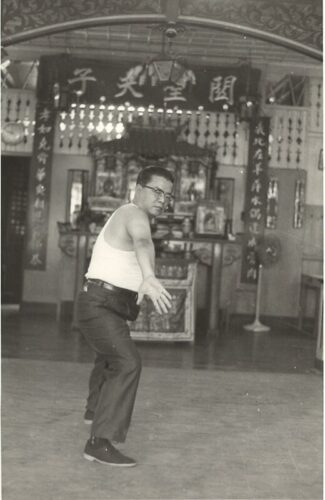
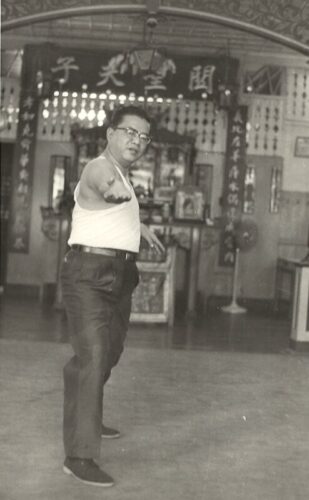
We followed this ancient protocol again the next time we met and the novelty was gone. It became routine after a while as I learned and became familiar with a new vocabulary of movements. From there, Chiuten shifu initiated me in complicated movements that were supposed to faithfully imitate the physical contortions and ferocity and grace of animals like the mythological dragon, crane, leopard, snake or the jungle tiger.
When my Chinese godfather Chan Bun Te heard that I was studying Kungfu, he gave me his cousin’s business card and told me to see him. He said, Study Tai chi. I did not know what it was, honest, but curious enough to have found my way to Manila’s Chinatown to see this mysterious master who taught this mysterious art. His name was Chan Bun Te.
The man at the desk was reading a Chinese newspaper. I gave the card to him. He took it and put it down, picked up the newspaper again, and continued reading. I waited and waited and waited. The silent treatment. Finally after 30 minutes, perhaps an hour, I said goodbye. I returned a couple more times. Same cold reception, same silent treatment. I believe I got the message that I could not join the Tai chi class. I was a Filipino, a foreigner trying to get a visa to enter the Middle Kingdom.
At the next town fiesta, my family was invited to a banquet at my Chinese godfather Chan Tek Lao’s house in our hometown. Godfather asked me, Are you studying Tai chi now? I said, No, your cousin does not even talk to me. Tek Lao called Bun Te and told him: Rene is my son, teach him. The master had to find a way to get me into the class because in the Chinese hierarchy of relationships, the older cousin or brother prevailed. The way Chan Bun Te found was a bit elaborate involving presenting me as prestigious lawyer with connections to the government. In short, somebody who had credentials and a welcome addition to the Chinese community. I was the only Filipino there at the time.
I had to wake up early, 4 or 5 in the morning, take the bus or jeepney from Diliman, Quezon City to Quiapo, Manila, and walk a mile to Hua Eng Athletic Club in Binondo, Manila’s Chinatown. I stood in the back and mimicked the movements of the person in front of me.
After every class, Chan Bun Te would make corrections to my form. He would adjust my postures and show me the refinements of the choreography. He would show a posture and he would emphasize its details: Stand in this position, he would say, and hold it. I learned that these standing posrures were called Zhan Zhuang and were the basic foundations of the art. Later in 1970, another famous Taiwanese master Liu Yun Hsiao came to town and started teaching Tai chi chuan Yang style. Chan Bun Te took me to him and registered me in the class. Our Hua Eng group gradually thinned out and closed. It was the same arrangement: there were about 50 students following the master as he demonstrated movements in front of the class. I stood in back mimicking him.
I’ve seen classes in different places: China, Taiwan, Manila, US. Many of them were on that model: the new student stood in the back and followed the person in front. Private instructions were an exception.
The reality of martial arts instructions is that there is really no single way of learning the form. Different schools and teacher follow different ways. But the workshop approach is still followed: the teacher demonstrated a posture or a movement in seminars and the students behind him followed.
How was it when Yang Chengfu taught his classes when he was spreading the knowledge of Tai chi chuan in China?
We tend to mythologize these old masters out of tradition or respect and we tend not to ask questions about their training. How were the classes conducted? How was the form taught and corrected? There are photos of Yang Cheng Fu, huge and overweight, in the center of a huge crowd of students in Tai Chi Chuan uniforms. Or riding a limousine driven by a chauffeur. But we have no idea about the lessons, we can only imagine how it was.
I do not know what Yang Chengfu taught but he did conduct seminars in different places in China. From the information I gathered, there were students who studied the solo fist form (sometimes called 108), among them, Chen Weiming, Fu Zhongwen, Tung Yinjie, Wang Sudong. Chen, Fu and Tung possibly studied the Dao/Broadsword #1and the Jian/Sword #1 also. Chen Weiming claims to have studied the Yang Family Tai chi chuan Chang Chuan/Long Fist with Yang Chengfu. (That’s what he claimed in his book and he listed the names of the movements.) There were others who studied one form or another but we do not have a way of verifying now. I do not have any evidence of what the famous Cheng Man Ching, who trained in Tai chi chuan with Ye Damy in the 1920s in Shanghai, studied with Yang Chengfu. I have not seen any credible evidence about it so far. Perhaps somebody with the resources could help with the information.
I am not criticizing them, just describing the reality of the contemporary situation at the time. The Yang Family had just opened its doors and, to improve the health of the country, Yang Chengfu was simplifying the solo fist form to make it accessible to the public. People were not really taught one by one unless they were indoor students because of the secrecy of the art and the Confucian hierarchy of values and relationships. Unless you were a member of the family, there was no way of getting into a class that taught the “secret methods.” Like me, I had to get my Chinese godfather to recommend me to learn from his cousin. And when I finally got into Hua Eng, I had to stand behind the group and follow the person in front of me. That was probably how it was during YCF’s time. It’s the same in many parts of the world I have seen: China, Taiwan, Italy, US, Europe, Philippines, etc. Unless Chan Bun Te took me in, and taught me after class, I would not have learned the correct forms.
The problem of course is that there is very little or no documentation about training. Cheng Man Ching talked about getting introduced and recommended to Yang Chengfu by a city politician Po Quicheng in1932 and getting knocked out 2 times. What did he say or do that made the great Yang angry enough to beat him not once but 2 times? And the other masters, what were their relationships to Yang and the nature of their classes? What was covered? How were their classes, public or private, conducted?
In the classes of modern Tai chi chuan master Gin Soon Chu, the classes were held in public, unless the student arranged a private lesson. He taught the student one by one, step by step. The classes were small. Nobody learned by standing at the back of the class and following the person in front. There were only 2 assistants at the time: Vincent F. Chu and Gordon Chu, Gin Soon’s sons. The only time the students did the Solo Fist form together was later and they were led by a senior in the school. Each one was coached individually in the course of the afternoon session or night. It was to me the ideal model for learning: one on one lessons taught in a small group situation.
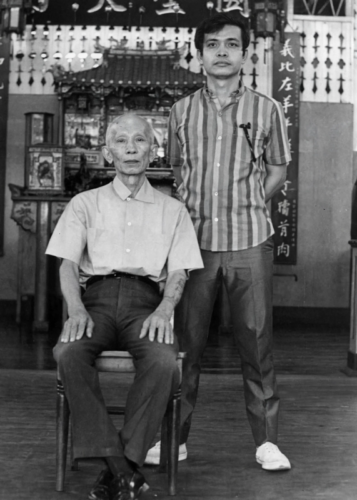
There were books and manuals even in ancient time. These contained illustrations of postures and annotations, studied meticulously and valued as treasures. During his time, Yang Cheng Fu posed in sequential photos that illustrated the flow of Tai chi chuan movements. They are still a cherished collection, serving as an exemplar of Tai chi chuan. With the advent of technology, we have been turning to videos and CDs and learning online. Absent personal corrections by a teacher, the quality of lessons and the art has predictably gotten worse. Perhaps nowadays, instead of standing in the back behind 50 others, there are lone students quietly following the video in the living room of their house. There is perhaps the same curiosity and passion but there is only the TV or computer screen as a guide. Perhaps, with IA, matters could get even worse.
I was asked to teach Tai chi online but I refuse do it. I could have made money teaching to absent and anonymous students around the world but I prefer to see my student, live and breathing, in front of me.
So we have the phenomenon of the new Tai chi chuan instructor: talking to a camera, dispensing lessons in a manufactured voice, dispensing instructions to an anonymous audience who paid for a video labelled “Easy Tai Chi” or “Tai chi Made Simple.”