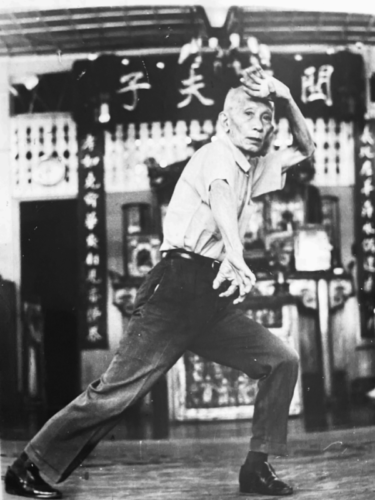
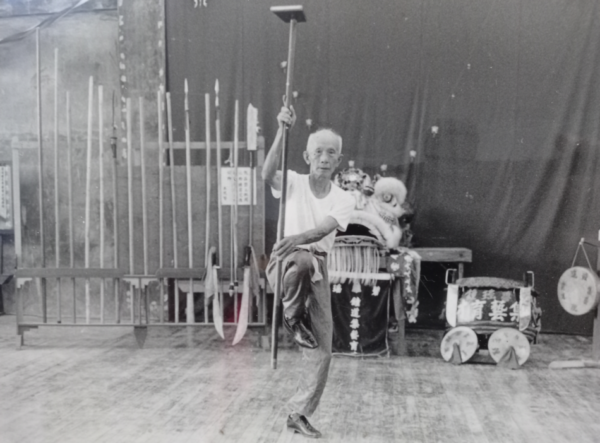
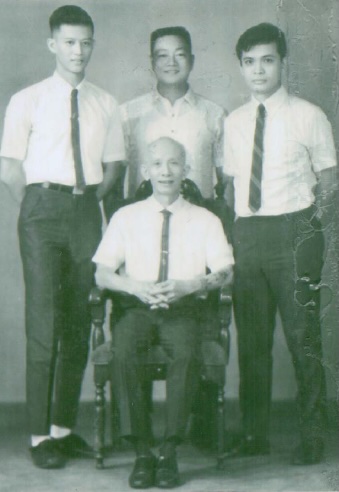
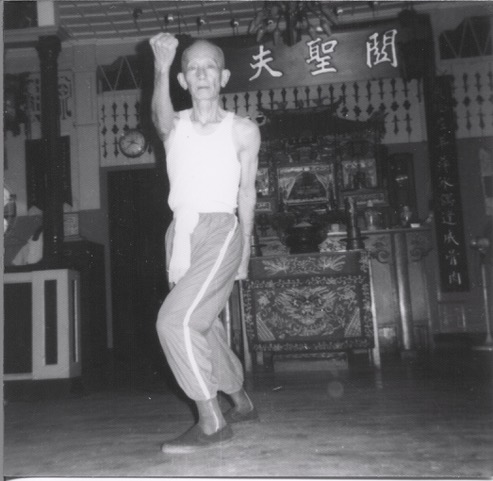
My first teacher in Chinese martial arts Johnny F. Chiuten (AKA Wong Fiaksan) told me, circa 1964, that the style he was teaching me was called Hong Cha, Angka or Hung Gar. For quite a long time, we carried that name. Chiuten shifu’s master Lao Kim (AKA Goon Tiong) studied in a Fujian Shaolin Temple. We have no evidence to show where it was, except that it was burned by Qing Dynasty soldiers because it became the refuge of anti-Qing Dynasty rebels from the Shaolin Temple in Loyang. By that time Lao Kim, a lay monk had already moved away and eventually ended up in the Philippines.
There are other styles also called Hung Gar, after a legendary monk Hung Hei Gun, who was a disciple of Gee Sin Sim See.
Decades later, in 2022, when Mark V. Wiley and I were deciding on what to call Lao Kim’s system, we researched the history of Hong Cha or Hung Gar, and we discovered that there is really no credible evidence of Gee Sin Sim Gee or his alleged disciple Hung Hei Gun. We found no reliable evidence, written or oral, that proved Gee’s existence, life or the curriculum or forms he taught. Much of the evidence about the style and the master pointed to Wong Fei Hong, as the creator of Hung Gar, a more recent development, not a character or a lineage from the 17th century. While Hong Cha or Hung Gar was and is a graceful and powerful style, no boubt about it, it became apparent after looking closely at the available evidence that, like the stories about Zhang Sanfeng and Bodhidharma, Hung Hei Gun and Gee Sin Si Gee have been exaggerated and embroidered by imaginative minds and fairy tales.
As far as Lao Kim’s biography is concerned, we could not verify the facts either. And we were not going to repeat the legend of Gee or Hung in the Southern Shaolin Temple which we thought was a fabrication, enriched by imaginary novels, movies and cartoons. Nobody’s fault, really, because that’s how legends evolve over time. But in Lao Kim’s case, there were just a few credible narrative details that we stuck to. So we decided to stay closer to the outline of the story we got from Lao Kim himself. He trained in a Buddhist mountain monastery in Fujian in the 1880s or 1890s during the Qing Dynasty. (When I met him he was already in his 80s in the mid-1960s. He passed away at the millennium in Hongkong when he was 114.) What the old master told Johnny F. Chiuten was that when he was 6 or 7 years old, Qing Dynasty soldiers came to his village and massacred members of his family who were accused of being rebels. Lao Kim was spared because he hid in a latrine. Emerging from his hiding place, he found his relatives dead on the village grounds. As he walked around the bodies, a couple of Buddhist monks found him and took him to the abbot of the monastery. There he was adopted and trained in Buddhist rituals and martial arts. I have written about him in my book “Of Fire and Water: Alchemy and Transformation” (Tambuli Media: 2023) available on Amazon and Barnes and Noble.
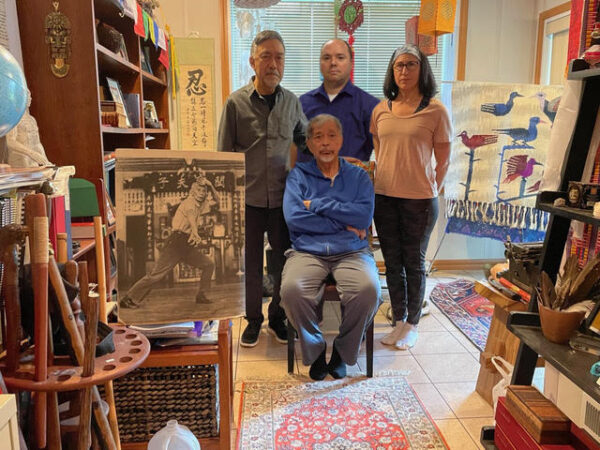
Mark and I decided to call the style of martial art “Dragon Tiger Fujian Temple Kungfu” because that is the name suggested by the master’s martial curriculum and story. We could have called it Southern Shaolin Kungfu or Hung Gar but we respected the facts as Lao Kim gave them.
The forms Lao Kim taught were rare and different from the mainstream Chinese Kungfu forms.
The curriculum he had taught.
Fist forms:
Sap Di Kun/#10 form
Ching Hua Kun
Red Boy Praying to Guanyin
Kang Li
Offering
Fist Attack
Ut Kit
Dragon Tiger
Dragon Tiger Crane Combination
Wat Let
Weapons:
Staff (3)
Spear
Broadsword
Sword
Hoe
5 Sectional Whip
Guantao
I am sure he had some other fist and weapons — like the Tiger Fork but I had no time to study it. In late 1970 I migrated to the US and I did not see again until he moved to Hongkong sometime in the 1980s or late 1970s,
So if Lao Kim was the first patriarch of the style, then his students were/are second generation of the Dragon Tiger Fujian Kungfu. As far as I know, there are only 4 of us: Johnny F. Chiuten, Dr. Jose Santiago “Dr. Joe” Laraya, Ching See San and me. Johnny and Ching have passed away.
For your information: Below is the video of me doing the Dragon Tiger form that I learned from both Johnny and Lao Kim. I did it more slowly and softly – and meditatively — when my children expressed interest in it so that they could follow the movements. In contrast please compare it with Lao Kim’s form and Ching See San’s Dragon Tiger (also in the Video and Audio secton) which are done as a martial arts form.
Dragon Tiger 2026
Offering 2026