Temples and Condoms

Just got back from a trip to the temples of Angkor Wat/Angkor Thom in Siem Reap, Cambodia; Vientiane and Luang Prabang, Laos; and Bangkok, Thailand. I have been to Thailand several times before, sometimes for a month at a time, in Bangkok and Chiangmai.

Well, I am terribly jet-lagged and trying to recover lost sleep and rest my legs sore from going up and down the temples. At my age, it seems to be getting more and more difficult to recover: I get sleepy at odd hours of the day, stay awake at night and in the morning I am in a daze. Here is what I was able to cobble together from the photos I took. I brought two cameras: a Canon powershot G9, a gift from my son Albert and his wife Laura, and an Olympus Camedia C 5060. The latter took excellent shots but broke down at Angkor Wat.

(Below is a selection of photos – to see the full gallery with larger photos scroll to the bottom of the page.)

AWTower_and_gate

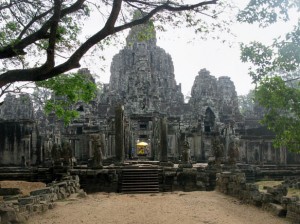
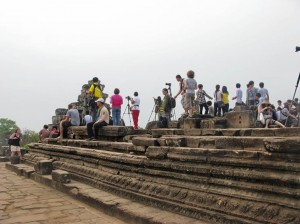
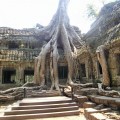
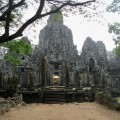
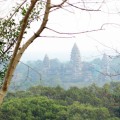
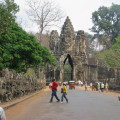
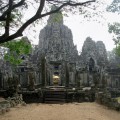
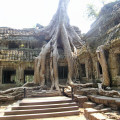
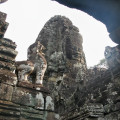
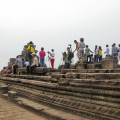
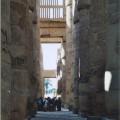
The different gates and temples with tall trees growing out of them. The umbrella through the entrance caught my eyes and I could not resist pointing my Canon powershot camera. There are many impressive sights in Angkor Wat and Angkor Thom, as if the jungle literally sprouted unnoticed for centuries, which is probably what happened before they were discovered again at least a hundred years ago. How did the Cambodians from the 12th century build these incredible edifices without cement and without nails and screws? And what kind of culture and civilization would construct such a temple complex? I had the same sense of marvel at Angkor Wat and Angkor Thom I had when I saw the temples and pyramids of Egypt.


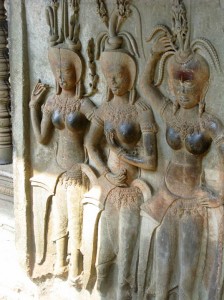
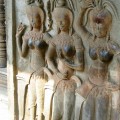
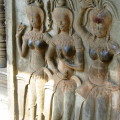
The 3 female statues in Angkor Wat are fondled well by unknown pilgrims, as we can see from the shiny and dark parts of their anatomy. Usually, among Christian saints, the feet or the hands are the objects of touching.


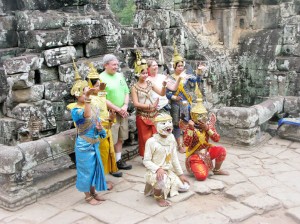
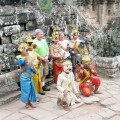
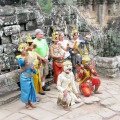
Like the Greeks and Indians, the Cambodians know the epics and myths as if the characters were part of their daily life. The photo shows the characters in masks from Ramayana: Sita, Rama, Hanuman and Ravana, among others.


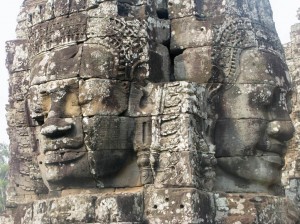
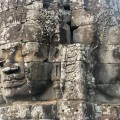
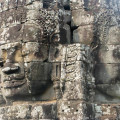
A photo shows two faces of Brahma. He was supposed to have had 5, the 4 to see the cardinal directions and 5th to follow his beloved consort Sarasvati. I read that the 5th was destroyed by Shiva during an altercation.


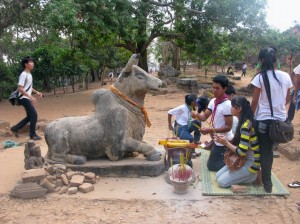
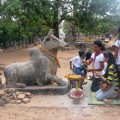
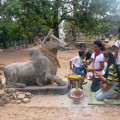
A photo shows a kneeling bull — Nandi — at the entrance to a temple of Angkor Thom. The bull is sacred, indeed a god in the Hindu pantheon. It is also considered the main vehicle of Vishnu. I lighted a candle and incense sticks at its feet.


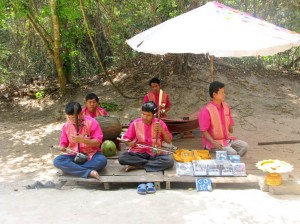
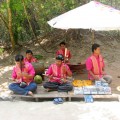
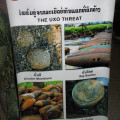
The musicians were disabled by the mines and bombs in Cambodia. Many of the unexploded cluster bombs, bombs and mines are still sitting in the fields in Laos, Vietnam and Cambodia where they were dropped by the US during the American War (that’s what it is called in the region, not Vietnam War) and campaign of carpet bombing in the 70s. Many of these disabled men (perhaps they were children at the time they lost their arm or leg) were probably farmers working in the field. I have no information about Agent Orange in Laos and Cambodia, except articles and photos in the media, but even now there are children in Vietnam who are born with severe congenital defects apparently because of the chemical.


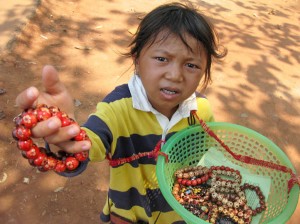
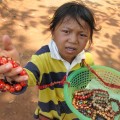
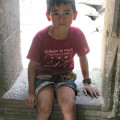
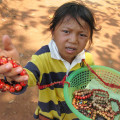
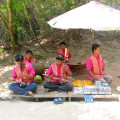
The children in the photos are some of the many small barefoot children who eke out a living selling native handicraft. It reminded me of the time in the late 40s when I was a kid selling chicklets/chewing gum at dances in the basketball court in the old hometown.


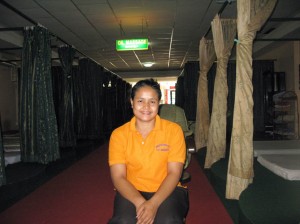
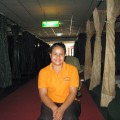
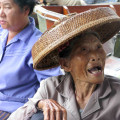
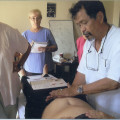
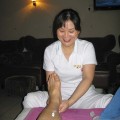
The best Thai massage on this trip was in Siem Reap, Cambodia outside of Angkor Wat from a young girl who studied in Thailand. Her name was Shante … perhaps spelled Shantih as in the Upanishads. She had one of the most composed faces I had seen during my recent journey. That’s she who is smiling at the camera. I asked for an hour of foot massage but when I realized she was good, I asked for another hour of full-body Thai massage. I came back the next day after the tour of Angkor Thom. Two of the best body-workers I know are from Chiangmai. Last time I was in Chiangmai in September, I called them on the phone but I was told I got the wrong number. Sadly, these bodyworkers receive only a small fraction of the fee (about $2) from their employers; without a generous tip from the customers, I do not know how they manage to survive.


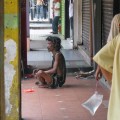
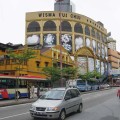
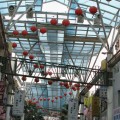
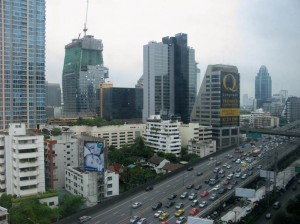
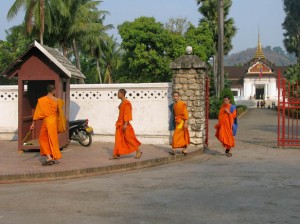
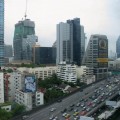
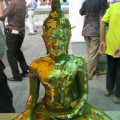
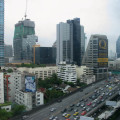
It is always amazing to travel through Bangkok, with its variety of colors and neighborhoods. Temples and Buddha statues sit side by side with shopping malls and pedestrian markets. Restaurants, massage parlors, and stalls selling native handicrafts can be found in the red light district.


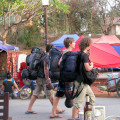
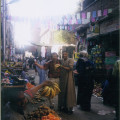
The Night Markets in different cities — Siem Reap, Cambodia; Vientiane and Luang Prabang, Laos; and Bangkok, Thailand — are often visited by tourists who are looking for bargain goods and native products. They also offer cheap meals and massage, especially to young European backpackers on a limited budget. If you are on a tour you’ll invariably be taken to silk factories, ceramic shops, woodworking centers (using teak wood) and silversmiths. A photo shows a young woman in Luang Prabang. I bought a couple of dragon bracelets from her. After paying, I discovered that the horn of one dragon was broken. She took it back and asked me to return the next day for the replacement. I did go back and she had a new bracelet for me. Every day, these vendors would set up their goods — sometimes hundreds of miniature buddhas — on a carpet and when they were done, they would pack them all over again. Haggling is an accepted mode of negotiation in many countries in the Third World. Remember to go to about 1/3 of the initial price and take it from there. You’ll be surprised to find out that the vendor is actually willing to accept your offer.


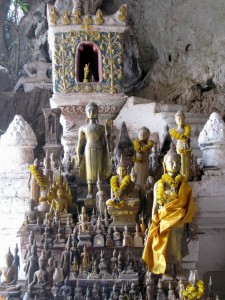
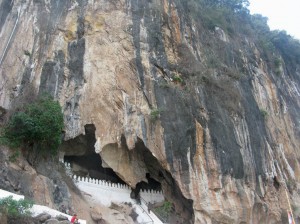
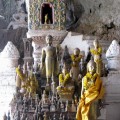
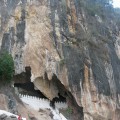
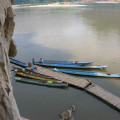
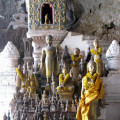
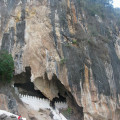
A truly relaxing divertissement was a trip upriver on the Mekong. After two hours on a boat between Laos and northern Thailand, you’ll reach a granite mountain. Climb the steep stairs and you’ll find yourself in a huge cave with a thousand buddha statues of differing sizes. There are restaurants on the river with river fish on the menu, along with papaya salad, tom yum soup and pad thai. Remember to avoid raw food. One useful rule from a travel guide: do not eat food that is not cooked; do not drink water that is not boiled; do not eat fruit that is not peeled. I learned my lesson from the time my friend Chaiyuth Prasingh, took me to a greasy spoon joint and ordered noodle soup with raw egg for breakfast. I was too timid to object. A couple of weeks later, I had an ulcer. This respected master died from a heart attack about 5 years ago probably from overwork. Arguably the best masseur in Chiangmai, he gave 4-hour massages and worked past midnight in some cases.


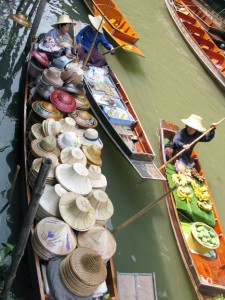
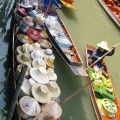
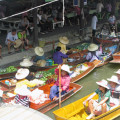
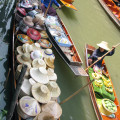
The trip focused on the temples but it was nice to sail along the canals outside Bangkok and see the Floating Market. I realized after seeing so many temples that you can get templed-out! Bangkok is heavily polluted and crowded. But the people have such a stillness about them, you do not notice that you are in one of the most densely-populated cities in Asia. Probably it has something to do with the fact that at least 90% of the people are Buddhist.


The idea of “jai yen,”or “cool heart,” according to the travel guides, is embraced wholeheartedly by the Thais. So they would say “mai ren pai” (never mind, what can we do, forget it) when something unpleasant happens. One time, a group of us from the Tao Garden in Chiangmai were in a car and nearly hit a Thai couple on a motorcycle. It was a “close shave” or a “near-miss.” But the couple just smiled and went on their way. Small wonder Thailand is called the land of smiles. They have a deep belief in karma, serendipity, fate and synchronicity, so whatever happens is taken as a part of destiny. For instance, the siting and geomancy of Wat Phrathat Doi Suthep in Chiangmai, one of the most beautiful temples in the north, was arrived at randomly, almost by “accident.” A white elephant was allowed to wander up the mountain and when it stopped and died from exhaustion, the spot where he lay down was chosen as the location for the temple.


If you are interested in meditation, do not expect to be able to do it in the temples. There are too many tourists walking back and forth and offering incense and flashing cameras. You can join one of the temples that offer a free room and food and an opportunity to join in the chanting. I have never done it myself, but a few of my friends have and they spoke highly of the experience. There is a temple in Doi Saket, Chiangmai, about 45 minutes northeast of downtown, that sits on a mountain and has some of the most interesting paintings on the wall. The temple has a school for monks and probably accepts lay guests.


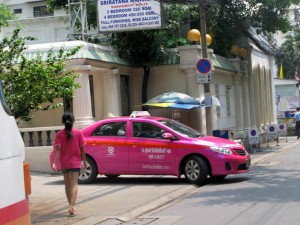
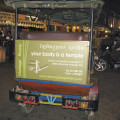
The pink taxi is a common sight in Bangkok.


The poster is from the Cabbages and Condoms restaurant in Bangkok, a project of the Population and Development Association (PDA), that has several branches in Thailand. PDA was initiated by Vichai Virabaldya ( I am not sure about the name and identity). It has different projects: free vasectomies, income-generating programs in villages, mobile clinics, reforestation, health education, safe sex and family planning, among others. Cabbages and Condoms is a very unusual place that is located near the red-light district! When you eat at the restaurant you receive colorful condoms with the bill! The restaurant has a handicraft store too vending native products, shirts, skirts, coffee cups (with photos of condoms), scarves, headgears made by women from villages around India, China and Thailand. Well, the food ain’t bad either! Try something different from Pad Thai and spring rolls like the steamed whole bass with lemon. It is a very popular Thai dish and is served on a fish-shaped metal tray over charcoal. Warning: it is very spicy. When I had it a couple of times at Cabbages and Condoms, it had at least 10 spicy red and green pepper. I also had it many times at the Night Bazaar in Chiangmai. Seems like even if you tell the waiter to cut down on the pepper, the dish always comes with the chopped pepper scattered almost irretrievably in the broth.


I met a Japanese girl who, like me, was waiting for the sunset over Angkor Wat from the top of Angkor Thom. I do not know how it happened, but as we were talking, she asked me where I was from, I said Philippines and I began humming a Japanese folk song, Sakura/Cherry Blossoms, and she joined me. Before we knew it, we were humming another tune, probably the Bridge to Edo. Three days later, when the tsunami and earthquake hit northern Japan, I thought about her. She gave me her name but not her address. She showed me the journal she was keeping of her travels. Every so often I think about her wondering if we will meet again.


In Siem Reap, Cambodia, a fellow tourist asked me why the Philippines does not have these Buddhist and Hindu temples and culture. It was not a well-thought out answer I gave at the time, but in retrospect, I can say within this limited space that the Philippines is geographically isolated from most of Asia and did not receive a significant influence from these two religions. While Buddhism and Daoism were introduced to Korea and Japan and Hinduism to Indonesia, Ceylon, and other countries, the Philippines “came under the influence of Spain and Roman Catholicism.” (The words in inverted commas are a euphemism for conquest.) And then in the late 1890s, the US invaded the Philippines and introduced Protestant Christianity (Methodist and Baptist). A wit remarked that the history of the Philippines is “300 years in a convent and 50 years in Hollywood.” A partial result of these conquests is that instead of the Mahabharata and the Ramayana and Journey to the West, the Philippines has the Odyssey and Iliad; instead of Laozi and Zhuangzi, we have Socrates, Plato and Aristotle; instead of Li Bai and Dufu, the Philippines reads Shakespeare and Longfellow; instead of Daoism and Buddhism, the Philippines has Christianity. I will write about this part more fully later.

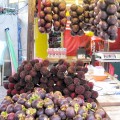
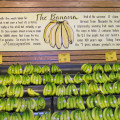
Oops! I inadvertently attached the photo of a huge sign from the produce section of  Wegmans, a popular grocery store,  in Nazareth, PA.

Full Photo Gallery: click on the thumbnail photos to see the full-size version.

Masters and Mentors

Len Roberts: Poet

It was in the mid-80s, perhaps ‘84, probably ‘85, that I first met Len Roberts. Ted Kloss, chair of the English Department at Lafayette College in Easton, PA was conducting a weekly poetry workshop and I was one of the community residents who attended regularly. One day Ted got sick and Len took his place.

I had submitted a couple of poems. One was about kite-flying with my children in Prospect Park, Brooklyn, the other was a war poem about a child in the ruins of a town in an island in the Philippines.

Len said that he liked the war poem, that writing political poetry is very difficult. After the workshop, Len told me that I should bring some of my poems to him at his office at the college. That I did. At that time, I was writing a sheaf of poems about Hiroshima. I still have a copy of the notes he had written at the time about 25 years ago. I have kept them like the other letters he had written to me over the years, mostly comments on drafts of poems I had sent him from wherever I was as I traveled the world.

Four years ago, as I packed my things to move to another house, I saw these letters again and re-read them.

These comments were not only meticulous, they also were generous and gentle. Len would ask for details, suggest another word, or hint that perhaps there is another poem sitting behind what I had written. He would say something truly encouraging and mark certain lines that he liked. There was never a time when he was cruel or nasty.  And always he was thoughtful and kind.
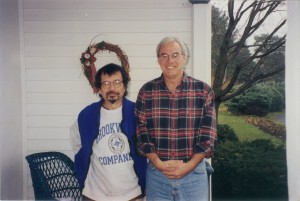
Len Roberts and Rene in Hellerstown. (Photo by Nancy Roberts.)
Len Roberts and Rene in Hellerstown. Photo by Nancy Roberts.

So over a period of more than two decades, Len helped me with my poetry. I sent him and his wife Nancy postcards – from Egypt, UK, Thailand, China, wherever I was. I visited him at his house, sometimes slept over. He would get a pizza or Nancy would cook, I would bring a bottle of red wine, and the three of us would sit in the living room. One time we listened to Yoyo Ma, another time I showed a Tai chi DVD I had done and talked about my Taoist practices – Tai chi, acupuncture, internal alchemy, qigong. A favorite subject of his was his new project – building a house on an island in Nassau. Always his son Joshua was a concern. Travels with Nancy were a topic that generated much laughter. Sometimes Len and I took a walk in the backyard up the hill where he had planted black walnuts and a grove of pine trees. One night, sitting in front of the fireplace, with a bottle of wine on the table, he read his favorite poems from Thomas Hardy and DH Laurence. For the first time, I saw the other facet of these two fictionists’ brilliance.

One summer afternoon, I brought him a new poem I had written in London. Let’s think about it, he said and jumped in the pool, did a few laps, and when he came back he had a few ideas to improve my poem. Water always seemed to invigorate him: he loved the sea and planned to spend his retirement at the home he was building in the islands.

We often wrote to each other, sometimes long letters, often just short notes. We read together in the Philipsburg Art Center, NJ. Here is our correspondence about a reading the two of us did in Allentown, PA:

At 01:13 PM 3/28/00:

Dear Len,

Thank you for making me a part of that poetry reading at Borders. I truly enjoyed doing it. The tea with you and the others was fun, too. SometimesI need a break from my otherwise solitary life and the regimen of meditation, qigong and Tai chi chuan.

It’s easier now to do these things. I do bits and pieces often. I can go out at any time of the day and do a sword or spear form like it’s not really a routine but just the flow of the universe.

Breathe well!

Rene

Dear Rene,

I had a fine time, too, reading with you!  One of my students who was there praised and praised your reading presence as well as the poems.  Thank you
for the kind dedication at the start, also.  I am touched whenever I think I have had anything to do with your fine poems.

I admire your practice and wish I could incorporate some of what you do daily into my poetry life.  But the world encroaches, snares …

Hopefully this summer will open up new avenues.  As well as provide time to see you here!

All best,

Len

His poetry often explored and engaged the everyday life: none of the big issues of the world but the ordinary happenings in school, at home, in his life. He wrote about the tools of carpentry, the search for the best Christmas tree in the backyard, shopping at the grocery store, doing the laundry, shoveling snow. He talked about the ordinary objects in the house and neighborhood: the gold carp, copper frog, mocking bird mobile, crickets, the periwinkle. Many of the poems are about his childhood at a Catholic school or about alcoholism, recovery, his parents and his brother. Sometimes he wrote about his early sexual experiences, which were more funny and awkward than erotic.

Even if the poems dealt with the quotidian, they were often metaphors for a bigger, larger universe or symbols of existential conflicts. He wrote about a snapping turtle that wandered in his lawn:

… his departing hiss at me a warning,
I did not take lightly,
having seen those eyes before,
and that thick shell,
that reptile brain,
knowing even as I let him go
that he would be back again.

In a memorable letter-poem, to his friend poet Hayden Carruth, who was sick and dying in a hospital, Len wrote:

… and because I know you’re close enough
to death now so you feel its breath,
its stink you’ve written so often about,
old man who used to sit at our round
oak table those blue-gray dawns
to stare out at the pond, waiting
to catch just one more glimpse
of the great blue heron flapping,
clumsy, its prehistoric wings
as it rose over the telephone wires
and trees, into the mountain
that has no name.

One of my favorite poems  “Talking to the Poison Sumac” recalls his older brother who went mad, was confined to the VA hospital for 24 years and received electric shocks treatment:

And I didn’t know why I was out there
thinking of his soft body I had not held
for more than twenty years, repeating
his story when I knew that nothing
I did or said mattered, that the sky
was powerless, and the sun setting
powerless, that the snow that started
to fall, the beautiful falling
itself, was nothing, the field, the world,
the unlivable, burning stars, the emptiness
of it all contained here in one small human heart.

He did not use any big words. You understood every single word, every single sentence, because they referred to things that we know, things that are familiar, but somehow, there was something else there, something we had to decipher, something we had to translate, something much bigger than the things he seemed to be writing about.

And his long lines are something else again. You read through a whole poem non-stop, possibly in a single breath, as if the poet cannot stop the flow of his narrative, he has to take in the whole experience in one gulp. I tried the style – which my father perhaps influenced by Victor Hugo, also used back when I was in high school — and found it very effective.

The body of his work describes a life, from the grades to maturity, the slow transformation and redemption of a human being through the anguish and pain of growing up in a totally dysfunctional family, through separations and divorces, and nervous breakdowns and drunkenness, and self-inflicted suffering. Somehow, we know that poetry played a great part in that life, poetry shed light on the darkness, cleared the way for him and fulfilled the destiny that was waiting like a hidden treasure in his heart.

I look at his attainment: selection of “Black Wings” for the National Poetry Series, grants from National Endowment of the Arts and Fulbright and awards from the Guggenheim. There is also an award for his translation of Sandor Csoori’s poems. Eight books of poetry and a couple of chapbooks. Decades as a teacher. It is a solid achievement.

When I read his obit in the local newspaper a few days after his death on May 25, 2007, I was struck dumb. I was standing at Wegman’s in Nazareth, Pennsylvania, paying for my lunch, and in front of the cashier, I could not hold back the tears. My family consoled me because they knew how much I loved and respected this man. He touched my soul and my life, both, and I’ve never been the same since the first time I met him at Lafayette College a quarter of a century ago.

Len Roberts’ books

Poetry:

The Disappearing Trick (posthumous)
The Silent Singer: New and Selected Poems
The Trouble-Making Finch
Counting the Black Angels
Dangerous Angels
Black Wings
Sweet Ones
From the Dark
Cohoes Theatre

Translations from Hungarian:

Waiting and Incurable Wounds (chapbook of Sandor Csoori)
Selected Poems of Sandor Csoori
Call to me in My Mother Tongue (chapbook of Sandor Csoori)

*** The quoted excerpts are from “The Silent Singer: New and Selected Poems.” Copyright 2001 by the Board of Trustees of the University of Chicago.

Johnny F. Chiuten: Fighter

I was in the Tao Garden, Doi Saket, Chiangmai, Thailand, attending the International Congress of the Healing Tao last September 2010. Recovering from jet lag, I received the first of many messages in the evening. One was from Ned Nepangue, a friend from Cebu, Philippines, asking me to call Johnny. Then another e-mail from Vic Ramos, a fraternity brother of Johnny’s, came within a few minutes telling me that Johnny, my “old sparring partner,” had passed away. Myla Salanga, his daughter, who lives in California, sent me the same message. So did Jopet Laraya, my martial arts classmate and Johnny’s disciple, from Hongkong.

A few more messages came, confirming Johnny’s death and sending me condolences.
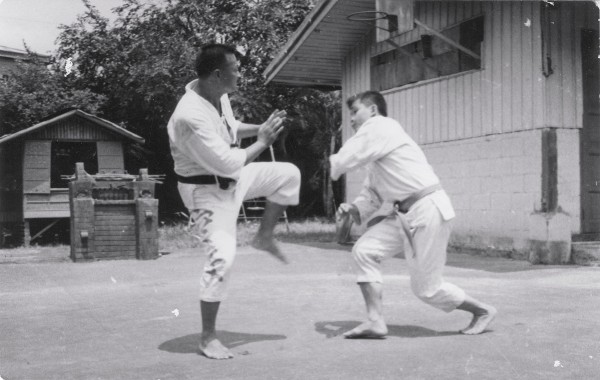
Johnny and Rene Sparring 1966
I am reluctant to print this photo because I avoid focusing on the fighting aspect of
self-cultivation. For more about Johnny, go to www.beta-sigma.org

The next few days I walked in a daze. I taught a couple of classes at the conference, one of them a sequence called “Twin Dragons Chasing the Pearl,” from a form – Cross Fist — I learned from Johnny in 1964.

Johnny was my first Shaolin master. He was one of the constants in my life, a great influence on my journey. I met him back in the early 1960s, a great presence in the university campus, a respected member of the Beta Sigma Fraternity. He used to come to my dorm room to teach my fraternity brother, a student of law like me. They would practice right there in the small space beside the bunk beds.

One day, Johnny and I met at the law school cafeteria and sat down at the same table. He asked me why I was not studying with him. I said I did not know that I could. We made an appointment for a lesson right then and there. It was the most important decision I had made at that juncture in my life.

On my first lesson, Johnny told me to stay in a very low horse position when we began. What he did to me for the next 3 hours or so was incredibly graphic — and painful. He kicked me, pushed me, rode on my thighs and back, asked me to walk around, slapped me all over. It was something I had not seen even in the kung-fu movies where the hero was asked to do 100 repetitions of a technique until he was bone-weary. Johnny’s method, presumably transmitted from Grandmaster Lao Kim, was meticulously sadistic in a benevolent way. I mean it was meant for a purpose, and that purpose was to test my patience, endurance and determination, and inculcate in me certain mystical values, and to build me into a warrior. Well, I don’t know if I became a warrior, but it certainly tested my patience. As for the mystical experience, I think I attained that, too, because at a certain point when I was about to collapse, I felt an enormous energy welling up, I saw a different reality, I reached a different level of awareness. I came back the next week and took some more of the same punishment. By that time, the novelty was gone, and I was ready to endure because I knew that to have a view of what it is at the top, you have to climb the mountain, by yourself.

When he graduated with a degree in pharmacy, after shuttling from one course to another to prolong his Kung-Fu studies with Grandmaster Lao Kim in Manila, he went home to the island of Cebu to run the family business. On one of his visits to Manila, he introduced me to Lao shifu, then in his 70s, and asked him to take me as a private student. The old man could not turn him down because Johnny was like his own son. It was a rare opportunity for anybody to be taught as an indoor disciple by Lao Kim, at the time considered to be the patriarch of Chinese Kung-Fu in the secretive world of martial arts in Manila.
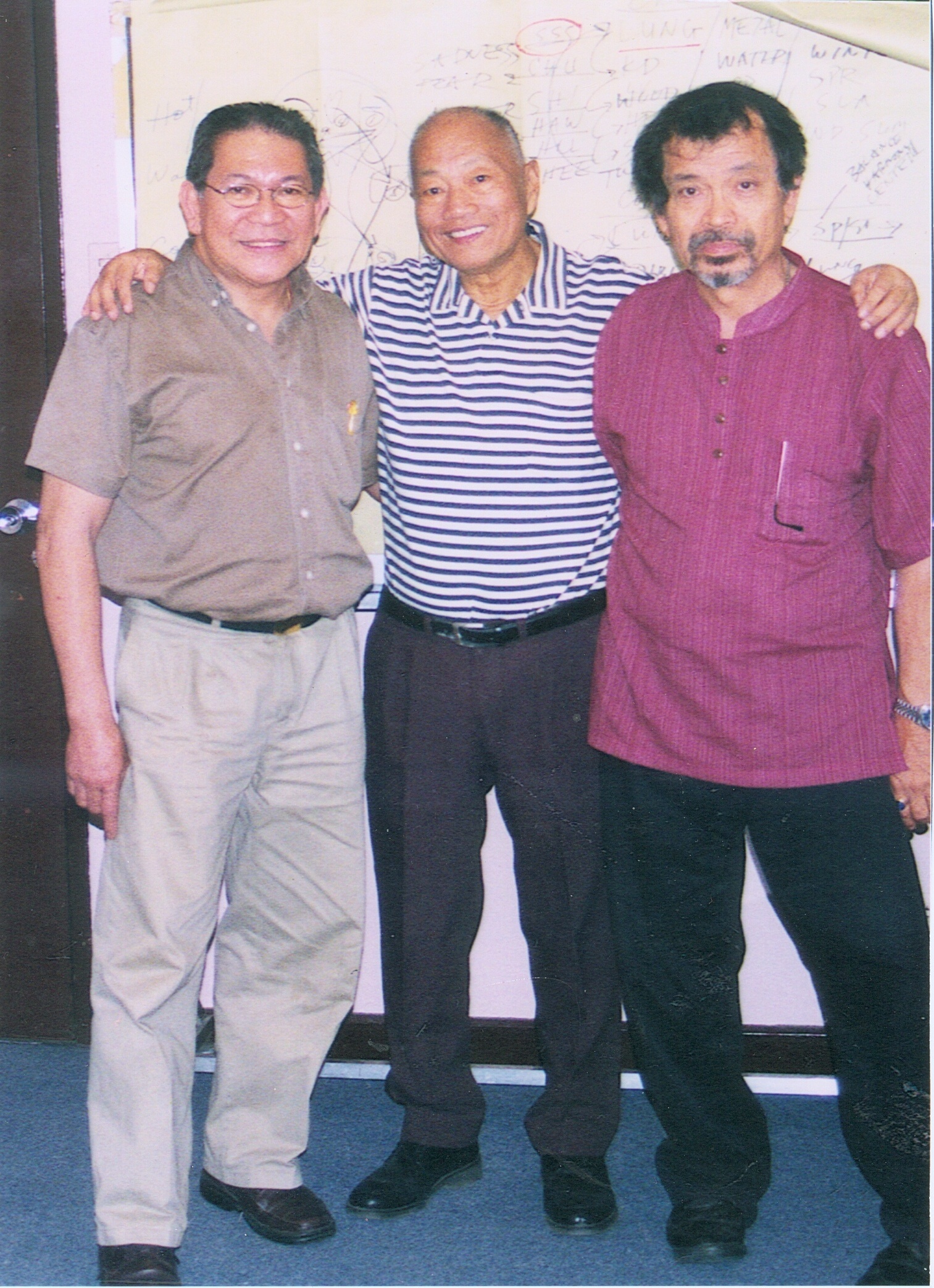
GM Johnny F. Chiuten with Dr. Jopet Laraya, martial arts master in HK, and Rene J. Navarro, 5 years ago, in the University of the Philippines.
GM Johnny F. Chiuten with Dr. Jopet Laraya, martial arts
master in HK, and Rene J. Navarro, 5 years ago, in the
University of the Philippines.

Whenever Johnny visited Manila, we would get together to take lessons and have dinner with Lao Kim. Johnny would also show me his new fighting techniques. One time, he stayed in Manila for a month and he and I studied Yang Family Tai Chi Chuan and Pa-Kua Chuan at Hua Eng Athletic Club in Binondo. He learned both 108 solo form and Pa-Kua in just a couple of weeks. When I saw him again, he had added astonishing components to his system: potent jing and trapping. That’s how he was, a serious and dedicated searcher. He studied karate, kundalini yoga, Tetada Kalimasada, he was a black belter in aikido. He was into cross-training and mixed martial arts even before there was a name for them.

In late 1970, I migrated to the US. I studied with Mat Marinas, an arnis de mano/Philippine stickfighting master in Queens, NY. Meantime, Johnny began exploring the different styles of stickfighting (also called escrima) in Cebu. He studied different styles and eventually developed his own system called “Arnis de Cadena Pronus Supinus.”

There were times when yet another foreign delegation would come to see him. Johnny would make them wait on mainland Cebu while he stayed in Bantayan, an island that until recently was accessible only by land transportation and by ferry. I was with him in Bantayan in 2004 when he said how tired he was of the endless challenges he had to face in his life. But in his search he wanted to test himself against the best.

He had had several serious cardiac procedures since the mid-80s, one of them in Texas, and I did not think he should be fighting again and other practitioners should have respected the fact that Johnny’s body was no longer as supple and strong as in the 60’s and 70’s when he used to fight 4 opponents at the same time. Nonetheless, in the prevailing martial arts culture, there was no rest for the master.

Many martial arts practitioners pursued him for his combat expertise and his instructions but he never did divorce martial arts from the energetic and philosophical aspects of self-cultivation. He was always looking for techniques that used the mind and Qi without relying on the physical. He wanted to use Qi to heal himself and others.  He was a fount of combat knowledge but he was also a wise man, a very rare combination in the martial world that is inhabited by many violent types and rarely by refinement.  He was always respectful of others, even those who were cross and rude. To Johnny, fighting was pursued with the detachment of zen. He never did fight anybody out of anger or resentment or personal issues. In this he was unique in the martial arts world, I believe. After a fight, he usually shared his techniques with his opponent. He had an open and benevolent nature. He had a generosity and wisdom that was beyond the comprehension of the ordinary man. And he was always humble, never denigrating anybody, even those he had defeated in combat. He was a paradox in the martial arts world, gentle, thoughtful, hospitable, fluid. I could have sworn that he was a Taoist sage!

When he passed away on September 10, 2010, I lost a friend, master and guide.

Om Shantih Shantih Shantih

____________________________________

Stories about Johnny:

He told me about his encounter with a famous Filipino fighter who tried to ingratiate himself to him by taking him to places in California when Johnny was there to visit his daughter Myla and her family. Johnny expressed his doubts about the man’s intentions when we saw each other in NY while he was visiting his brother. “I do not know what he wants from me,” he said. When Johnny returned to California, the intention of the man became clear:  he wanted a fight. This man was known as somebody who boasted about beating up people apparently to build the legend of his prowess. He also claimed he was a “psychic healer” and bragged about his exploits with women. As Johnny related the episode, this man said:

“Johnny, what posture will you take if I attacked you?”

“You will see if you attack me.”

The man attacked and Johnny pushed him against a wall. Johnny could have inflicted serious injury, but he used the Press technique from Yang Family Tai Chi Chuan that was partly meant to stop an attack in its track. I do not know if that was enough to bring this man back to his senses, he was not hurt but it was a shock and an eye-opener for him. Perhaps he learned a lesson from Johnny, but then again, I do not know. Johnny was terribly disappointed by the episode partly because this man tried to befriend him and abusing Johnny’s trusting nature, tried to exploit it.
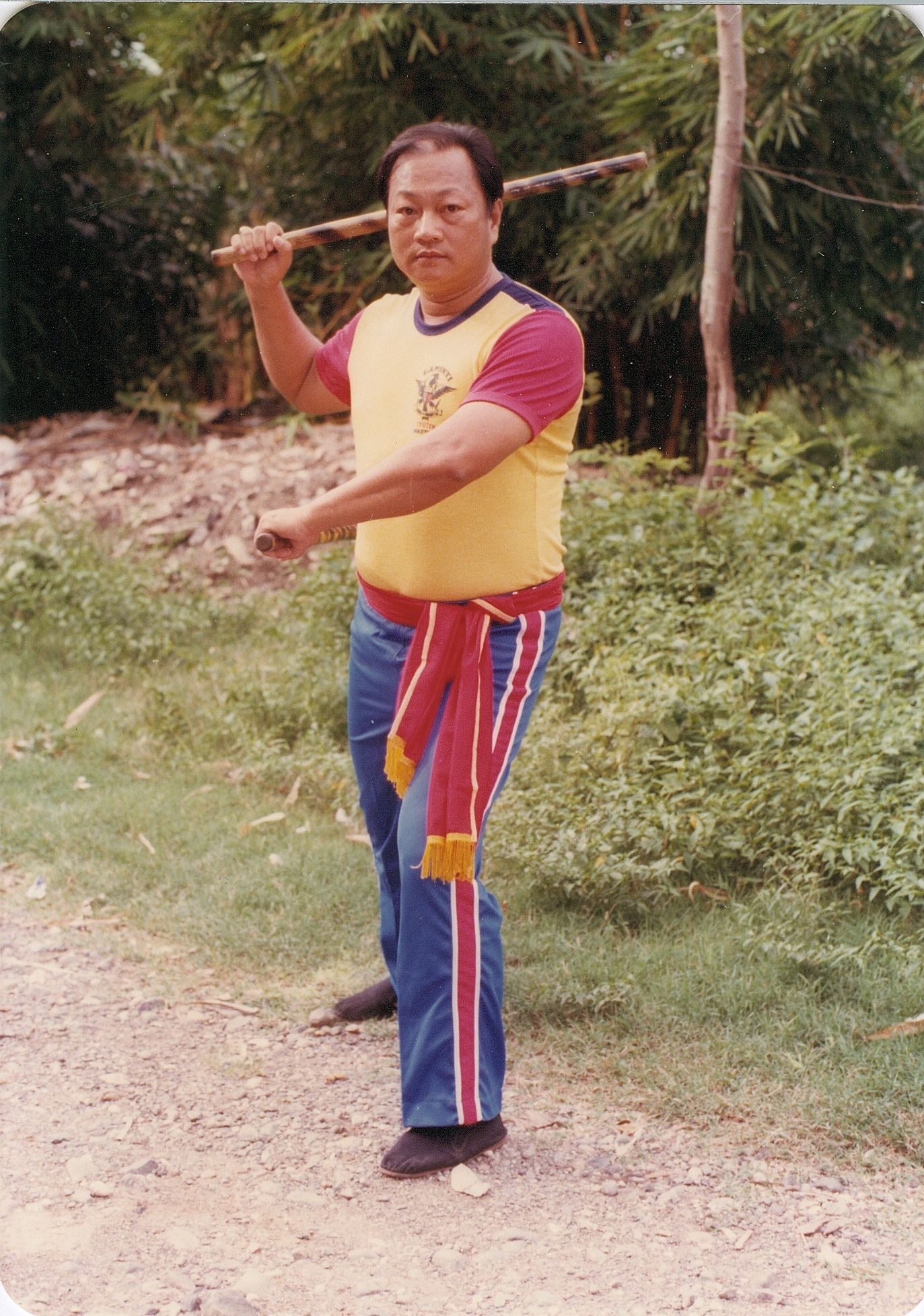
Johnny F. Chiuten with doble baston
Johnny F. Chiuten with doble baston. He studied different
systems of Philippine stickfighting/arnis de mano,
Wudang and Shaolin. He also studied with a grandmaster
of a Northern Praying Mantis style in HK in the 70s.
He has videos of the forms.

This second story happened back in the mid-60s when Johnny was a student in the University of the Philippines. It was late at night and Johnny had just got off the bus from Manila where he had been training with GM Lao Kim. As Johnny was walking home, he encountered a group from a rival fraternity. He was surrounded by about 30 of them. When somebody attacked him, Johnny went into what he called  “ground fighting.” In this technique, it was difficult to hit him because he was down there most of the time, kicking and rolling. He managed to escape and inflict some serious damage to the muggers. Later a cop from the campus security knocked on his door and asked him to go to the police precinct. The chief told him that there were complaints that he had attacked and beat up some fratmen. But it was a charge that was impossible to prove because Johnny was alone against a big group. The charge was dropped.

The third story I can authenticate myself. In the 60s we used to spend hours doing nothing but forms and sparring. In 1966, on a Wednesday at about 12 am, it was during the Holy Week, if I remember, we had a memorable match. We had had numerous fights before, at different places. Sometimes we started at 8 o’clock in the morning and we carried the exchanges off and on until 1 in the afternoon. But this was the first time he had resorted to the technique.  During a furious exchange, he stabbed my left leg and I fell. A bubble of blood formed instantly. It was one of those moments when life passes in front of your eyes. Johnny showed me how to massage the leg and put the blood back into the vein. Later, the bubble appeared again and grew to the size of a baseball. I went to see Johnny at his house in the campus. He slapped the baseball and spread the blood all over my leg. He made me drink two cups of dit da jow liniment made of 36 herbs. The recipe came from Lao Kim. My leg was black and blue for a few weeks. It was one of the scariest times of my life. Asked about it years later, he replied, “You were going to kill me. I had to defend myself.” I am sure he was exaggerating my abilities — and intention — because during the years we sparred I had never been able to touch him. I have photos to show what Johnny did, one of them I cannot publish because it shows the moment he delivered the thrust of the finger. Footnote: Dr. Guillermo Lengson, vice president of the Karate Federation of the Philippines under Johnny in the 60s, who also studied with Johnny, said of his sparring sessions with Johnny:  “Sinagasa ako,” (literally translated as “run over”) referring to the technique of non-stop attack that Johnny had honed to perfection.
Egypt

What happened in Egypt the last few weeks was strangely familiar. It was in many ways like a replay of the People Power Revolution in the Philippines in 1986. The relatively peaceful demonstrations, the involvement of the clerics and religious and the massive participation of the people were three of the characteristics they shared.

The peaceful and unprecedented uprising against Ferdinand Marcos was an inspiration to the world. It showed the possibility that the masses, if united, can actually topple an entrenched dictator and truly transform politics, government and society in a peaceful way.

I was drawn to the TV and newspapers. I followed the developments in Egypt. I hoped that the situation would not explode into mayhem and bloodshed. I wrote to friends in Cairo asking how they were. With great anxiety, I waited to hear from them. It was a relief when both Amira and Rana answered.

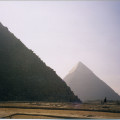
It was just after the millennium that I started going to Egypt. A group of Egyptians whom I met in the Tao Garden in Chiang-mai, Thailand had invited me to teach in Cairo. During several visits, I taught Tai Chi Chuan, Qigong, meditation and DragonWell Chi Nei Tsang internal organs massage in both Cairo and Heliopolis. One time, for a week, I did healing on a boat on the Nile just outside of Cairo. I visited the temples in Luxor and Upper Egypt like Abydos, Dendera, Karnak … and the pyramids in Giza and Saqqara … and took the midnight train from Luxor to Cairo. For more of my experiences in Egypt, go to: “Letter from Cyprus,” Our Own Voice (www.oovrag.com) 7/9/04 issue.

When I think of Egypt, it is not the scenes of protest that strike me, nor the bravery of the demonstrators. I know they are important and I hope the demonstrators will eventually achieve their goals. The memories that come rushing back are … faces of the people I taught and befriended, the landscapes along the Nile, the people in the street and markets. In my mind, the recent mass movement to unseat President Mubarak was important, but it was similar to a gate being opened: an opportunity to democratize the country, provide a decent livelihood and education to the people, and allow free expression and egalitarian changes. The unequal distribution of wealth and power, the poverty of the mass of people, the low status of women, have been there, probably since the time of the pharaohs. Will there be genuine changes in society?

In the Philippines, in 1986, Ferdinand Marcos was unseated through mass action. There was widespread celebration. A new Constitution was written, a new Congress was elected, a new government was put in place. But did it change much of anything? Did it improve the lot of the masses? Did it diminish graft and corruption? Did it reduce the power of the military?

The images from the Freedom Square in Cairo are iconic. They show, most of them, moments of heroism and courage. What endure in my mind in Egypt are the views of the pyramids, the healing sessions and seminars, the faces of friends and strangers in the streets, the ordinary workers at their job, the market vendors. Somehow, to me, they are as a poet said, evanescent and eternal. They show the monuments of history, the enduring vignettes of life, in the here and now, that we capture with brush, chisel, words, and camera.

Here are some photos. (Click on the small photo to see the full size version and caption.)

Thinking of my friend, Uncle Rudy

I was leaving for China last August (2006) when I received an e-mail from Isis that Uncle Rudy had passed away at his house in Sampaloc, Manila.

In my journey through Beijing, Shanghai, Chongqing, Xian, the Three Gorges, I often found myself thinking about him.

His full name was Rodolfo C. Vidad.  It was sometime in 1968 that Isis introduced me to him. I was in my late 20s, a lawyer working in the Philippine Senate, a student of Shaolin Temple Boxing and Tai chi chuan, married with a child.

He occupied a room with shelves for records and tapes, a turntable, tape player, and two speakers. His bed sat in the center of it. There was clear glass window occupying one side facing outside. Another room held more of his records and tapes. It was the largest private collection that I had ever seen, comparable to the one at USIS Jefferson Reading room in the Escolta, where at 17 or 18, a student taking undergraduate studies, I first heard recordings of TS Eliot’s The Wasteland and Edith Sitwell’s The Canticle of the Rose.

At the time, I did not know much about his life, except that he studied at the Massachusetts Institute of Technology. He was an engineer. He smoked. I did not know if he was Protestant or Catholic. Religion wasn’t something we talked about.

I don’t have a picture of him now, but with my eyes closed, I can remember how he looked: his pompadour of a hairdo, a smile that was slightly askew, his bright, but sad eyes, the expressive hands. I remember his soft voice, his dry humor, his thoughtfulness. He was tall for a Filipino, slim, with a slight stoop and a gangly walk. He never did wear anything fancy, just a plain shirt and light colored pants.

I can’t exactly remember our first conversation. But I do remember that sometime during my visits I told him that as a child I studied the violin in our hometown, but the teacher stopped coming, and so that was the end of my music studies. I said much of the music I had heard was from the radio and what our church choir sang (Handel and Bach, among others). What I also listened to but was probably too embarrassed to admit, was what was called “light classical” – Song of India, Barcarolle, Mantovani, Ray Coniff – and a few themes from the popular repertoire.

In the next few times that I saw him at his house, Uncle played different types of music, classical and romantic, and sometimes recitations (one of them of Dylan in America by Sir Alec Guinness*). It was at his house that I first heard Britten’s Children’s Introduction to the Orchestra and Peter and the Wolf narrated by Sean Connery.

He introduced me to Haydn, Mozart and then to Beethoven. He made me listen to a commentary explaining the similarities and differences between Mozart and the early Beethoven. He gave me materials about the technique of transformation and variations in Beethoven’s 5th Symphony and the triad in the 3rd (dedicated to Napoleon). He played the Eroica and Wellington’s Victory, Beethoven’s apologia for Eroica. We listened to Brahms, Schumann (I loved his composition for the piano, Kinderszenen/Songs of Childhood) and Ravel and the French impressionists and many others.

He would play a piece of music, say, Rachmaninoff’s  Piano Concerto #2 performed by different pianists. Or Tchaikovsky’s Violin Concerto also by different performers. Often it was like that. We would also listen to operas and then arias sung by different singers: Callas, Scotto, Sills, among them.

It’s not just a matter of recognizing the music, he said, you should be able to recognize the performer. He also said, Why buy an expensive stereo equipment if all you are going to play is junk?

I would sometimes drop by his house on Remedios Street after my Yang Tai chi chuan or Shaolin lessons in Chinatown or when I was not busy at work.  At the time I had grown deeply interested in Chinese kung-fu and had the rare privilege of having two new masters in Chan Bun Te, who trained in Yang Tai chi chuan style with the Taiwanese Han Ching Tang, and Lao Kim, the patriarch of Shaolin (Buddhist) wu-shu in Ongpin.

In the course of time, I was able to listen to many compositions from the classical, romantic, baroque, modern eras. It was a great education. I also got acquainted with the Soviet Army Chorus and Missa Luba.

One time, he told me that he was going to play Rachmaninoff’s Piano Concerto # 3. It was a composition I had not heard before. It was played by Alexis Weissenberg, of whom I had known nothing before either. Weissenberg, if I remember from the liner notes, was about 8 or 9 years old when his teacher played a recording of the concerto for him. It was performed by no less than Rachmaninoff himself. The young boy was enchanted and at that early age, committed himself to learning to play it. Years later, when he was in his early 20s or late teens, he became co-winner with the violinist Itzak Perlmann of the Leventritt. Rach 3 was the piece he played at the competition.

Another time Uncle played recordings of Mahler: Symphony # 1, the “Titan,” and then Symphony # 2, “the Resurrection”. I can’t remember who conducted the orchestras, but I do remember that they were “Mahlerians,” i.e., the conductors were famous for their work on Mahler’s compositions. It was later that I learned – probably from the album cover notes, possibly from one of the books in Uncle Rudy’s library – about Mahler’s struggle with the superstition about and the “curse” of the 9th symphony and death. It was then that Uncle played Gustav Mahler’s Songs of the Earth, a set of lieders based on the poems of Du-Fu, Li-Po and others. I had read these two Chinese poets of the Tang dynasty but did not really appreciate them until I heard their words being sung in Mahler. (Perhaps, it had something to do with “colonial mentality,” the tendency to dismiss or ignore something from Asia until somebody famous in the west recognized or praised it.)

Uncle talked about the 3 B’s in music. I learned about Hector Berlioz and was awed by his Requiem.

Later on, Uncle introduced me to Shostakovich, Takemitsu and Schoenberg. I fell in love with Tchaikovsky’s Souvenir of Florence.

I learned bits and pieces of the lives of the composers, conductors and performers. I learned the vocabulary of music. I read Leonard Bernstein explain Beethoven and the concepts of harmony and melody.

Inclined to privacy, Uncle did not say much about himself. He did not really talk a lot. He put on a recording and listened all the while. We would have snatches of conversation here and there. But I learned how he got immersed in this life of music. He was a young postgraduate student at MIT in Cambridge, Massachusetts, when he began attending concerts. When he got to know the doormen and guards at the symphony hall, he was allowed to get in free. If the house was full, he would sit on the stairs in the balcony. It was at this time that he started his giant record collection.
I never heard him sing. He told me that if there was a song he wanted to sing, it was “None but the lonely heart.” I did not ask why. He did not explain.
Sometimes, Uncle would tape a recording for me to take home. I had acquired a small second-hand tape recorder at the time and all of a sudden our small neighborhood apartments in Kamuning were echoing with Tchaikovsky’s Violin in D and Dylan Thomas’ poetry.
In 1969, Uncle picked up photography probably influenced by his nephew Melvin. He and I started to talk about photography. He opened a dark room. My brother Flor gave  me an Asahi Pentax professional camera and I began to take photos, too.
In 1970, Uncle Rudy gave up smoking. He explained to me that he would put a pack of Marlboro infront of him, struggled with his addiction, until he succeeded in overcoming it. To me, that was quite a heroic feat.

I gave him my used recording of Shakespeare plays by the Marlowe Reading Society that I got from the Solidaridad Bookstore on Padre Faura.

When I left for the US late in 1970, Uncle gifted me with three tapes. “Rots of Rock,” he wrote on the wrapper. One had Wagner, the second stories for children (“Babar, the Elephant” and others) and the third was Jerry Dadap’s music from his first concert at PhilamLife Auditorium (including his first symphony and his obra maestra “Alay sa Inang Bayang,” a composition for orchestra, chorus and rondalla) and Philippine songs. (I actually gave Uncle the recording of Dadap’s first concert which I got from a DJ at a radio station in Caloocan City somewhere. I was listening to the radio one morning when I heard the music and decided right then to call the DJ to make an appointment to see him.)

In New Jersey, I started my own modest collection of recordings, which included some of what I heard at Uncle’s, and readings. I frequented Sam Goody’s, Harmony House and a few other record stores when we lived near Asbury Park. I bought a cheap stereo set.

In Brooklyn, New York City in 1972, I got a Benjamin Miracord II turntable, large Bose speakers, a Japanese tape recorder. Often, the children Norman and Albert, then 6 and 3, and I would sit and listen to Peter and the Wolf, Children’s Introduction to the Orchestra (narrated by Sean Connery),  Peter Ustinov reading Exupery’s The Little Prince, and others. Albert at 3 had memorized many passages from Exupery, including the famous “mushroom” paragraph that began with, “I know a red faced gentlemen. He has never smelled the flowers, he has never looked at the stars, he has never loved anyone.”

Later, I was also able to acquire bargain recordings of Shakespeare, Greek plays, Dylan Thomas, among them, from closing sales.

Intermittently, I sent Uncle vinyl and CD recordings. A couple of solos by Cleo Laine, a Messiaen, Chinese pipa music, Weissenberg playing Chopin, Maria Farantouri singing Theodorakis, Cleo Laine at Carnegie Hall, Cleo Laine and Ray Charles singing Porgy and Bess, among others. One time, concerned about a photography book a friend borrowed from him and never returned, I looked around, found a copy and sent it to Uncle as a replacement.

I saw him when I visited Manila after the fall of Marcos in 1986. By that time, he had become immersed in photography. When I called, he was often out taking pictures. He gave me a copy of his book of photographs which featured many of the visiting ballet dancers at the Cultural Center of the Philippines.

Years had passed since I last saw him in the mid-90s. I had trained in Chinese and Japanese acupuncture and traditional Chinese herbology, left lawyering, became a healer and teacher (of martial arts, massage, meditation, qigong, internal alchemy) wrote poetry and essays (and got published), studied more Taoist arts and Tai chi chuan, traveled much, saw my 2 boys grow up, marry and gift me with 5 grandchildren, met new teachers who broadened my life and knowledge.

In the middle of it all, music has been very much a part of my life. Over the years I acquired a good collection of vinyl recordings: Tibetan and Buddhist chants, symphonies, Japanese shakuhachi, folk songs from different countries, concertos, solos, new interpretations of the traditional repertoire. Ten years ago, my son Albert asked me if he could have them. I retained a few which are sitting in my library. I have stereo equipment all over the house. Last year, Albert installed a sophisticated stereo set at my house to replace the old one I bought in the early 70s.

Last year, I took a course in Music Theory at a local community college. I have consistently had a stereo – an audio before, now a CD – player in my car and a bunch of recordings.

The grandchildren – Emily, Madalyn, Ava and Isabel — have just had their first recital. They perform for me when I visit. I’ve given them CDs of Beethoven’s piano sonatas and Peter and the Wolf and Introduction to the Orchestra, along with Pete Seeger’s Concert at Town Hall.

I’ve played Peter and the Wolf and Introduction to the Orchestra for Ava and Isabel  when they are with me. A few times, we sat in my library and listened to the old vinyl of Peter Ustinov reading The Little Prince. Both Ava and Isabel have memorized the “mushroom paragraph” and sometimes, moved by the spirit, we three would recite it from memory.  They are studying the piano now. Isabel studies the recorder and the trumpet.

Often when I attend a concert –  Shostakovich’s 13th Symphony (“Babi Yar” with Yevtushenko reading his own poem) at the Met in New York or Yoyo Ma playing Bach’s complete Suite for the cello at Carnegie Hall – I think about Uncle Rudy and wish he was there with me. When I saw Berlioz’s Symphony Fantastique at Royal Albert Hall in London, I sent Uncle a postcard about it.

When I was in China after Uncle’s death, I wondered if I had done justice to our friendship. I thought about what he did for me, how he opened experiences I had not imagined, how he enriched my life, how his legacy of music has been passed down to my children and grandchildren. I regretted not seeing Uncle more often when I visited Manila. But I could not do anything about that. Instead I wrote and mailed a postcard addressed to him saying “Thank you for everything. I miss you. Love, Rene”