Taiwan – Taroko

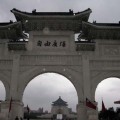
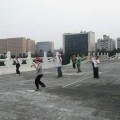
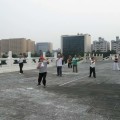
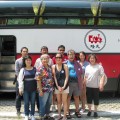
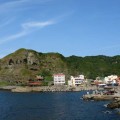
Taroko is a part of the Hua Lien region of northern Taiwan. It is a mountainous terrain that is famous for its landscapes, marbles and stones. It is good to take the morning plane going there and return to Taipei on the afternoon train. That’s exactly what a group of 8 did although I heard that a Japanese man was probably left behind on the way back because we and the travel guide did not see him board the train or get off in Taipei.

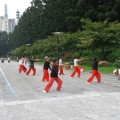
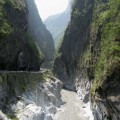
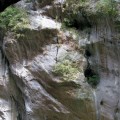
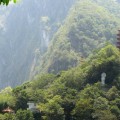
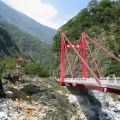
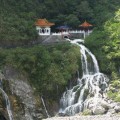
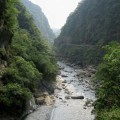
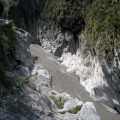
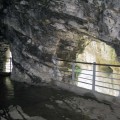
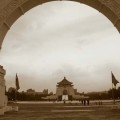
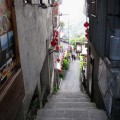
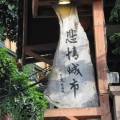
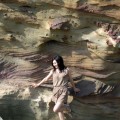
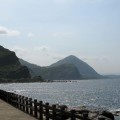
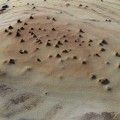
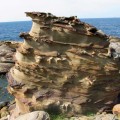
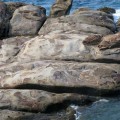
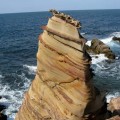
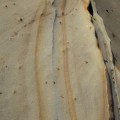
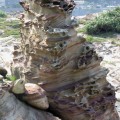
After you arrive, you ride a bus and are taken to the first stop, a marble marker across from a red bridge. The marker has some calligraphy saying that this is Taroko. Everybody seems to carry a camera in this group and each one takes multiple photos of the place at each stop. From the gateway, you are taken from place to place, each spot an awesome scenery — dizzying cliffs and gorges, still or raging rivers (from the recent typhoon), temples on the marble mountainsides, and waterfalls. The cliffs have stunning textures, sometimes with caves, always with unusual patterns.

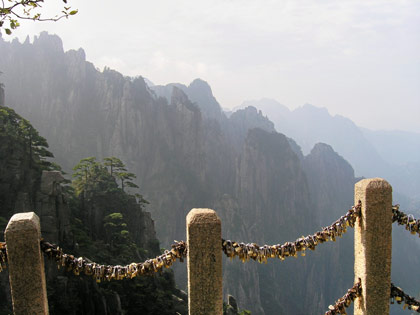
The mountainous range — there’s not just one single mountain or two, but many, each one with a cloud-covered summit. I wanted to do meditation and Tai chi but for an 8-hour visit, the time wasn’t enough even for doing one form. I probably should have decided to stay for 2 days at least. Camping is available, so for those who have plans of going there, it is something that should be seriously considered. On my trip to Huangshan/Yellow Mountain in 2007, 3 full days were allotted. I was able to trek up and down several peaks, do several sets of the Classical Yang Family Tai chi chuan form, walk up to a peak at 4 in the morning and watch the sunrise.

Even a remote region like Taroko, the roads and bridges are first-class. They reminded me of the roads and bridges of China and Thailand, countries that as far as I know have spent much of their budgets on infrastructure and not on external wars. The subway and train complexes of Taiwan and China are also excellent. One time in 2007, my friends and I took a taxi from Tunxi to Hangzhou. It took almost 5 hours to navigate the trip. Amazingly, the wide 4 lane highways, sometimes going through tunnels and passing unpopulated mountains, were all newly built.

Taiwan – Wedding & Tea Master

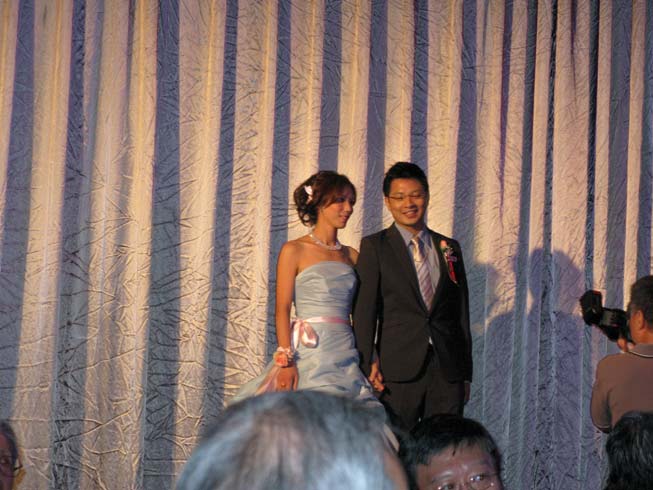
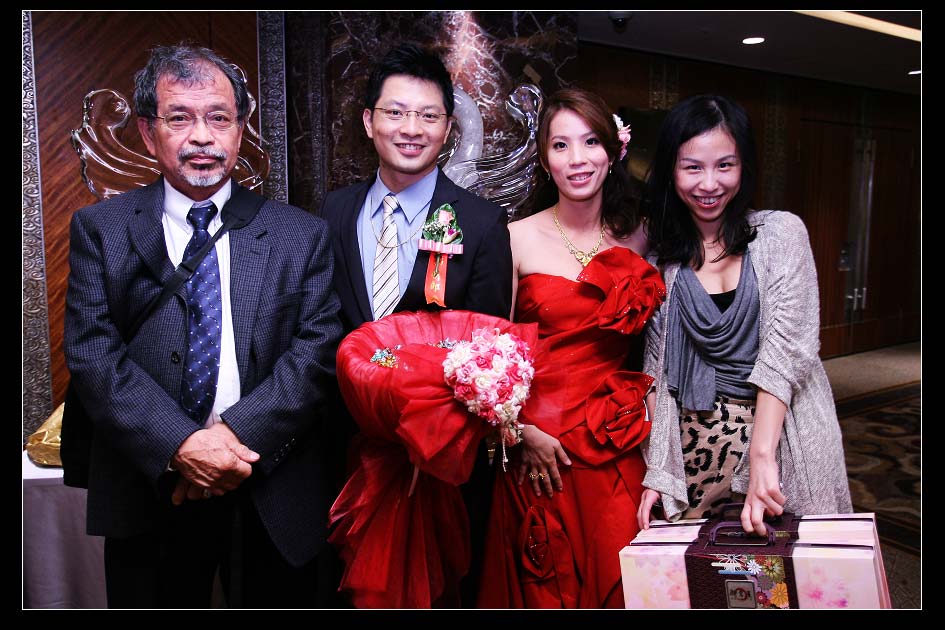
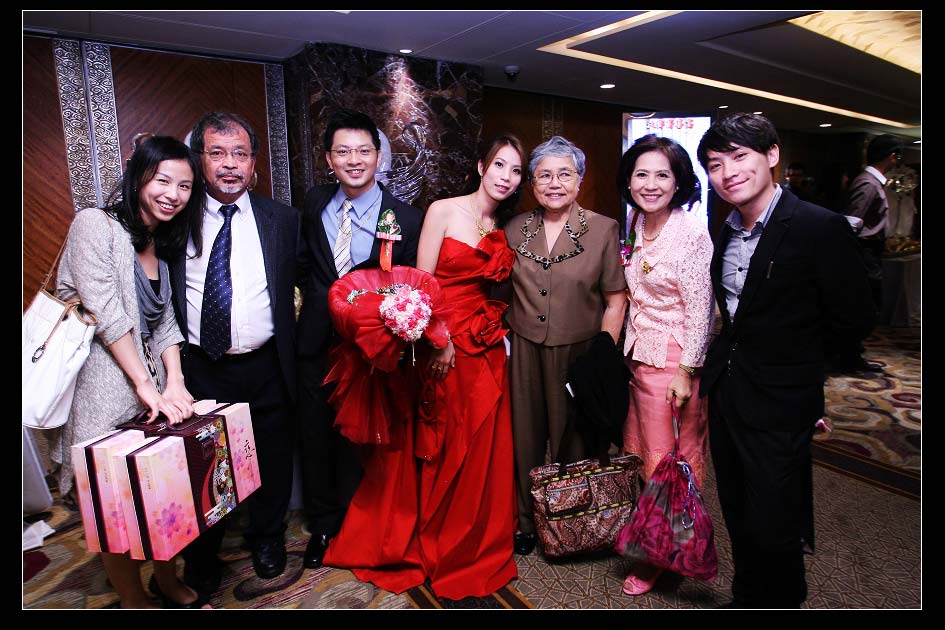
A Chinese wedding banquet at the Sheraton Hotel. Roger, the bridegroom, wore only his one suit. Very often however, in the course of the proceedings, the bride changes 3 times. In this case, at first Aishuan put on a white gown, then a pink one, and lastly, at the end of the banquet, she wore a red one to greet the guests. From my experience attending at least 7 Chinese Wedding Banquets, I noticed that there is a variety of dishes, at least 20, and that doesn’t include the appetizers. Many of them are excellent. I have tasted lobster, hairy Shanghai crabs, turtle, duck, sharkfin soup, sharksfin soup, razor clams. On my 70th birthday, Aishuan’s mother spent a day shopping and a day cooking. The list of dishes included, among others: black chicken with herbs, pig’s trotters, taro cake, sticky rice, dried fish roe sandwiched between oriental pear, and steamed snapper. At a party, if you plan to stay sober and not stagger to the taxi queue,  be sure not to say “gan bei” at a toast because that means “bottoms up.”

Taiwan.-Aishuan-and-Roger.-

Taiwan.-Aishuan-Wedding

Aishuan.-Wedding

Aishuan.-Wedding.-CW,-RN,-R

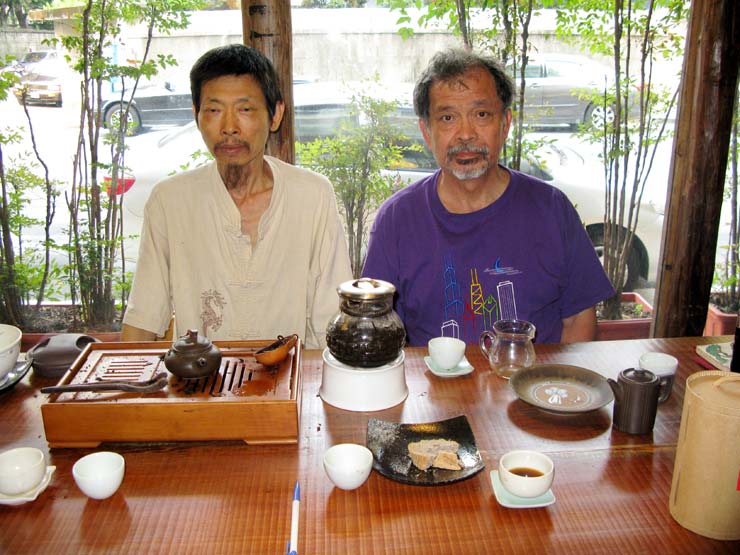
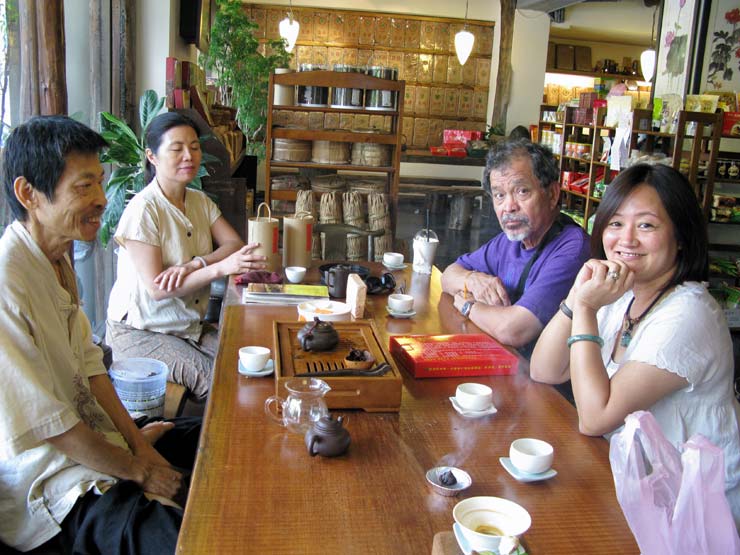
It was my last day in Taipei. I was “sauntering” in the neighborhood and saw this small tea shop. There were people inside having tea. I was invited to come in. An old Chinese was presiding over the ceremony, serving the most expensive tea I have ever tasted in my life. The teas were something like 10 to 20 years old. I cannot find the adjective to describe them. After exchanging information, he asked me to do a bit of Tai chi. While I did the first section of the Classical Yang Family Tai chi chuan solo form, he chanted a sutra that sounded familiar to me. Then he wrote something on a piece of paper saying that Tai chi will clear the mind. There’s more but I can’t translate it. It was great sitting right across from the master whose qi and stillness, especially when he closed his eyes, and presence just permeated the tea shop. He served more of the expensive tea and then he chanted again, this time a longer sutra which was also vaguely familiar to it. That “accidental” encounter was probably the highlight of the whole journey. Oh yes, I bought a rather cheap tea — compared to the $400 -500 kind — at $136!

taiwan-tea-shop

taiwan-tea-shop-group-shot

Manila

1. Ed Maranan, Carlos Palanca Hall of Fame Awardee for Literature, to my right. His sister Ellen is to my left. I was his guest at the dinner ceremony.

Manila Palanca

2. Group shot of writers at the Carlos Palanca Memorial Awards for Literature ceremony at the Peninsula Hotel. In front of me (seated) is Alfred “Krip” Yuson, professor of English literature at the Ateneo de Manila University.

Manila.-Palanca.-Group-shot

3. Seated from left to right: RJN, Krip and Edgar.

Manila.-Palanca.-Krip,-RN,-

4. RJN, F. Sionil Jose, and Edgar. Frankie S. Jose is a national artist for literature. I met him a few times in the course of 50 years in conferences, at his bookstore Solidaridad, and at the PEN congress in Cebu City. He was the speaker.

Manila.-PalancaRN

5. Edgar Maranan, who invited me to the ceremony, receiving his prize in the raffle in the amount of P50,000 roughly equivalent to $1200. Before the winner was announced, Ed said that he never won anything. I said he will win. A few moments later, his name was called from the stage. Coincidence?

Manila.-Palanca.-Ed.3.

6. Ed and Rene with Mikael de Lara Co and his wife. Mikael, an award-winning poet, read “Immigrant” by Lourdes Marie S. La Vina, prize-winner in poetry.

Manila.Palanca

Post scriptum:

Ed and I first met in London about 7 to 8 years ago. He invited me and Patrick Rosal, a prize-winning poet from the US, to read at the Philippine Centre at the time. Ed and I used to have dinner together with Paolo Coghe of Sardegna, at a flat in Barnes overlooking the Thames. I cooked, Ed brought a bottle of wine. We had memorable and extended conversations about politics, religion and literature (sorry, nothing about sex, GBS).
Ed and I have met since then in Manila. He was my guest at my seminar on Tai chi chuan last time I was in Manila during my 70th birthday. To receive a Hall of Fame recognition, a writer has to have won at least 4 first prize awards in the main categories.

It was the first time Alfred “Krip” Yuson, a professor of literature at the Ateneo de Manila University, and I met although he and I have known each other through our literary work for years. He probably recognized me from my photo somewhere and approached me to say hello. Great to finally meet you, Krip. A much-awarded writer, fictionist and poet, Alfred has included my poetry in the books he co-edited: “Eros Pinoy: Erotic Poetry and Art in the Philippines,” “Father Poems,” and “Love Gathers All,” a book of love poems published simultaneously in Singapore and the Philippines. Believe it or not, Krip honored me with a complimentary cameo appearance in his award-winning novel “Voyeurs and Savages.” Please note that I was neither one of the voyeurs nor savages he was writing about. If you are curious about this bit, tell me and I will send an excerpt. It is amazing to appear with my real name in this work of “fiction.”

Kuala Lumpur – Ramadan

Last Night in Kuala Lumpur

August 27, 2011

The capital city has been observing Ramadan. There’s fasting every day from sunrise to sundown. But at night, there is a celebration. Possibly it was a partly a business promotion, but the buffet at 7:30 pm in the Royale Chulan Hotel in the Golden Triangle was quite indulgent. It cost $100 a head although seniors were entitled to a 50% discount. There were at least 100 dishes, not including appetizers and desserts, from the cuisines of different ethnic and cultural groups — Malayan, Indonesian, Chinese, Arabic, Japanese — in the garden downstairs. Curry was a dominant flavor, but there was a whole lamb roasting in a pit, as well as seafood and vegies. There was a fountain dripping with chocolate in one corner of the premises. There were fruits in another. I focused on a wok of Malayan Fish Head Curry with Okra and Eggplant. I had cooked it a few times since the late 70s. There was a small ensemble playing Middle Eastern instruments and singing on the stage. I have been to Egypt before, a few times, and to Istanbul, Turkey and northern Cyprus, but I did not really know about Ramadan even if my Muslim friends talked and wrote about it to me. Realizing my ignorance about this sacred rite, I tried to read up on the festival that is celebrated in the Muslim world of which I know nothing much. If only for this late discovery, the travel to KL is worth all the money and effort. I have noticed a few signs in the buildings around town and notices on TV that August 29/Monday will be a celebration of Hari Raya at the end of Ramadan. I had seen this in the Philippines before and did not know what it meant. Here is part of what I found on the internet. Sorry, I do not know who wrote it.

QUOTE UNQUOTE FROM THE INTERNET

This article over is essentially information about Ramadan and Eid ul-Fitr as it applies to Malaysia.

Bold text==Literal Translation== I refute the literal translation of Hari Raya Aidilfitri as “Celebration Day of Fasting”. Aidilfitri is a transliteration of the Arabic term Eid ul-Fitr. Hari Raya is a translation of Eid ul-Fitr. However, this is not at literal translation. Hari Raya and Aidilfitri put together in one expression hence becomes a tautology. In an article about a Malay phenomenon we want the literal translation of the Malay part of the term, which is Hari Raya or possibly Hari Raya Puasa. We should not accept a literal translation of a transliteration from Arabic mixed with Malay. Here it is important to clarify what it is that is being literally translated. Hari Raya Aidilfitri (also seen as Hari Raya Idul Fitri and Hari Raya Puasa, literally ‘Celebration Day of Fasting'” is not a clear sentence).

Eid is an Arabic word meaning “festivity”, while Fitr means “to break fast”. But the literal translation from Malay to English should be from the Malay translation of Eid ul-Fitr, not the transliteration.
The best literal translation of raya is big. It does not mean celebration or festivity. Sambutan is celebration or festivity according to Kamus Dwibahasa Oxford Fajar edisi keempat. Kamus Dwibahasa Oxford Fajar translates raya only as a verb (merayakan) and defines it as celebrate. However, dictionaries in Malay language provide more nuance. Tesaurus Bahasa Melayu Dewan 1998, Kamus Pelajar and other Malay dictionaries defines raya only as an adjective meaning big (besar). Kamus Dewan Bahasa Edisi Tiga clarifies the misconception that can arise from the translation in Kamus Dwibahasa Oxford Fajar:
merayakan memuliakan (memperingati, meramaikan) hari besar (hari peringatan, peristiwa penting, dll).” Loosely translated to English: merayakan to honour (and remember) a big day.

Meanwhile, as all other mono-lingual dictionaries, Kamus Dewan Bahasa Edisi Tiga defines raya as big (besar). So for anyone who understands Malay prefixes (imbuhan) it becomes clear that the translation of raya as celebrate is inappropriate. Merayakan certainly can be translated to celebrate but that is not the term we are translating. Raya in the context of Hari Raya or Hari Raya Puasa is clearly an adjective meaning big. This is why we can say berhari raya and merayakan hari raya.

End of quotation.

August 29, 2011, Manila, Philippines

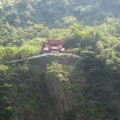
After 5 days in Kuala Lumpur (KL to many people), I wanted to leave touristing behind. I wanted to sit down and relish the last few hours in this multi-ethnic city. My wake-up call for my flight was at 4:30. I wanted to carry some memories beyond the Petronas Twin Towers, the tallest buildings in the world at one point, and Chinatown. I had been up to the Batu Caves, sacred pilgrimage of Hindus, but I wanted an appropriate closure to Ramadan, the Muslim high holy day/holiday. I went to the courtyard at about 10 when the feast was winding down. The place was almost deserted, except for the workers cleaning up and the musicians putting their instruments away. I noticed these people seated at the next table in front of the stage listening to the Middle Eastern ensemble playing music. I was writing a postcard to a friend when I thought of writing “Inshallah” but was not sure how. I asked them if they knew it in Arabic. The dark woman wrote the transliteration: In sha Allah. The woman next to her left wrote: In Sha-a Allah. Three words, five syllables, she said. And then she wrote the Arabic script/character on the postcard. The man to her left was her boyfriend. The woman on the extreme right was the wife of a singer. I went backstage to take photos of the musicians. They asked me to pose with them instead. It was a night to remember: the sound of Arabia drifting in the night in Kuala Lumpur like the scent of desert a flower and the laughter of beautiful Muslim women breaking the stillness. I went up to my hotel room and could not sleep again until past midnight.
My correspondence with Amira, my wonderful Egyptian friend follows:

Dear Rene,

I remember writing to you on more than one occasion about Ramadan. It is a very special time spiritually. It is said that the bad spirits and devils are in chains. The energy of the whole month — not just parts of the day — is supposedly ultra-violet – which is the most spiritual colour. The fasting is meant to teach you patience and compassion for the hungry and to leave you purified, but most people eat too much after sunset which defeats the purpose of the fast.
When we’ve chatted in the last few weeks and I’ve told you that I am preparing or eating my midnight meal, it has been because I am fasting so at around 12:30. My mother (who is staying with me) and I eat a light meal of fruit and yoghurt before we go to bed. (Some people eat more substantial meals but I worry about getting indigestion or becoming thirsty.) Then I wake up again at 3:30 or 3:45 to pray and meditate till dawn, then pray again at dawn and go back to bed at around 4ish. And hopefully to sleep in late. Some people just stay awake till dawn prayers and then sleep in which case they will eat later in the night like at 2 or 3. I can’t keep going that long and prefer to sleep even for an hour before waking up for predawn and dawn prayers. I am always out on the terrace at this time and the stars and moon are fabulous and the air is so fresh and the flowers smell so sweet. It is my favourite time of the day.

The Eid is a celebration of the end of the fast which can be 29 or 30 days depending on the moon. They say it will be 30 days this year which means the Eid will be on Wednesday the 31st. People are out in the street the night it is announced joyously celebrating the end of the fast. It really wears you down by the end of the month and there is nothing nicer than waking up on Eid morning and having a cup of tea! Children wear new clothes and are given small gifts of money. Everyone gets money gifts in fact – called Eidiya – employees, children, poor people in the streets and so on. At 7 am there is a special Eid prayer with a beautiful chant that everyone sings together.

Well, enjoy the rest of your holiday. Have a great time in Manila and Taiwan and please send me a post card from Taroko Gorge (if you can)!

Amira x

Dear Amira,

Excerpt:

Fish head curry with some bao (Chinese bread) was practically all I had, except for the marang, jackfruit and lychees. I walked around the courtyard and checked out the food. A lot of curry-based food: chicken (a few pots of it from different countries), lamb, and fish. There was even a version of it from Kazakstan! It did not make much sense to eat meat at the time. I had a taste of the grilled lamb but it did not taste good without any sauce. And the roasted goat did not taste any better. I was eager to try different dishes but my mouth wasn’t ready for anything else.

Rene

Dear Rene,

Excerpt:

The problem with large buffet dinners is that you want to taste everything and you end up eating far too much! Even with a small taste of each dish it is a lot – but it is fun … Whole roast lamb or goat does look very impressive especially when they are placed on enormous platters of rice cooked with nuts and raisins. But I don’t eat lamb or goat so that’s two things less for me to taste!

It is 3 words: In Shaa Allah. In=If – Shaa= Wills – Allah= God.

I forgot to tell you the reason why my fave part of the day is when I am up in the small hours waiting for the dawn prayers. It’s because I hear all the different calls to prayer chanting at the same time from all the mosques around. Each guy has a slightly different style – a different voice – a different tempo – a different music, and it all just harmonizes wonderfully together in the night air against the backdrop of stars and moon and the smell of the flowers. It is very beautiful and moving…

Enjoy your time in Manila. I am sure it is always nice to go home and see old friends and family.

Love,

Amira

Kuala Lumpur – Batu Caves & Downtown

Batu Caves, just about 30 minutes outside of the city, have several Hindu temples inside. They can actually hold several buildings. Great place, but you have to walk up 292 steps to the top and another 50 in the inner temple. Multiply that by two.

The guide said that for every step you take going up and down one sin is forgiven. At least that is a little more difficult than buying indulgences or making a handsome donation to the church. There are actually other caves but they are not developed although a tour is offered by some travel company.

{click on any image to see the full size version with a desciption}

Shanthi Project, Oct. 16th, 23rd and 30th

Shanthi Project
Presents
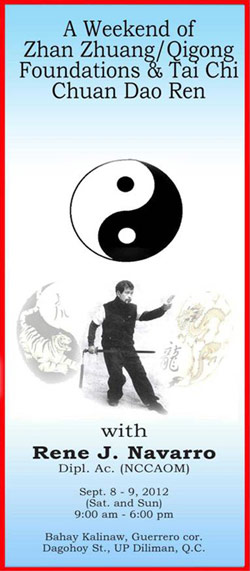
Rene J. Navarro

Tai Chi Chuan DaoRen and Xing Shen Zhuang Fa

Sunday October 16th, 23rd, and 30th
Xing Shen Zhuang Fa : 2-4:30 pm
Tai Chi Chuan : 5:30-8pm

Location: Alick Smith Nazareth Karate Academy 220 East Lawn Rd., Nazareth, PA 18064

All Proceeds to Benefit Shanthi Project

Shanthi Project is a non-profit organization that brings yoga, meditation, and life skills to incarcerated youth and adults, in-need and at-risk children, and community organizations. Shanthi Project teaches classes at Northampton County Juvenile Detention and Prison, teens that reside at Children’s Home of Easton, and Boys & Girls Club of Easton and in the past year has taught over 160 students. Visit www.shanthiproject.org for more information.

Xing Shen Zhuang Fa
Xing Shen Zhuang Fa is a method of moving qi through the spine and limbs and giving shape to the spirit. This particular sequence of 10 movements will focus on different parts of the spine and help students take care of obstructions in the physical and energy body.  Xing Shen Zhuang has been adopted in Chinese hospitals both as a cure and rehabilitative therapy.

Tai Chi Chuan DaoRen
Tai Chi Chuan DaoRen is a short version based on the Traditional Yang Family form. It contains 8 classical movements – Ward-off, Rollback, Press, Push, Pull Down, Shoulder, Elbow, and Split. Its unhurried pace promotes relaxation, centering, joy, and inner peace. Among older people it can develop flexibility, balance, and mobility. Regular performance of Tai Chi Chuan improves muscle tone and blood pressure and can help develop concentration, serenity, and discipline. After more than 40 years of practicing the art, Rene J. Navarro choreographed this form showing the reality of energy as the student moves from posture to posture. The form takes you to different levels of experience the way Tai Chi Chuan should be done: magical, playful, and shamanic.

Fee Schedule
$275 for entire course; all sessions, if registered by October 1
($300 for entire course if registered after October 1)
$150 for just Xing Shen Zhuang Fa (3 sessions)
$150 for just Tai Chi Chuan DaoRen (3 sessions)
$60 for an individual class of Xing Shen Zhuang or Tai Chi

Make checks payable to “Shanthi Project”.

To register, contact Denise Veres, Shanthi Project at denise@shanthiproject.org or 610-737-8006

Pictures from Alaska

Alaska - Dream Mountain

There is in every child-
hood imagination a dream
mountain.
Sometimes there is snow
on top. Sometimes the peak
is hidden by the clouds
or mist.
Sometimes it is just a bald
granite rock. In mine, there
is a shimmering light,
a distant inaccessibility,
a mystery, so that as
in the deepest meditation,
if I entered
it, I would be stepping
into emptiness,
into a frequency
so soft,
I would dissolve
in the arms
of the Great Mother
of all.

Alaska - Train Exiting Tunnel

There were no tunnels
in my time. Nobody
blasted through
the mountain
with machines
or exploded
dynamites to open
a road. The trail
circled the boulders
and the rocks,
and where it could
be done, spared
the trees that stood
in the way. The tunnels
were the caverns
that were there
from who knows when.
We went inside
with a torch
and heard the wings
of the bats, smelled
their home,
felt the flow
of a hidden spring.
When the strangers
came looking
for gold, they
followed a straight
line to their goal,
lighted dynamites
in the thick granite
and blasted
a whole mountain
side.

Alaska - Boat and Mountain 1

You get up from your meditation
in the morning, open the curtain,
go outside your cabin, and
expecting darkness, find
this sea- and mountain-scape
looming in the distance. What
it triggers is part awe and
part humility and part gratitude.
You know you are lucky
to be there before it disappeared
from your sight or from
the earth. Such fragile
scenes do not last: it was there
thousands of years ago and now
the glacier has melted,
“retreated” back, diminished,
and is now just a shadow
of the past, and we can
not even imagine what
it looked like when its
history began. You take
a child to this place
to teach her the lessons
of nature and life, to learn how
to hold on to this beauty,
gently with her hands,
“while it is still there.” How
many of the landmarks
of our childhood are
gone? The old ricefield
or woodland has been
levelled to make way
for a warehouse
or housing development.
On the lot of the historic moviehouse stands
a skyscraper. Everything
is there for just a moment
and then disappears
from our sight.

Alaska -Boat and Mountain 2

The distant boat leaves
a white ribbon on its trail.
You aim the camera and shoot
sometimes a little too late,
sometimes a little too fast.
While looking through
the viewfinder, you
hope for the elements
of the scene to come together.
But the clouds and the boat
are both moving according
to their own pace, they do not
wait. Nothing
you can do, except press
and shoot, hoping you’ll capture
what is called the Moment,
that split-second experience
or image when everything
stands still and sometimes
if you are lucky, you are gifted
with an epiphany that is beyond
understanding,
beyond description.

Alaska - Glacier Lake glacier

The glaciers have been there
for millennia. Yet within
the last hundred years, they
have been retreating, have retreated,
more than the millennia before.
The planet has changed more
within the last
century than ever before.
What shift has our sun
taken as the earth
wobbled on its path?
Technology and the pollution,
and greed have also left
their ugly mark
on our world. And we,
the custodian of the earth,
still don’t realize what
we have done to it,
what we can do now.

Alaska -Mountain, Yukon Route
Alaska Mountain Yukon Route 2

It was on another train
somewhere in China.
Summer of 1983. I had
a glimpse of mountains,
ricefields, small villages,
caves on clay cliffs,
peasants hoeing
the ground,

and there was a quick
chance to shoot a dreamscape:
a mountain in the mist.

The camera, an SLR,
had to be adjusted
for speed and depth of field
and focus and there was
no time to compose.
It was an old Asahi
Pentax from the 60s
my brother gave me.
With a stationary object
like a building
or a flower,
you had time
to compose. But when
the subject was
in motion or
you were on a moving train,
would
the aperture catch
that split-second
image you wanted?
If you did not click,
the opportunity was
lost, so were the cloud
patterns over the top,
the angle, the colors.
It was only
an instant,
a thin slice of
the present
that flashed
into life
and was gone.

Where was I at the time
almost 30 years ago?
Three days and 2 nights
on a train between Shanghai
and Cheng-du
somewhere
in the hinterlands, crossing
territory that had no name.

Here in Alaska
many of the mountains
are nameless, too,
except perhaps
to a tribe,
and like dreams, they pass
in one’s vision
and are gone.

Alaska Ketchikan view from the train

It was like a dream city
from the train as it must
have been to many
during the Gold Rush.
There were diamonds, too,
and jade and minerals.
How extract
the stones and metals
with machines,
chemicals,
and explosives.
Even now, we can see
the jewelry outlets
side by side
on the strip
of road
running from
the ship. A town
beckoning tourists
to buy trinkets, fishing
equipment
and camping gears
while up in the mountain
forests are being
cut down and
prospectors
are diverting
rivers and changing
the landscape
forever.

Alaska Clan House door

Without opening
her eyes, she knows from
the sounds
around her
how the day
will be. The color
of the sky
and clouds,
what school of fish
enter the bay,
the scent of strangers
coming around
with muskets.
When the child woke up today,
she looked through the door
that’s always open
to life,
and saw the woods
and the lake outside,
heard the geese
and the moose,
the splash of the halibut,
sometimes
the song
of the whales,
smelled the sea salt
and the pine,
the world
of Mother
Earth
all etched
on her mind.

That world
is gone now.
The empty clan house
still carries the smell
of the hunt, the fish
grilling on the fire,
and the lost voices
of the ancestors,
the stories
told and re-told
in chants
and totem poles.

Alaska - Bight Totem Park

“We did not borrow this land from our ancestors;
we borrow it from our children.” Haida Indian
Saying

Where the clan lived
is empty now. Enter
the open
door,
see a totem
on the opposite wall
first, and then dried skin,
weapons, snow shoes,
fishing gear,
blankets.A circle of stones
in the center for family meals.

Where did they go?
Where is the tribe
that told stories
with totems
and chants by the ancestral
fire, where
are they
who fished the waters,
held the sacred
halibut and the thunder-
bird in reverence,
and the clouds
and sky,
in trust
for
the children?

Alaska Ava and Isabel on train

When you are young,
it is exhilarating to feel
the wind
and the chill,
as the train goes up
the mountain and
you look down the cliff
at the river, the white foam,
the waterfall,
the mist rising, and ahead,
snow-capped peaks. Always,
in your dreams, you can see
animals there, ferocious bears
and colorful snakes, and strange birds,
and giant tigers and dragons
and phoenixes.

Alaska - Mountain on Yukon Route 3

The mountain brought back
a time in my hometown:
A child of 8 went up
the mountain, whispered
bari-bari Apu to honor
the presence of its spirit, sat
on a rock and, breathless, looked
at the landscape below.
There was Ingkong Poli’s
farm: mango trees, tomatoes,
eggplants, okra. And the
ricefields green now but
turning golden with harvest.
There’s the dam where
cousins would swim
in the brown water
and pick kangkong
leaves and balibid snails
for lunch. When you
are a kid, you have
to hunt and forage to survive
on wild plants, bamboo shoots,
catch and dress the frogs
and the birds
or the elusive iguana
that hides in the woods
and cook rice
in a length
of green bamboo
tube.

Alaska - Ava on deck

LOOKING AT AVA

When I was 10,
like you, a dragon child
but born in 1940,
my world was
a small town
bordered by
a mountain
range on one side
and the great plains
on the other.
There was no
library or movie
house, no phones,
no hobby shops.
You carved your own
slingshot, or sword,
played the ancient
games,
and lived a life
demarcated
by family and tribe,
and grandfather’s
farm, a school
to which you walked
barefoot or with clogs.
How different it is
now: to travel
to places the ancestors
did not know, to learn
about the earth
and the stars
with the touch
of a button,
breathe the startling
journey
and see new
vistas far
from home,
ride a cruise ship
the size of a village,
to reach beyond
boundaries,
to link
oneself
to a universe
of forests, water,
glaciers,
valleys
and mountains,
and embrace the world
with
your body,
spirit and mind.

Interview for the New England School of Acupuncture Newsletter

What did you do before coming to acupuncture?

I was a lawyer and then an office manager for Legal Services, the poverty agency serving the poor in Long Island and then NJ. I was a member of the NY Bar having passed the bar exams in 1978. I stopped lawyering in early 1986 and focused on studying and teaching martial arts. I was studying Healing Tao with Mantak Chia too. One time I had an acupuncture treatment for a wrist injury. One treatment did it and I was impressed. I took a weekend acupuncture course in New York and a seminar on Chinese herbs and I decided Chinese medicine was what I wanted to do in midlife.

Why did you come to NESA?

It was serendipitous really. Partly because I wanted to study with the Tai Chi Master Gin Soon Chu who was in Boston and partly because of the high reputation of NESA. Also because I had friends in Boston.

You have been involved in the martial arts and self-cultivation and you’ve seen and experienced some amazing things in your travels. Would you share a few with your NESA colleagues?

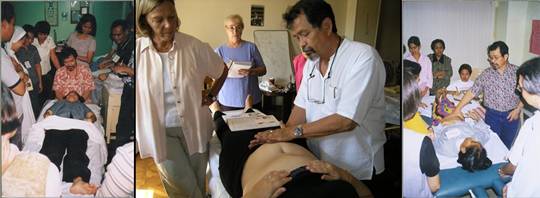
In October 2007, I visited the beautiful mountains of Huangshan, China for a second time. I trained in a lineage of the Lei Shan Dao (Thunder and Lightning Path). Included in the foundation classes were Xing Shen Zhuang Fa and Sheng Zheng Gong, basic courses encoded by David Verdesi Shen, a disciple of
the Lei Shan Dao Damo lineage. During the training, his master Jiang Shifu was in attendance. He did treatments on us. He diagnosed partly with what is known as “yin yang gong,” the mating of the yin and yang in the lower dantian, which is manifested as electricity. Jiang Shifu is the main disciple of the Grandmaster (whose name will not be mentioned to respect his privacy) a 100 year old hermit with incredible powers of pyrokinesis and telekinesis. The Grandmaster was also present to do demonstrations. He could project intense heat and move objects from a distance.

In February 2006, I was in Java, Indonesia, as a guest of David Verdesi. He wanted me to meet John Chang, the famous Magus of Java. Two books have been written about this Daoist master by Kostas Danaos entitled “TheMagus of Java: The Teachings of a Taoist Immortal” and “Nei-Kung: The Secrets of the Warrior Sages.” For the month I was there, David, Ana Vladirimova and I visited the Magus almost every day. The first time I met the Magus, David asked him to do a little demo for me. The Magus raised his arm and asked me to touch it. I did and I was shocked by the intensely strong current I felt. He said it was just 5% of his power. He asked me to touch his belly at CV 6 and I felt the same strong current. David asked him to test my qi. TheMagus put his
index finger on my belly and it felt like shooting electricity up and down my body. He said my dantian was 20% full. I did not know if I should be embarrassed or proud. But that set the tone of my perspective on Lei Shan Dao.

I asked him if he could treat me for a rotator cuff injury that had been bothering me for 2 years. Surgery was recommended by a doctor but I refused. We all repaired to his small clinic. I laid down on one of the tables and he asked Ana to take off her shoes and hold my arm. I understood this was meant to ground me. When he inserted the needle and manipulated it, the stimulation was so powerful, it went up and down my whole body. He inserted and manipulated 3 needles and each time the qi was extremely strong. The Magus did 3 treatments over a period of days. The injury that had immobilized my right arm was healed completely.
My focus in recent years is the study of Lei Shan Dao, a mysterious lineage. One thread of it was supposed to have been developed by Mo-Tzu/Mozi and it is called theMo Pai. The master associated with it is John Chang. The other thread is traced to Boddhidharma of the Shaolin Temple and its most visible representative is Jiang shifu of Huangshan.

What are you doing now?

I’m basically retired now and living a very productive life. I have been writing essays and poetry, which have been published in the US, Europe, and Asia. I am still committed to pursuing the different lineages: Lei Shan Dao, Angka, Classical Yang Family Tai Chi Chuan, and Healing Tao. Hopefully I will be able start studying Miao Tong Dao, a lineage directly attributed to Lao Zi, the author of the Dao De Jing. I also plan to continue sharing what I’ve experienced and learned in seminars in the US, Europe and the Phillipines.

Learn more about Rene Navarro  at www.ourownvoice.com and on this site. You can read Rene’s essay
“Thunder Path in Huangshan”, a background study on David and the Lei Shan Dao, one the Writings page of this site.

Mike Arsenault ’99 practices in Ipswich, MA and Winchester Hospital and is the founder the herbal skin care line Emily Skin Soothers.