CAVEAT: Sadly, the video starts when my hands are already up to the level of my shoulders. In the process of transferring the film to VHS and later to DVD, a short strip got deleted. The actual opening movement starts with the hands down beside my thighs facing the back; then they turn slowly until the palms are facing the front before they are raised with the palms up. When the hands reach shoulder level, they stop and turn over, palms down.
“The Tai chi chuan curriculum consists of hand forms first (i.e., empty hands), such as Tai Chi Chuan and Tai Chi Long Boxing. Next comes One Hand Push Hands, Push Hands with Active Steps, Ta Lu, and Free Sparring. Last comes weapons, such as the Double-Edged Sword, Tai chi Broadsword, Tai chi Spear (i.e., 13 spear), and so forth.”* Yang Chengfu in Tai chi Touchstones: Yang Family Transmissions by Douglas Wile.
Yang Cheng Fu simply calls the Solo Fist form Tai Chi Chuan. It is different from Tai Chi Long Boxing or Tai Chi Chuan Chang Chuan, a much shorter and older form. **
It is often called the 108 in the tradition, even if there are more or less movements than that number calls for. It’s also called the Long Form to distinguish it from the Short or abbreviated forms of Cheng Man Ching (37 movements), the legendary Zhang Sanfeng (13-movements) or the modern Wu-shu Tai Chi (24 movements).
The 108/Large Frame, Crane Style is the form that was promoted by Yang Chengfu in the 1920s and until his death in1936. It was also apparently the form that was learned and propagated by his famous students like Chen Weiming, Fu Zhongwen, and Tung Yinjie. I did not include the other famous student Cheng Man Ching because his form is shorter and probably came from Ye Da Mi, the master he studied with for 6-7 years before his legendary encounter with Yang Cheng Fu in 1932. Photos and drawings of Yang over that period show a man with big girth who had gained a lot of weight. I estimate he was 300 pounds at the time when he was at his heaviest. They also show postures that were transformed; it is difficult to speculate how it happened: what older form did he base it on? As far as we know, he wanted to improve the health of the country by teaching Tai Chi Chuan. But he had to simplify the form to make it accessible to the population. Yang Cheng Fu had omitted the smaller arm movements to make it easier to practice, according to Vincent F. Chu, who has researched the Yang Family lineage and is a master of the style himself. Hence, with the deletion of the smaller movements, the form was considered a Large Frame. He also made changes to the postures: instead of the more difficult Tiger Posture, where the spine is inclined forward at an angle, he made the back straight like a Crane. As a result, the movements became larger and more flowing instead of medium and closer to the body. That is how many people practice the form now. Actually, it is possible that Yang Chengfu might have omitted some other difficult martial techniques too like jumps, kicks and fast movements that are in the original Tai chi chuan.
In different martial arts, Shaolin and Wudang both, there are several stances that are used. They are commonly called Horse, Cat, Snake, Crane, Bow and Arrow and Crossed Stance.
Here are the Chinese names with English translation:
qi ma shi (ma bu – horse riding stance),
gong jian shi (gong bu – bow and arrow stance)
xi shi (xi bu – empty leg stance)
pu tui shi (pu bu – low leg stretching stance)
du li shi (du li bu – single leg stance)
zuo pan shi (xie bu – seated-on-own-twisted-leg stance)
All these stances are in the Large Frame, Crane Style, EXCEPT the last one that’s also called Crossed Stance or Scissor, but we do not know when it was done. Chen Wei Ming, in his book on his Annotations to the Yang Family Tai Chi Chuan Jian/Sword (#1), mentioned it in his list of Tai Chi Chuan Chang Chuan/Long Fist movements. Crossed Stance has appeared several times in the form.
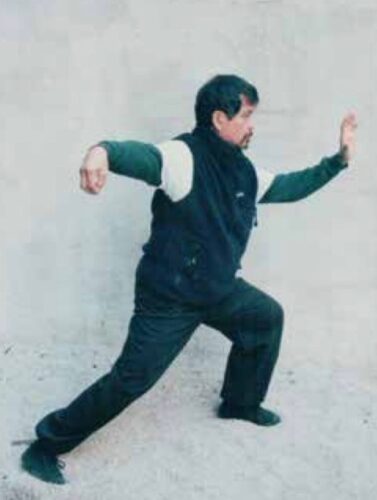
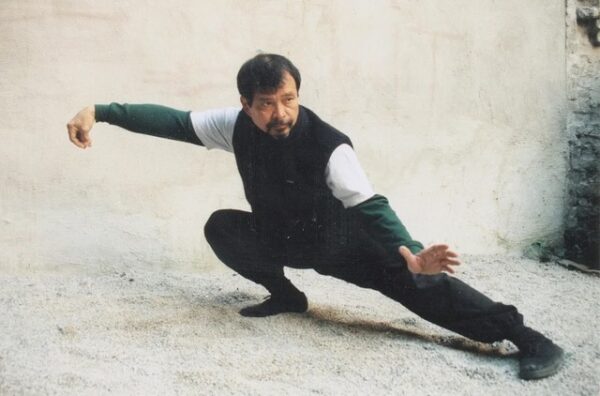
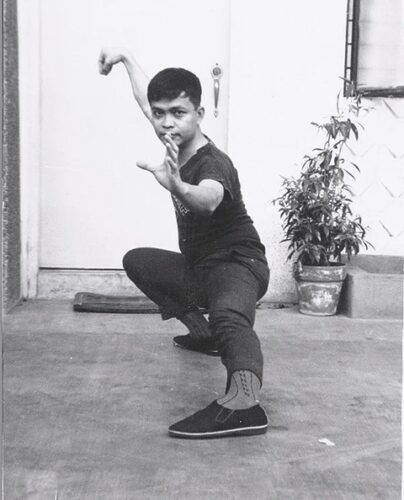
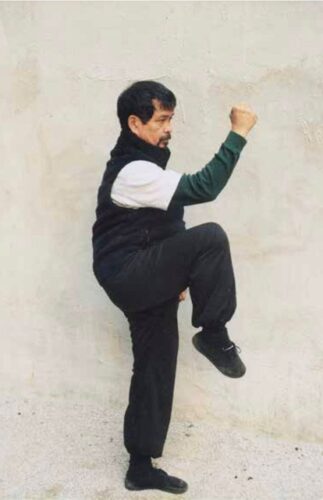
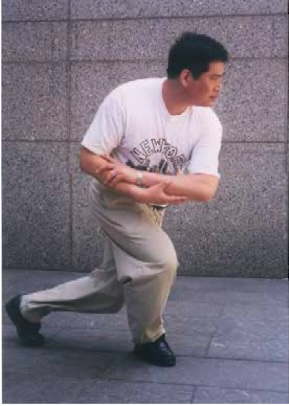
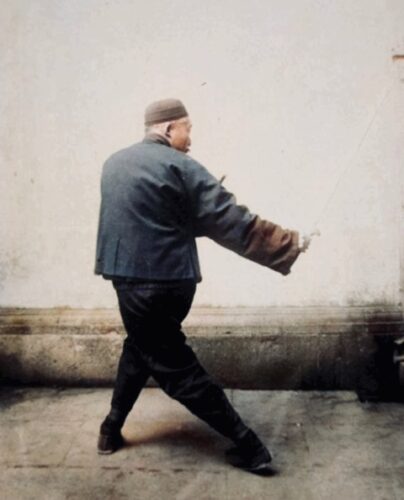
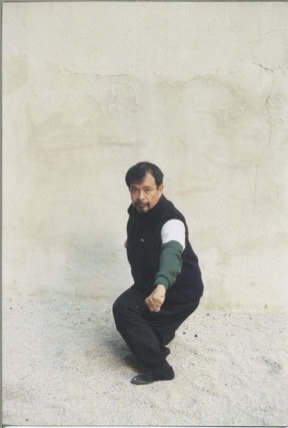
So the conclusion we could draw from Yang’s efforts to popularize Tai Chi Chuan to improve the health of the population (emphasis on health) is that he was actually simplifying the art to make it more accessible to the Chinese public. Was that the first attempt at the simplification of Yang Family Tai Chi Chuan? We cannot really say but apparently it was successful enough that, since then, the art has spread throughout China and later all over the world.
This version of the Long Form or 108 in the video was passed on by Yang Sau-Chaung to my master Gin Soon Chu, his second disciple. It is not the straight-back style (called Crane in the Yang Family) and Large Frame popularized by Yang Chengfu or the Small Frame that was adopted by the Wu Family; it is Medium Frame and Tiger style.** There are students of Gin Soon Chu who do the form with more bend on the back and lower and wider stances and hands closer to the body. The names of the movements are the same as the Large frame, Crane style. Needless to say, while it is a genuine Classical Yang Family Tai chi chuan transmission, THE ERRORS ARE SOLELY MINE! In retrospect, the form in the video was still young and immature. I had been doing the fist form (as well as the weapons) at least 5 times straight through almost every day but it was barely 5 years old at the time (1995) and had not undergone the decades-long refinement of corrections and practice. Watching the video at a slow clip, I could see movements I could have corrected. I guess it would take another 5 to 10 years to reach maturity. I took more lessons at Gin Soon’s school until about 2003 or later: I discovered a $50 check with that date in my files payable to the master!
I do not know if the same procedure is followed now, but when I was studying with the Grandmaster in the decade of the 1990s there were certain steps that made the lessons truly transparent and valuable: he taught every student personally. Unlike in many classes, you did not stand behind and mimicked what the person in front of you was doing. Chu shifu actually showed a movement, including the details of the hands, body and feet, and the student like me did it for the rest of the class. I took it home and practiced it for a few days. Then I returned to be corrected. If I am doing the movement right, I was taught the next movement: piece by piece. This went on for the rest of the 108. If you are good, then perhaps you could finish the form in 6 months to 1 year. The student could actually take private one-hour lessons to move faster. Those who have finished the form repeat the same lessons, the short movement, and the teacher makes corrections. Meantime, you were also taught the Tai Chi Walk and Dalu/Great Pulling.
But the Grandmaster would help you develop your posture and your Qi by pushing you in a stationary position. Through this rare method the student learned, if he has the talent and the desire, the initiation of a long evolution into the mysterious secrets of fajing/discharge of jing. I’ve described this process in the essay “Developing the Tai Chi Body” in my book “Of Fire and Water: Alchemy and Transformation” (Tambuli Media: 2023).
There was no Push Hands until the student got his 108 form corrected 2 times from beginning to the end, movement by movement. I asked for and did 4 corrections before I did Push Hands. So it was probably more than a year since I started the lessons.
Perhaps it is not visible in the video but the opening movements are the “signature” of GM Yang Sau-Chaung. The practitioner is in the Wuji stance, feet positioned shoulder-width apart. Sadly, the video starts when my hands are already up to the level of my shoulders. In the process of transferring the film to VHS and later to DVD, a short strip got deleted. The actual opening movement starts with the hands down beside my thighs facing the back; then they turn slowly until the palms are facing the front before they are raised with the palms up. When the hands reach shoulder level, they stop and turn over, palms down.
Since this presentation is only for the purpose of introducing the 108, I am going to skip the details, including the energy centers, acupuncture points, and their alignment and activation and their roles in the form. I know that Tai Chi Chuan is multi-faceted, it is not just a physical exercise but also an energetic, intellectual and spiritual regimen. So it’s not just the physical body that is involved. I will not touch the different refinements like the procedure for the integration of the Yong Quan (KD 1), the Bai Hui (GV 20), Fengfu (GV 16), Yintang/Esoteric Hall), the Triangle Bones and the Dantian/Elixir field, among others. In my classes I can usually go into these minutiae of practice because there is time and opportunity for it. That is why live lessons, with the student there, – and not on a video — is really crucial to me. Obviously I could have made money but that’s why I refuse to teach online.
There were also smaller gestures that were apparently omitted from the popular version of the form. In the Cloud Hands, for instance, the 3 segments (done 9, 7 and 5 times respectively) are actually different from each other: one time the right and left hands turn at the same time, another time, the bottom hand turns first, and last, the top hand. (Please see the list of movements below.) Different schools of Yang Family Tai chi chuan seem to do Cloud Hands differently. Some of the variations are smaller, some are more angular, others are round, or wider. The famous Taiwanese martial arts master Han Ching Tang choreographed an entirely different movement for Cloud Hands: it has a thrusting movement. I studied his form in the late 1960s at the Hua Eng Athletic Club in Manila’s Chinatown.
The video was done in a park in New Jersey, in the vicinity of Newark Airport: that is why you could hear the hum of the airplanes taking off or landing there. It could have been after 1995, when the form was barely 5 years old, literally just emerging from infancy. I recorded the form for my children, not for the Tai Chi Chuan community. I have discovered and learned a few different things about the form(s) since then: I have integrated them in my private practice. So, to make a long story short, the way I did the form in the video in 1995 is not how I do the form today.
*The Traditional Yang Family Tai Chi Chuan curriculum I studied in Boston with Grandmasters Gin Soon Chu and his son Vincent Chu:
1. Solo Fist form (108)
2. Tai chi walking
4. Dalu/Great Pulling
5. Staff-Spear (single and paired)
6. Broadsword form #1, Broadsword form #2
7. Sword form #1, Sword form #2
8. Push Hands (Stationary and walking, one hand, two hands, etc.)
9. Fajing/Discharge of Jing
10. Sanshou/2-man fighting
11. Tai chi chuan Chang Chuan/Long Fist
12.Tai chi Fast form
**Please see the essay “The Mysterious Yang Family Chang Chuan Form” in my book “Of Fire and Water: Alchemy and Transformation” (Tambuli Media: 2023) available on Amazon and Barnes and Noble.
***The Snake Style is even lower and more difficult than the Tiger Style. There is in my files a video of Gin Soon Chu demonstrating it, along with the Dao/Broadsword form #2. It is perhaps the only existing video of these forms.
NB: Thanks to Manny Maramara for his work on the video and other information incorporated in the annotation.
Below is List of Movements with Chinese and English names: