It was a lovely weekend in New York City.
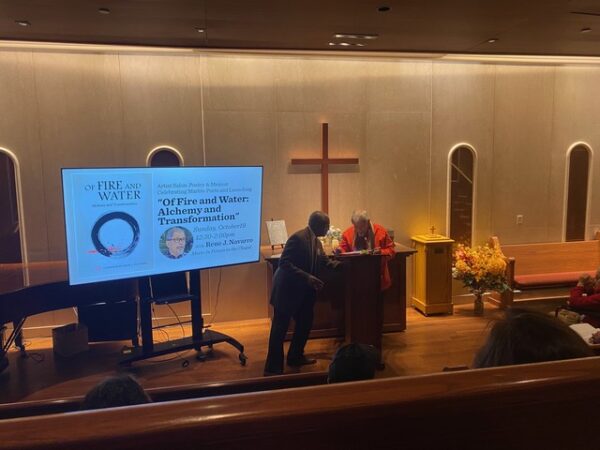
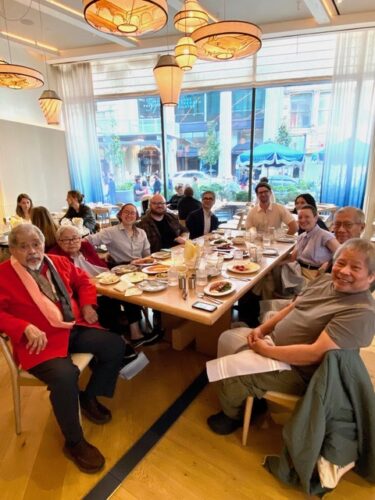
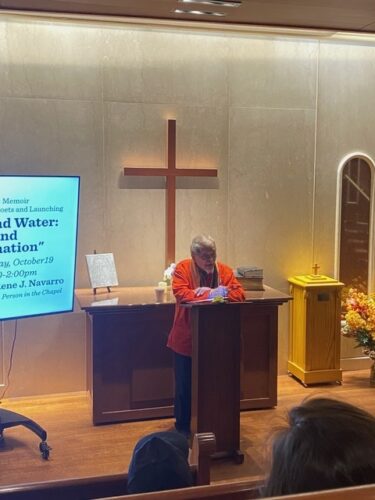
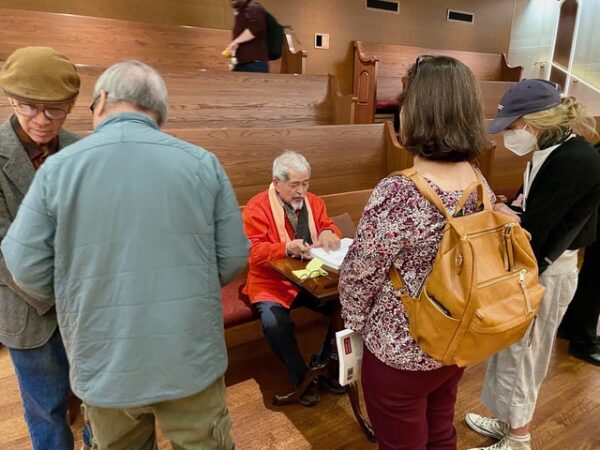
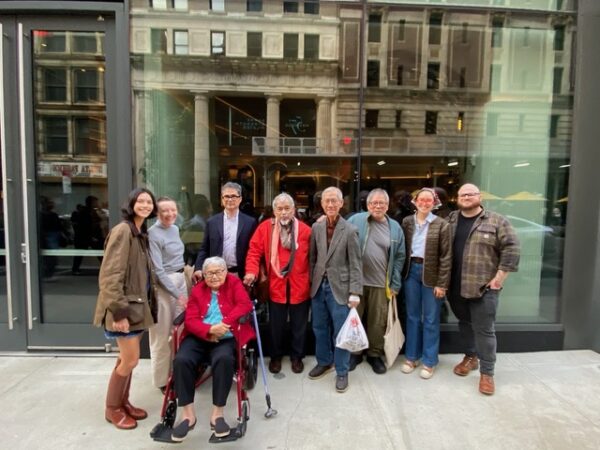
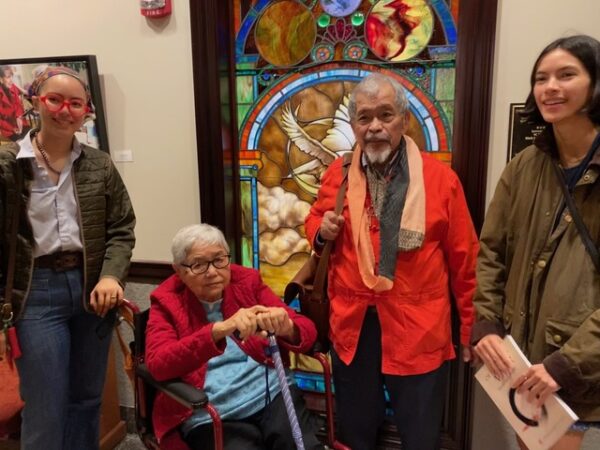
It was a wonderful birthday celebration for my wife Lolit (now 84, the Year of the Snake)) and me (85, the year of the Dragon). We spent the weekend in NYC. Ace, the hotel on 29th Street where we stayed, is a historic landmark. Albert made a great choice of hotel and restaurants (one traditional Sichuan for lunch, another a fusion cuisine (both oh Saturday), and the last Middle Eastern (on Sunday afternoon). He also volunteered to sell my books at the door of the chapel at Marble Collegiate Church: we made a good income, but I won’t abandon everything to become a full-time writer yet. Lovely company: Laura, Ava, Charl, Isabel, Jay and on Sunday Carlos Esguerra, the famous photographer, and Romy Dorotan, the famous chef, both brothers from the Alpha Phi Fraternity of the University of the Philippines. Lola Lolit told me that she had the most wonderful time of her life! Which is definitely the truest compliment she could say for all the loving fellowship we had over the weekend. Not to mention the food, the steamed fish with fermented beans, the Su Dong Po Pork, Peking Duck and for Lola, the pineapple beer. As she would often say, PRICELESS!!! I share her sentiments. It was a great time. I thought the Book Launch organized by Mario Sprouse and Karla Hendrick at the Mable Collegiate Church chapel was incomparable.
At the Book Launch I read the excerpt (below) from “Of Fire and Water: Alchemy and Transformation” (Tambuli Media). The book was published in December of 2023 but the Launch was delayed because of Covid. Two of my books (the other was “Ascension and Return: Poetry of a Village Daoist,” published by Tambuli Media in 2020), were published during the epidemic. Mark V.Wiley, Manny Maramara and I worked on the books mostly by e-mail. It was a very productive time for us. Thanks to Karla Hendricks and Mario Sprouse of the Marble Collegiate Church Arts Ministry who organized the Book Launch. The book is available on Amazon and Barnes and Noble.

Early Childhood in Bamban
By Rene J. Navarro
I was born in Bamban, Tarlac, Philippines, a small town across the northern border of Pampanga on the main island of Luzon. There was a river flowing steadily beside a range of mountains to the West. After 1945, we kids would cut classes and go for a swim in the Bamban River or in the dam at the family farm. In town was an old, smelly warehouse in the Feliciano compound which doubled occasionally as a moviehouse. Phantom, Flash Gordon and Tarzan became a big part of the fare in this smalltown entertainment. Those were the boundaries of our world.
My grandfather, Paulino Navarro, Ingkong Poli to us little kids, was a farmer, patriarch, raconteur. He made me buy old books during the town fiestas—an assortment of corridos and legends that he promised to read to me. As we sat at his feet in the living room of the clan house, he regaled us with stories about mythical heroes and native characters and assorted powerful and miraculous beings who could jump from the ground to the roof of a house. I could swear from the distance of 80 years that we actually believed that they existed, not just in our imagination. I learned to make kites, some bigger than me, out of manila paper and bamboo and homemade glue. With a scout knife, Ingkong Poli taught me how to carve slingshots and spinning tops from guava or mango branches. He also presided over the circumcision of the boys of the clan at the Bamban River after we had undergone a strange period of initiation. I was 7 or 8 at the time. Before the Big Event, we were taught the use of pandakaki sap for freeing the foreskin and assorted other “tricks” for our journey into manhood. The actual ritual was performed in the river where we jumped in the cold water one early morning to deaden the pain. Using an ordinary razor blade and a piece of guava branch as a batakan or chopping board, another piece of wood was used to tap the razor and the job was done—unless Ingkong Poli for reasons of aesthetics or practicality thought that more of the prepuce had to be cut. Afterwards, the bloody batakan shaped like a primitive phallus was thrust into the ground repeatedly, presumably as a symbol of coitus, and it was over. No anesthesia was used. None of that sterile hospital stuff for us either. We stuck to spit and guava leaves in the face of infection and swelling. Cousins Dan and Ray and I had survived a rite of passage together in a mystical brotherhood that nothing else in our young lives can compare to.
Ingkong was also a patient guide. He knew the different plants and herbs. We children picked up some of this knowledge—what leaves, fruits, barks and roots were good for cuts and wounds, what worked for diarrhea, fever, postpartum depression, bladder problems, what was edible, whatever. He even knew how to train a martin to sing and talk. Apung Poli taught me the method when I was seven—rub the bird’s tongue daily with a slice of betel nut—but just as my pet began to say the first word, he was unceremoniously seized from his bamboo cage by a hungry house cat and dragged into the darkness before I could recover from my shock at having witnessed the scene up close and personal.
We pictured the mountains and fields as teeming with creatures and spirits and elementals who came down to haunt the streams or the trees. There were ghosts and vampires, tikbalang and tiyanak and duwende, shape-shifters, some of them malevolent, lurking around the ant hill or near the giant banyan tree. We believed in encanto, enchantment, and to protect ourselves and exorcise evil, we would chant “bari, bari Apu,” remnants of an ancient animist past. I can upon my sacred oath say that once on a hunt for spiders early at dawn, I had seen a few of them at the boundary where the town proper ended and the rice paddies began. Needless to say, I ran as fast as I could the moment they emerged from the mist with their thick fur, monstrous heads and huge claws..
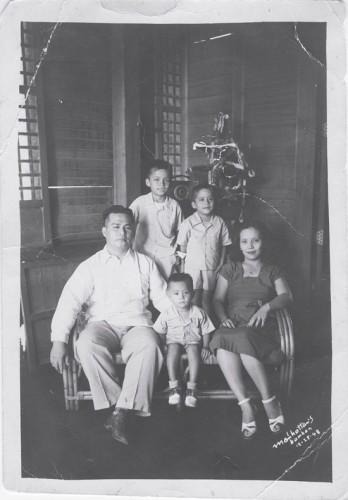
The photo taken 12-25-48 shows the family in the old house.
Seated from the left: Ricardo Y. Navarro, my father; Danilo Navarro,
my brother; Amelia J. Navarro, my mother. Standing are me and my
brother Florante. That forlorn-looking “thing” in the back
was actually our Christmas Tree.
A patch of wilderness sat dangerously close in the backyard. At times a colorful gekko or a salamander would find its way into the tree or a poisonous cobra would wander nearby. One time while my cousin Ray and I were up a tamarind tree, harvesting its fruits, hundreds of snakes arrived and began working themselves into an agitated sexual frenzy on the ground below.
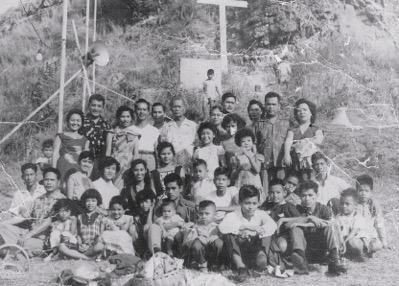
Photo below: Four generations of the Navarros during the Sunrise/Resurrection Service in Bamban. That’s me in in the white shirt infront. UNDATED.
Not infrequently this naughty boy – that is me — would be taken to the local herbolario or hilot, native healers, whenever I had a twisted ankle or wrist, and he would apply a magical oil, often on the opposite side of the injury as he mumbled an incomprehensible mantra. We in the clan reverenced these healers as belonging to a higher species altogether, heirs of an ancient knowledge that was slowly getting lost and forgotten.
I spent my childhood in that environment of innocence where myth and reality were intertwining threads of a dream life, nature was a habitat for spirits who knew—and rewarded or punished—our every move, and grandfather Ingkong Poli was a huge presence in our world. It was what shaped my young mind as I got exposed to literature and poetry, the mystical, martial arts and warriorship, and healing
There were several colorful uncles in this extended clan. A couple of them had a secret life, involving dalliances with women, which the family only talked about in whispers. Uncle Sergio was the brilliant child prodigy and renaissance man of the family. He was at home with Handel’s The Messiah as he was with Christopher Marlowe’s Faustus and Albert Einstein’s formulas. In another culture, he would have been a national icon, but he preferred to live in obscurity in our small town all his life. Uncle Crisencio was the youngest. A high school teacher, and a perennial youth, he memorized long lines of inspirational poetry from Tennyson’s Ulysses to Wordsworth’s Ode to Intimations of Immortality. Uncle Eduardo was the politician of the family, determinedly obsessed until his death to become mayor of the town. An Errol Flynn look-alike, he possessed the most beautiful voice among the brothers and with it, he used to seduce the young Japanese waitresses in Ermita with Japanese love songs he picked up during the war. There were also a couple of sisters who stayed in the background while the family was dominated by strong and charismatic men.
Uncle Odon was my favorite. He was a school teacher and a poet. A romantic, he was intense, joyous and sad at the same time. During the war, he owned a set of horses and carretelas. He was also a barber who had the unique ability of cutting his own hair. Setting one mirror in front and another in the back, he would awe us kids with the precision of his scissors. What was remarkable was he also loved a different cuisine from the wilds. He knew how to trap birds, snakes and monitor lizards, of which there were many in the woods beyond the house. I should not forget to include bats.
When I was about 7 or 8, I picked up Tatang Odon’s fondness for game and learned to use a sling shot to hunt birds. On occasion, I would bring a kingfisher or two back from my solitary escapade in the marsh. I also learned how to dress bats and cook these into an adobo dish. No, I did not progress to catching reptiles because by the time I was 11 my father decided to move the family to the capital for his law practice. After living in the US for 15 years, I returned to my hometown a couple of times and visited Panaisan, Ingkong Poli’s farm, but the enchantment was gone. The mountain that had loomed large in my memory was reduced in size, the dam where we learned to swim was now but a small stream. The mango trees had been cut down. The old house where I spent my early childhood was gone, too. Even the concrete stairs that sheltered us from the bombing during the war was razed. Nothing was left of the landscape I remembered so well. The spell of the past was lost.
It is puzzling how events happen that way. Sometimes we cherish a memory and we keep it alive for a long time; and then somehow for no discernible reason it evaporates like mist. Suddenly our world changes. A familiar place is different now. We wake up in the morning and things are not the same. But I wonder if we realize that we must have changed, too. Perhaps we have grown up and matured and now see with different eyes. Or perhaps we have become skeptical of other dimensions, or earlier beliefs and values. Who knows what we have gone through, what we have become, what the world has done to us? Who knows where the spirits of the earth we communicated with have disappeared to? Who knows?
Excerpt from my essay “Reflections on the diaspora, burung babi, a favorite uncle, Malayan fish head curry, and a trip to the mountains” in the anthology “A Taste of Home: Pinoy Expats and Food Memories” edited by Ed Maranan and Len Maranan Goldstein published by Anvil Publications, Manila, Philippines (2008).
©RN 2025